
Free CXC Physics Paper 2 January 2012 past paper from 2012. Includes a worked answer key. Open the PDF, take a timed test, and study with AI on Caribbean AI.
Answer keys are free on Caribbean AI. View the answers to every past-paper question at no cost - no payment needed - with step-by-step worked solutions and instant AI marking available on Premium.
CSEC Physics Paper 2 January 2012 - Free CXC Past Paper with Answers
Free CXC Physics Paper 2 January 2012 past paper from 2012. Includes a worked answer key. Open the PDF, take a timed test, and study with AI on Caribbean AI.
Opening the interactive papers…
Every question from this paper as text. See the answers and worked solutions. Questions are the property of the Caribbean Examinations Council; Caribbean AI is not affiliated with CXC.
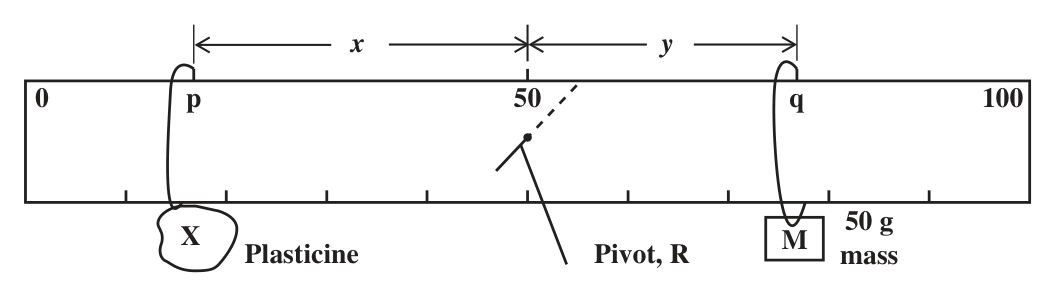
A Form 4 Physics student performed an activity to determine the mass of a lump of Plasticine, . A diagram of the setup of the apparatus used is seen in Figure 1 below. The Principle of Moments was used.
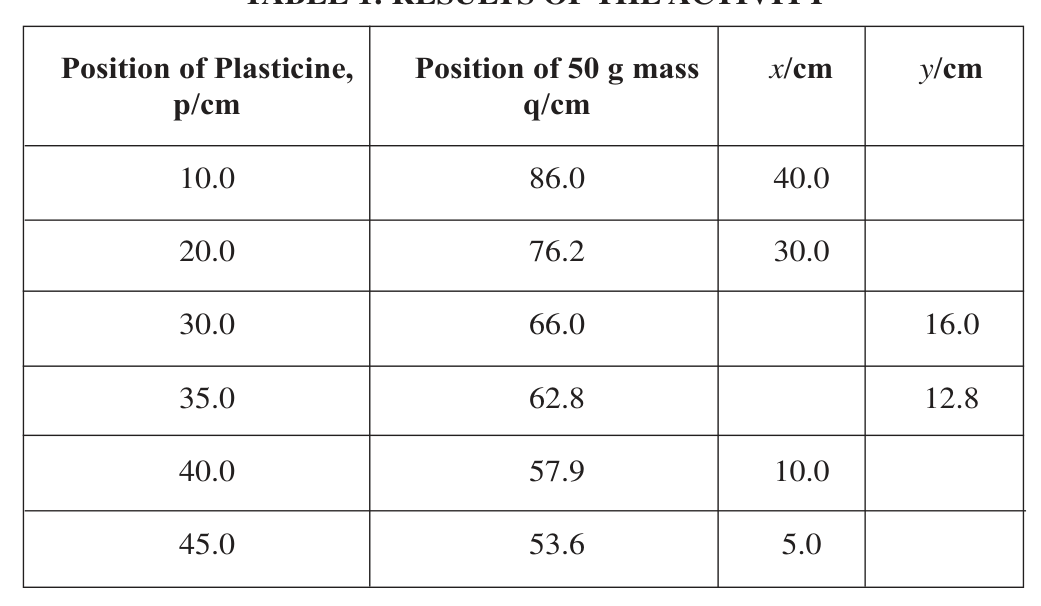
The results of the activity were recorded in Table 1 below.
TABLE 1: RESULTS OF THE ACTIVITY
| Position of Plasticine, p/cm | Position of 50 g mass q/cm | x/cm | y/cm |
|---|---|---|---|
| 10.0 | 86.0 | 40.0 | |
| 20.0 | 76.2 | 30.0 | |
| 30.0 | 66.0 |
| 16.0 |
| 35.0 | 62.8 | 12.8 |
| 40.0 | 57.9 | 10.0 |
| 45.0 | 53.6 | 5.0 |
[g = 10 N kg]
[25 marks]
Complete Table 1 by calculating the values of x and y.
[3 marks]
Use the results from the completed Table 1 to plot a graph of y/cm against x/cm, on the graph paper provided on page 3.
[6 marks]
From your graph, calculate the slope, z.
[5 marks]
Use your graph to determine how far the 50 g mass needs to be placed if it balances when the plasticine was placed 27.5 cm from the pivot, R.
[1 mark]
State the Principle of Moments.
[4 marks]
The weight of the plasticine, , is related to the weight of the 50 g mass, , by the formula, .
(i) Determine the weight of the plasticine, .
[4 marks]
Determine the weight of the plasticine, .
[4 marks]
Calculate the mass of the plasticine, .
[g = 10 N kg]
[2 marks]
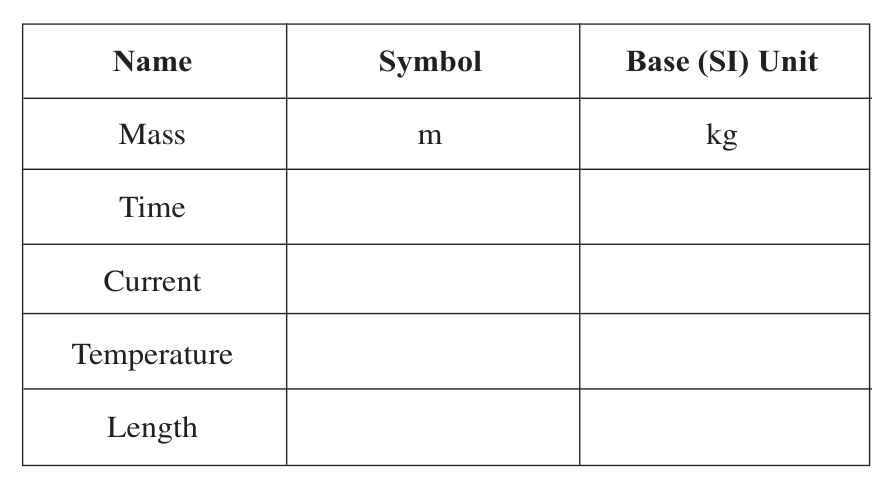
Complete Table 2 relating fundamental quantities and their base unit symbols.
TABLE 2: FUNDAMENTAL QUANTITIES AND THEIR BASE UNITS
| Name | Symbol | Base (SI) Unit |
|---|---|---|
| Mass | m | kg |
| Time | ||
| Current | ||
| Temperature | ||
| Length |
[4 marks]
Complete Table 2 relating fundamental quantities and their base unit symbols.
| Name | Symbol | Base (SI) Unit |
|---|---|---|
| Mass | m | kg |
| Time | ||
| Current | ||
| Temperature | ||
| Length |
[4 marks]
State the difference between a 'linear scale' and a 'non-linear scale'.
[2 marks]
You are provided with the following three measuring instruments.
Which of the instruments listed above has a non-linear scale?
[1 mark]
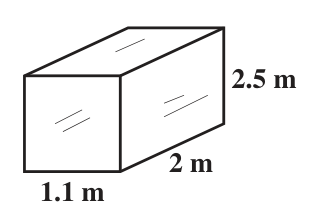
The container shown in Figure 2 is completely filled with cement.
[8 marks]
If the mass of the cement is , calculate the density of this cement sample in .
[4 marks]
What pressure, in Newtons, would the cement exert on the base of the container?
[4 marks]
Albert Einstein put forward a theory that if the energy of a body changes, then its mass also changes. State the equation which relates these changes, clearly identifying the symbols or letters used in the equation.
[3 marks]
State TWO arguments EACH for and against the utilization of nuclear energy.
For: 1. 2.
Against: 1. 2.
[4 marks]
Nuclear fission is a nuclear reaction in which a moving neutron strikes the nucleus of an atom splitting it into lighter nuclei, often producing free neutrons and photons in the form of gamma rays. One such reaction is given below.
Calculate the values of and .
[2 marks]
The energy released in the given reaction is . Calculate the excess mass (mass change) in this reaction.
[3 marks]
Fusion is the joining together of two nuclei. One possible fusion reaction is
With reference to the d.c. motor shown in Figure 3, explain how the coil is able to rotate continuously.
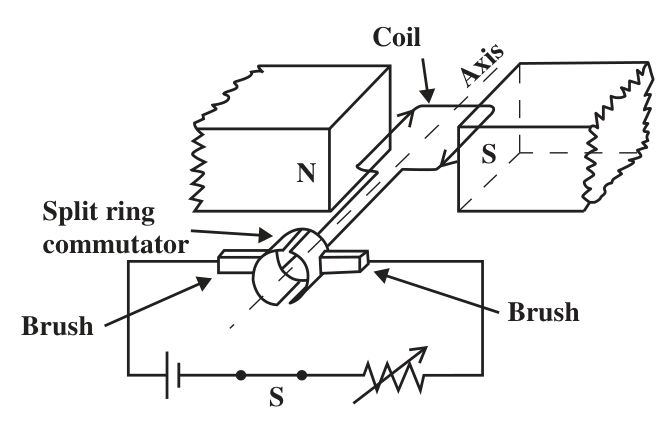
[6 marks]
The waveform shown in Figure 4 depicts the current through a resistor connected in an a.c. circuit.
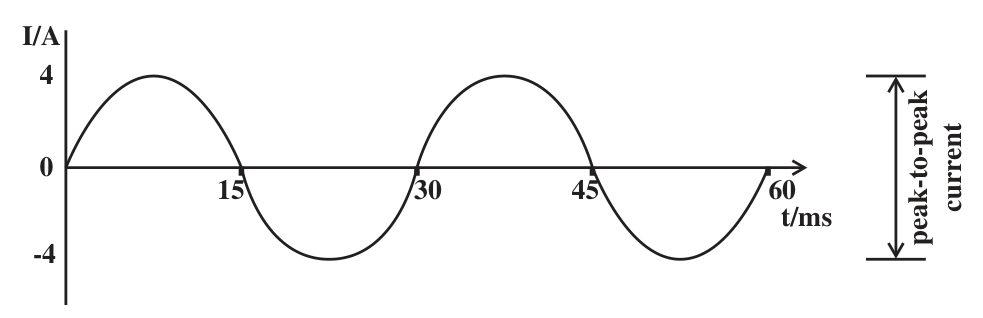
Calculate the period and frequency of the alternating supply.
[3 marks]
If the resistor is , determine the peak-to-peak voltage across the resistor.
[3 marks]
Calculate the maximum power dissipated in the resistor.
[3 marks]
Write your answer to Question 5 here.
[15 marks]
Figure 5 shows two blocks of copper that are placed in contact with each other. Block A initially has a temperature of 40 °C and block B has a temperature of 70 °C.
+-----------------+
|     BLOCK A     |
|     40 °C       |
+-----------------+
|     BLOCK B     |
|     70 °C       |
+-----------------+
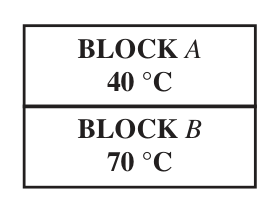
What is the direction of net heat transfer between the blocks?
[1 mark]
The final equilibrium temperature of the blocks is 52 °C. Convert this temperature to Kelvin.
[3 marks]
Figure 6 shows the sketch of a natural convection solar water heating system.
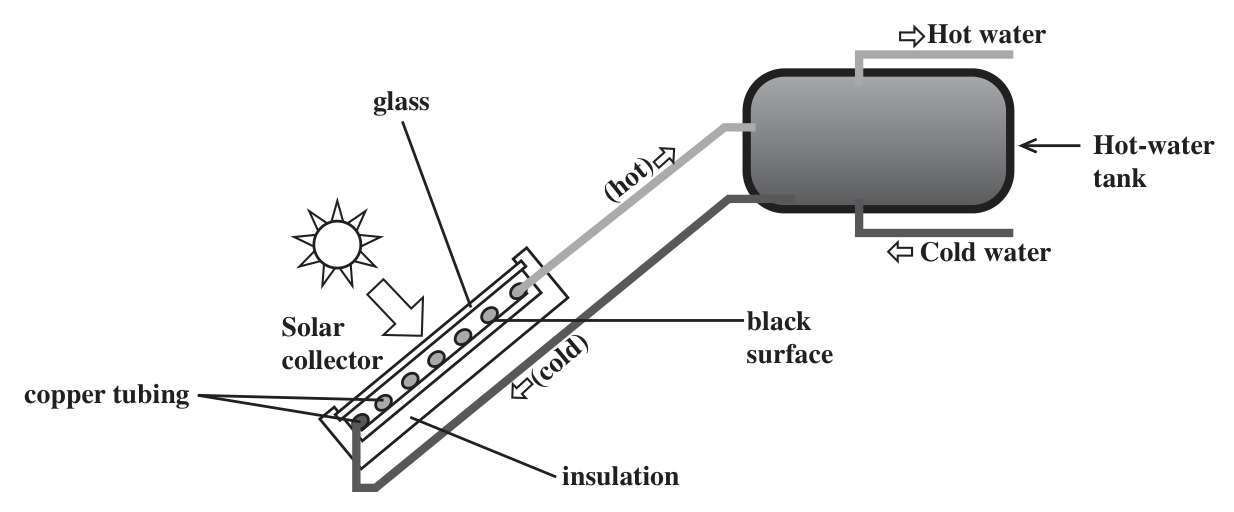
The energy absorbed by the solar collector is 300 kJ and 40% of this is transferred to the 2 kg of water in the copper tubing. If the initial temperature of the water is 27 °C, calculate the final temperature of the water.
[Specific heat capacity of water = ]
[6 marks]
Outline which feature of the solar water heating system shown in Figure 6 demonstrates EACH of the following thermal energy principles: a) Good absorption of heat b) Heat transfer by convection c) The green house effect d) Good heat transfer by conduction e) Reduction of heat transfer by conduction
[5 marks]
Write your answer to Question 6 here.

[15 marks]
What is the difference between 'longitudinal waves' and 'transverse waves'?
[2 marks]
Given that red light has a wavelength of m, calculate its frequency.
[4 marks]
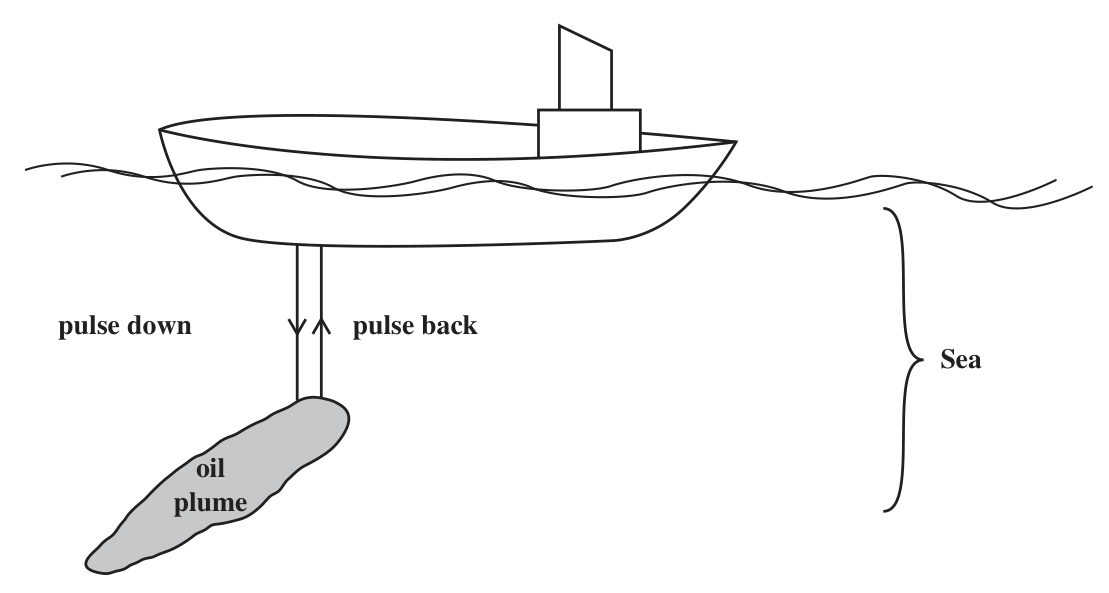
In 2010, Sound Navigation and Ranging (SONAR) was used to detect the presence of submerged oil plumes in the Gulf of Mexico after a massive oil spill. Figure 7 shows a ship using SONAR to locate an oil plume.
[Image of a ship using SONAR to detect an oil plume]
[9 marks]
Explain, with reference to Figure 7, how SONAR was used to determine the depth of an oil plume.
[4 marks]
If echoes are received 0.3 seconds after being sent, calculate the depth of the oil plume below the detector, given that Velocity = .
[Speed of sound in sea water = ] [Speed of light in air = ]
By calculating and , identify the nucleus .
[3 marks]
[5 marks]