Free CXC Physics Paper 2 May/June 2008 past paper from 2008. Includes a worked answer key. Open the PDF, take a timed test, and study with AI on Caribbean AI.
Answer keys are free on Caribbean AI. View the answers to every past-paper question at no cost - no payment needed - with step-by-step worked solutions and instant AI marking available on Premium.
CSEC Physics Paper 2 May/June 2008 - Free CXC Past Paper with Answers
Free CXC Physics Paper 2 May/June 2008 past paper from 2008. Includes a worked answer key. Open the PDF, take a timed test, and study with AI on Caribbean AI.
Opening the interactive papers…
Every question from this paper as text. See the answers and worked solutions. Questions are the property of the Caribbean Examinations Council; Caribbean AI is not affiliated with CXC.
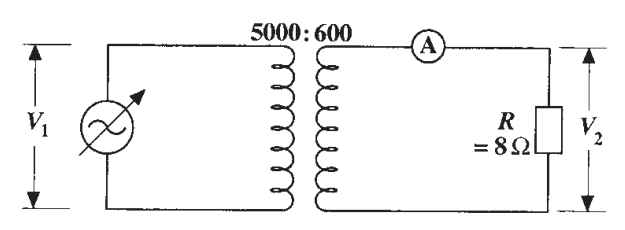
In the experimental setup shown in Figure 1, a variable a.c. voltage source, , drives the primary of a step down transformer of turns ratio 5000 : 600. A resistor, , is connected across the secondary winding.
(Diagram of a transformer circuit with primary voltage , primary coil, secondary coil, resistor R, and secondary voltage )
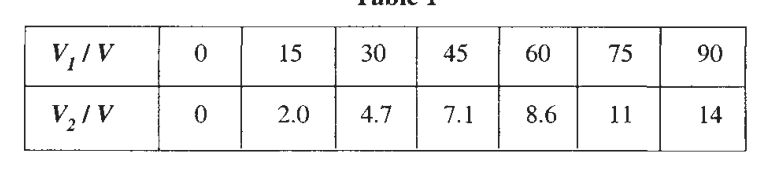
Table 1 shows the values obtained for when is varied from 0 V to 90 V.
| 0 | 15 | 30 | 45 | 60 | 75 | 90 | |
|---|---|---|---|---|---|---|---|
| 0 | 2.0 | 4.7 | 7.1 | 8.6 | 11 | 14 |
[25 marks]
Use the readings from Table 1 to plot a graph of vs on the graph page opposite.
[6 marks]
Find the slope, S, of your graph.
[4 marks]
What does the slope of your graph represent?
[1 mark]
Use your graph to determine the value of when V.
[1 mark]
Calculate the current in the secondary windings when V.
[3 marks]
Use the slope of your graph and the equation to determine the current in the primary winding.
[2 marks]
Calculate the power delivered to the resistor, R, by the secondary windings.
[3 marks]
Calculate, also, the power input to the primary windings by the source.
[1 mark]
State TWO major sources of energy loss in transformers.
[2 marks]
Describe the constructional features of commercial transformers which minimize the losses stated in Part (h) (i).
[2 marks]
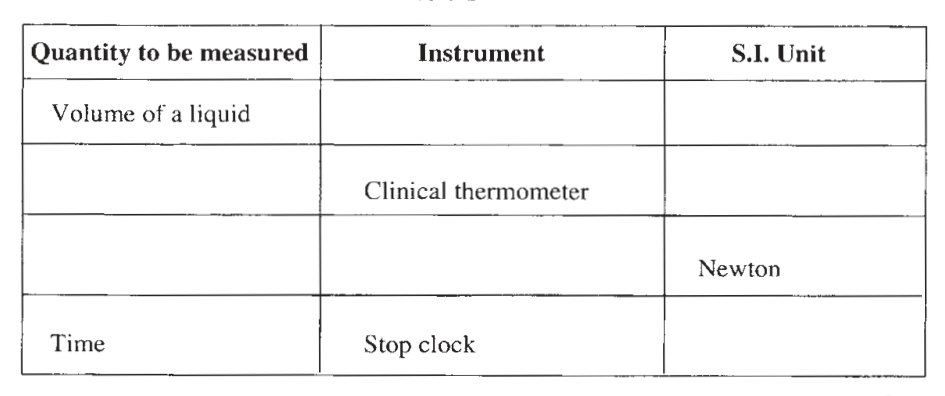
Table 2 is an incomplete table showing the quantity to be measured, the instrument used to measure the quantity and its S.I. unit. Complete Table 2 by writing in the missing information.
| Quantity to be measured | Instrument | S.I. Unit |
|---|---|---|
| Volume of a liquid | ||
| Clinical thermometer | ||
| Newton | ||
| Time | Stop clock |
[7 marks]
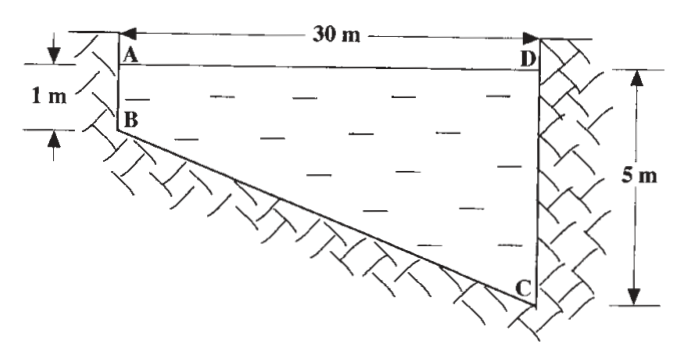
A swimming pool 30 metres long is filled with water to a depth of 1 metre at the shallow end and 5 metres at the deep end (see Figure 2 not drawn to scale).
(Diagram of a swimming pool's cross-section, showing dimensions and labels A, B, C, D)
(i) ABCD the vertical cross-section through the pool has the shape of a trapezium with area given by: Area ABCD = (AB + CD) x AD Calculate the area ABCD.
[2 marks]
Determine the volume of water in the pool, given that it is 20 metres wide.
[3 marks]
Calculate the mass of water in the pool. [density of water = ]
[3 marks]
The THREE MAIN particles in an atom are: A. B. C.
[3 marks]
The corresponding location of EACH of these particles is: A. B. C.
[3 marks]
The particle with NO charge is called
[1 mark]
How many half-lives would it take for a sample of Carbon-14 to be reduced to of its original mass?
[2 marks]
Given that Carbon-14 has a half-life of 5700 years, determine how long it would take for this reduction to occur.
[2 marks]
Carbon dating involves the use of Carbon-14 to determine the age of ancient objects. Explain how this is accomplished.
[4 marks]
Define the 'moment of a force'.
[6 marks]
Draw a diagram to illustrate the action of a force multiplier lever.
Explain the operation of a force multiplier lever.
Figure 3 shows a wheelbarrow and stones with a total mass of 43 kg. The wheelbarrow is in equilibrium with two of the three forces acting on it shown in Figure 3.
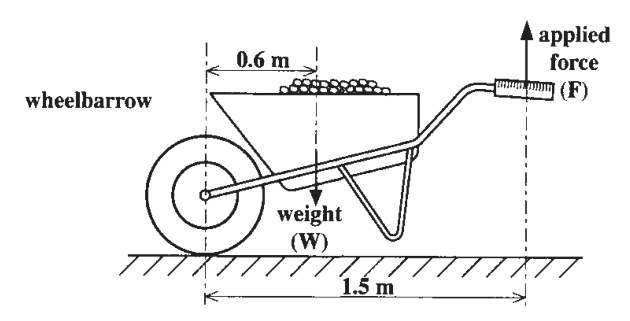
[9 marks]
Identify the nature and point of action of the third force acting on the wheelbarrow. Write down an equation showing the relationship between the THREE forces.
Calculate a) the weight, W (see Figure 3) b) the value of the applied force, F (see Figure 3). [acceleration due to gravity, g = ]
Describe an experiment to verify Snell's law. State the apparatus used, your method, and the results you would take to arrive at your conclusion.
[6 marks]
Figure 4 shows a ray of light, XY, incident on a right-angled prism, PQR, of refractive index 1.5. The point of incidence on PR is such that the refracted ray inside the prism is incident on PQ.
Calculate the angle of refraction at the boundary, PR. Given that the critical angle for the glass-air boundary, PQ, is , deduce whether or not there would be total internal reflection at this boundary.
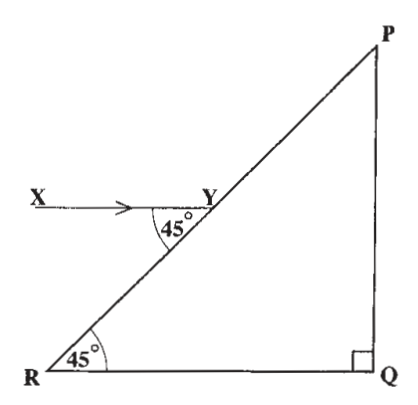
[9 marks]
The method of mixtures is used to determine the specific heat capacity of liquids and solids by experiment. Describe the procedure, the measurements to be taken and the use of these measurements to obtain the result in such an experiment.
[6 marks]
It is recommended that in order to maintain good health a person should drink at least [4 kg] of water per day. Assume that this entire volume of water, initially at , is eventually excreted as urine at .
Find the amount of heat removed each day by the quantity of urine. [Assume the specific heat capacity of urine = specific heat capacity of water = ; density of urine = density of water = ]
[6 marks]
What mass of perspiration would remove the same quantity of heat as the urine in Part (b), when completely evaporated from the skin? Assume that evaporation is equivalent to a change of phase from liquid to vapour without an increase in temperature. [Specific latent heat of vaporisation of water = ]
[3 marks]