Free CXC Physics Paper 2 May/June 2025 past paper from 2025. Includes a worked answer key. Open the PDF, take a timed test, and study with AI on Caribbean AI.
Answer keys are free on Caribbean AI. View the answers to every past-paper question at no cost - no payment needed - with step-by-step worked solutions and instant AI marking available on Premium.
CSEC Physics Paper 2 May/June 2025 - Free CXC Past Paper with Answers
Free CXC Physics Paper 2 May/June 2025 past paper from 2025. Includes a worked answer key. Open the PDF, take a timed test, and study with AI on Caribbean AI.
Opening the interactive papers…
Every question from this paper as text. See the answers and worked solutions. Questions are the property of the Caribbean Examinations Council; Caribbean AI is not affiliated with CXC.
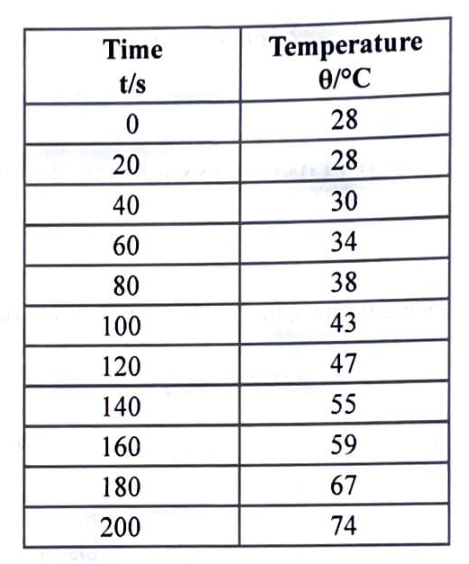
Using the data recorded in Table 1 and the grid provided in Figure 1 on page 5, plot a graph of temperature (/°C) against time (t/s).
Draw the line of best fit through the last five points (that is, from s to s).
[8 marks]
Hence, calculate the gradient, G, of the line drawn in (a) (i).

[5 marks]
Calculate the power, P, of the hotplate, in watts.
[2 marks]
Assuming that all the energy from the hotplate is transferred to the liquid, calculate the energy, in joules, absorbed by the liquid in the last 80 seconds.
[3 marks]
For the liquid, calculate the value of c, given that the power, P, is related to the gradient by the equation , where is the mass of the liquid. Express your answer to three significant figures.
[4 marks]
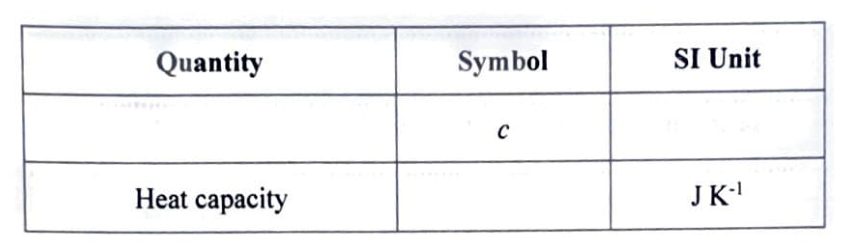
Complete Table 2 by inserting the symbol and SI unit for the quantities involved in the experiment.
TABLE 2: SYMBOLS AND SI UNITS FOR QUANTITIES INVOLVED IN THE EXPERIMENT
| Quantity | Symbol | SI Unit |
|---|---|---|
| Heat capacity | J K |
[3 marks]
Define the term 'gravitational potential energy'.
[2 marks]
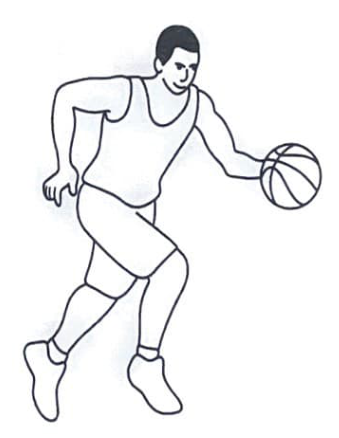
Figure 2 shows Keroi, a basketball player in the national league in St Vincent, going through his routine.
As Keroi dribbles the ball with either his right or left hand, energy conversion takes place. List the energy changes which take place through the following stages as he dribbles the ball. (i) When the ball leaves his hand and strikes the ground
[4 marks]
While the ball is in contact with the ground
[1 mark]
When the ball leaves the ground and rebounds to his hand
[2 marks]
In a test to determine if a basketball with a mass of 1.1 kg is properly inflated, the basketball is dropped from a height of 1.5 m and rebounds to a height of 0.8 m.
Calculate the energy lost by the basketball.
[6 marks]
Suggest TWO possible ways in which the energy was lost by the ball.
[2 marks]
Draw and label a diagram of a simple transformer.
[5 marks]
With the aid of your diagram, explain the operation of a simple transformer.
[4 marks]
A local power station distributes power at 13.2 kV. This power is then converted to 220 V for domestic use.
[6 marks]
Based on the scenario above, identify the key assumption made with respect to an ideal transformer.
[1 mark]
State the equation for an ideal transformer.
[1 mark]
Assuming the transformer is ideal, calculate its turns ratio.
[2 marks]
If the current in the secondary coils is 5 A, calculate the current in the primary coils.
[2 marks]
SECTION B Answer ALL questions.
Define EACH of the following wave phenomena.
[6 marks]
Wavelength
[2 marks]
Amplitude
[2 marks]
Diffraction
[2 marks]
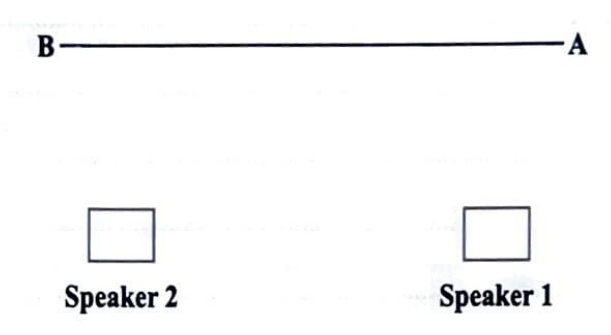
Two loudspeakers placed about one metre apart are simultaneously playing the same music. Sophia walks along the line from A to B, as shown in Figure 3.
(i) Describe what Sophia hears while walking along the line from A to B. (ii) Explain your answer in (b) (i).
[5 marks]
Explain the concept of 'wave particle duality' of light, making use of the contributions of Newton and Young.
[4 marks]
Define EACH of the following terms.
[3 marks]
Velocity
[2 marks]
Momentum
[1 mark]
State the principle of conservation of linear momentum.
[3 marks]
In a Twenty20 cricket match, a ball with a mass of has a velocity of off the pitch and is hit by a bat with a mass of moving in the opposite direction at .
(i) Calculate the momentum of the a) bat before collision b) ball before collision. (ii) After contact between the bat and the ball, the ball moves in the opposite direction at . Assuming the collision is completely elastic, calculate the a) momentum of the bat after the collision b) velocity of the bat after the collision.
[9 marks]
Calculate the momentum of the a) bat before collision b) ball before collision.
[4 marks]
After contact between the bat and the ball, the ball moves in the opposite direction at . Assuming the collision is completely elastic, calculate the a) momentum of the bat after the collision b) velocity of the bat after the collision.
[5 marks]
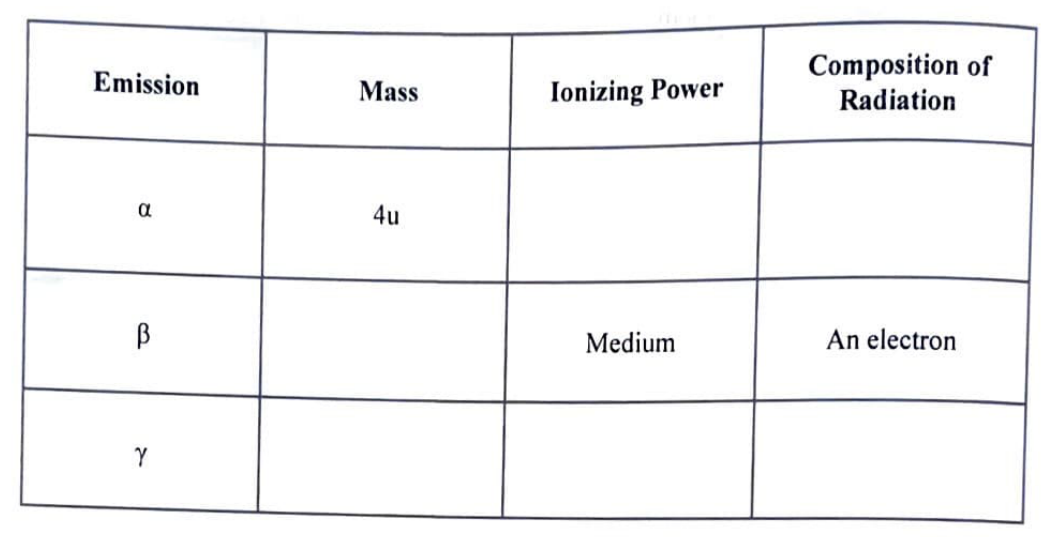
(a) Table 3 shows the properties of the radiation emitted in radioactive decay.
| Emission | Mass | Ionizing Power | Composition of Radiation |
|---|---|---|---|
| Medium | An electron | ||
Fill in the missing information in Table 3. (b) An equation for radioactive decay is shown below. (i) Determine the values of K and P. Explain your response. (ii) Using the equation of radioactive decay given on page 18, deduce the type of emission. (iii) If, during the decay process, the energy liberated is , calculate the mass difference. Use Einstein's mass-energy equation. [Take the velocity of light as ]
[15 marks]