

Free CXC Physics Paper 2 January 2025 past paper from 2025. Includes a worked answer key. Open the PDF, take a timed test, and study with AI on Caribbean AI.
Answer keys are free on Caribbean AI. View the answers to every past-paper question at no cost - no payment needed - with step-by-step worked solutions and instant AI marking available on Premium.
CSEC Physics Paper 2 January 2025 - Free CXC Past Paper with Answers
Free CXC Physics Paper 2 January 2025 past paper from 2025. Includes a worked answer key. Open the PDF, take a timed test, and study with AI on Caribbean AI.
Opening the interactive papers…
Every question from this paper as text. See the answers and worked solutions. Questions are the property of the Caribbean Examinations Council; Caribbean AI is not affiliated with CXC.
Complete the statement below.
Transformers can increase or decrease the ______________________, with a corresponding decrease or increase in ______________________. The basic principle behind the working of a transformer is the phenomenon of ______________________ between two windings linked by a common magnetic flux.
[3 marks]
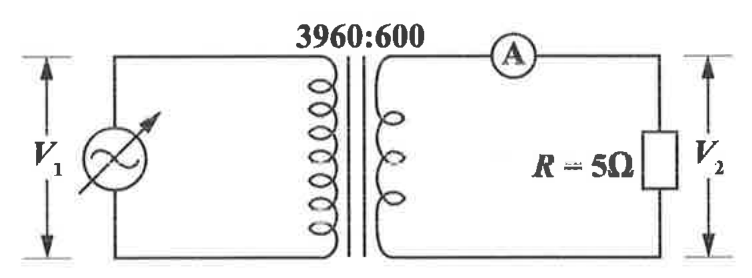
In the experimental setup shown in Figure 1, a variable AC voltage source, , drives the primary winding of an ideal step-down transformer with a turns ratio of 3960:600. A resistor, , is connected across the secondary winding.
Figure 1. Diagram of a transformer
Table 1 shows the values obtained for when is varied from 0 V to 80 V.
TABLE 1: VALUES OBTAINED FOR WHEN IS VARIED
| /V | 0 | 10 | 20 | 30 | 45 | 60 | 70 |
|---|---|---|---|---|---|---|---|
| /V | 0 | 1.5 | 3.1 | 4.7 | 6.7 | 9.0 | 10.7 |
Use the readings from Table 1 to plot a graph of vs on the grid on page 5.
[7 marks]
Find the slope, , of your graph.
[4 marks]
What does the slope of your graph represent?
[1 mark]
Use your graph to determine the value of when V.
$V_2 = \text{______________________________}$
[1 mark]
Calculate the current, , in the secondary windings when V.
[3 marks]
Use the slope of your graph and the equation to determine the current, , in the primary winding.
[2 marks]
Calculate the power dissipated in the resistor, .
[3 marks]
Determine the power input to the primary windings by the source.
[1 mark]
Identify ONE alternative energy source utilized in or that is relevant to the Caribbean.
[1 mark]
State TWO ways in which alternative energy sources, like the one mentioned in (a) (i), are important to the Caribbean.
[2 marks]
State the law of conservation of energy.
[2 marks]
A motor vehicle is travelling along a level road. What are the MAIN energy changes taking place when the vehicle comes to rest after the brakes are applied?
[2 marks]
An elevator raises a group of 12 persons through a vertical height of 10 m in 5 s. If the average mass of the persons in the group is 55 kg, calculate
An elevator raises a group of 12 persons through a vertical height of 10 m in 5 s. If the average mass of the persons in the group is 55 kg, calculate the gravitational potential energy gained by the group [Use ]
[4 marks]
the power required to raise the group.
[4 marks]
The effects of thermal expansion can be observed in many everyday situations. List THREE observed examples of the effects of thermal expansion.
[3 marks]
Indicate whether there will be an increase or decrease in temperature in the following scenarios. a) Samara turned on the oven to roast a breadfruit. More thermal energy enters the breadfruit than the energy that leaves the breadfruit.
Identify the physical property that is being used in the following thermometers to measure temperature.
A thermocouple is used to measure the temperature of an oven.
[1 mark]
A liquid-in-glass clinical thermometer is used to take the temperature reading of a sick child.
[1 mark]
A weather balloon is deployed to observe and send information about the make-up of the volcanic ash plumes that were emitted from the La Soufrière volcano in St Vincent.
The balloon has a volume of . The gas inside the balloon is heated from to . If the pressure inside the balloon remains constant, determine the new volume of the balloon.
[3 marks]
In another situation, the volume of the balloon was kept constant and the pressure of the gas was allowed to change from its initial value of .
Calculate the new pressure if the temperature of the gas inside the balloon was heated from to .
Determine the percentage increase in the pressure in (c) (ii).
[2 marks]
State the laws of reflection. Law 1 Law 2
[2 marks]
One property of an image formed by a plane mirror is that it is virtual. State ONE other property of the image.
[1 mark]
State Snell's law.
[3 marks]
Blue and red light are incident on a Perspex block as shown in Figure 3.
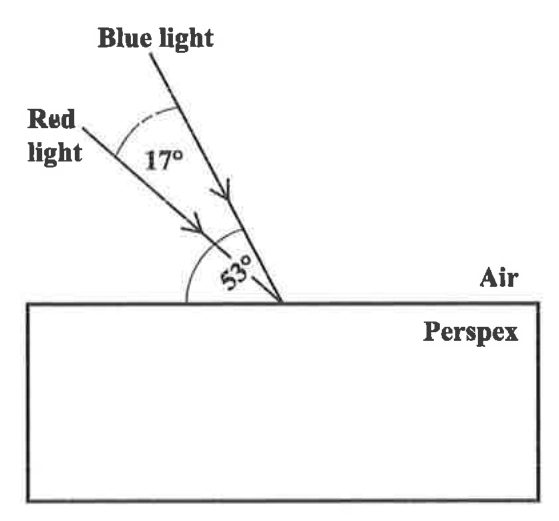
Calculate the angle of incidence for EACH colour of light. Blue light Red light
[2 marks]
Calculate the angle of refraction of the blue light, given that the refractive index for the blue light is .
[4 marks]
Calculate the critical angle, , for the blue light.
[3 marks]
Write the formula to show how potential difference (V), charge (Q) and energy (E) are related and state the SI unit for EACH quantity.
[4 marks]
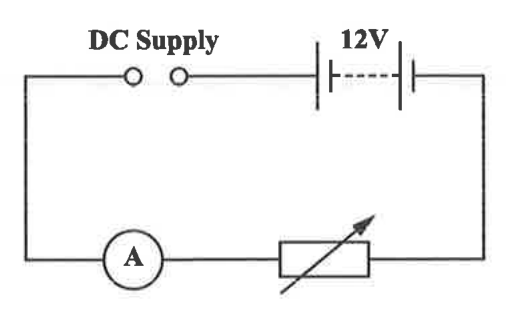
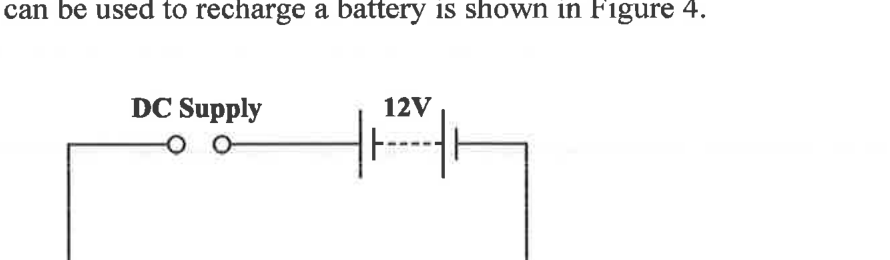
A circuit that can be used to recharge a battery is shown in Figure 4.
(i) On the diagram, insert the polarity of the DC supply.
[1 mark]
On the diagram, insert the polarity of the DC supply.
[1 mark]
Indicate, in the space provided below, which of the values, 6 V, 12 V or 15 V, would be MOST suitable for the DC supply.
[1 mark]
A compact fluorescent light bulb consumes 4.8 W of power when connected to a 120 V AC supply.
(i) Calculate the current flowing through the bulb.
[3 marks]
Calculate the current flowing through the bulb.
[3 marks]
If the bulb is connected for 5 minutes, calculate the charge passing through it.
[4 marks]
Calculate the energy the bulb transfers in 5 minutes.
[2 marks]
Radioactive materials emit nuclear radiation.
(i) List THREE main types of nuclear radiation.
[3 marks]
List THREE main types of nuclear radiation.
[3 marks]
Identify the type of nuclear radiation which forms part of the electromagnetic spectrum.
[1 mark]
Determine the type of radiation that is
a) the most ionizing
[1 mark]
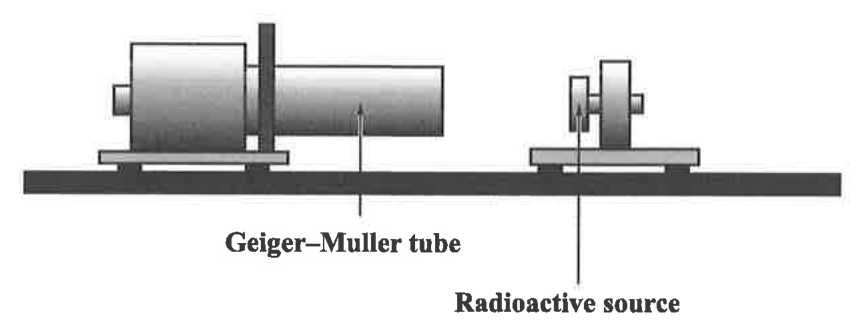
Figure 5 shows a radioactive source which was placed in front of a radioactive detector. The average background count rate is 5 counts per second. With the source in place, the rate rises to 69 counts per second. After an hour, the count rate drops to 21 counts per second.
(i) Determine the corrected count rates for the activities of the source.
[2 marks]
Calculate the half-life of the source.
[3 marks]
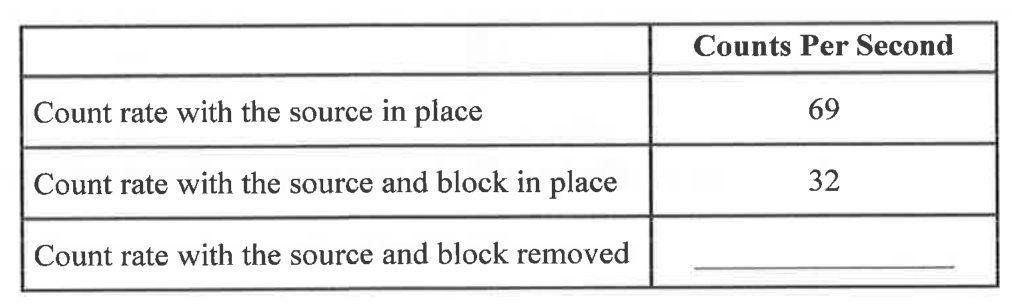
A block of lead is then placed between the source and the detector. The results of the count rates are recorded in Table 2.
(i) Complete Table 2 by inserting the missing value.
[1 mark]
a) The source is known to emit one type of radiation only. Deduce what type of radiation it is.
[1 mark]
[3 marks]