Free CXC Chemistry Paper 2 May/June 2005 past paper from 2005. Includes a worked answer key. Open the PDF, take a timed test, and study with AI on Caribbean AI.
Answer keys are free on Caribbean AI. View the answers to every past-paper question at no cost - no payment needed - with step-by-step worked solutions and instant AI marking available on Premium.
CSEC Chemistry Paper 2 May/June 2005 - Free CXC Past Paper with Answers
Free CXC Chemistry Paper 2 May/June 2005 past paper from 2005. Includes a worked answer key. Open the PDF, take a timed test, and study with AI on Caribbean AI.
Opening the interactive papers…
Every question from this paper as text. See the answers and worked solutions. Questions are the property of the Caribbean Examinations Council; Caribbean AI is not affiliated with CXC.
One can usually follow the rate of a reaction by monitoring the rate of disappearance of the reactant or appearance of the product. When aqueous sodium thiosulphate () reacts with hydrochloric acid, a precipitate of sulphur, sulphur dioxide, sodium chloride and water are formed as the only products. The rate of this reaction can be followed by measuring the time taken for a certain amount of sulphur precipitate to be formed.
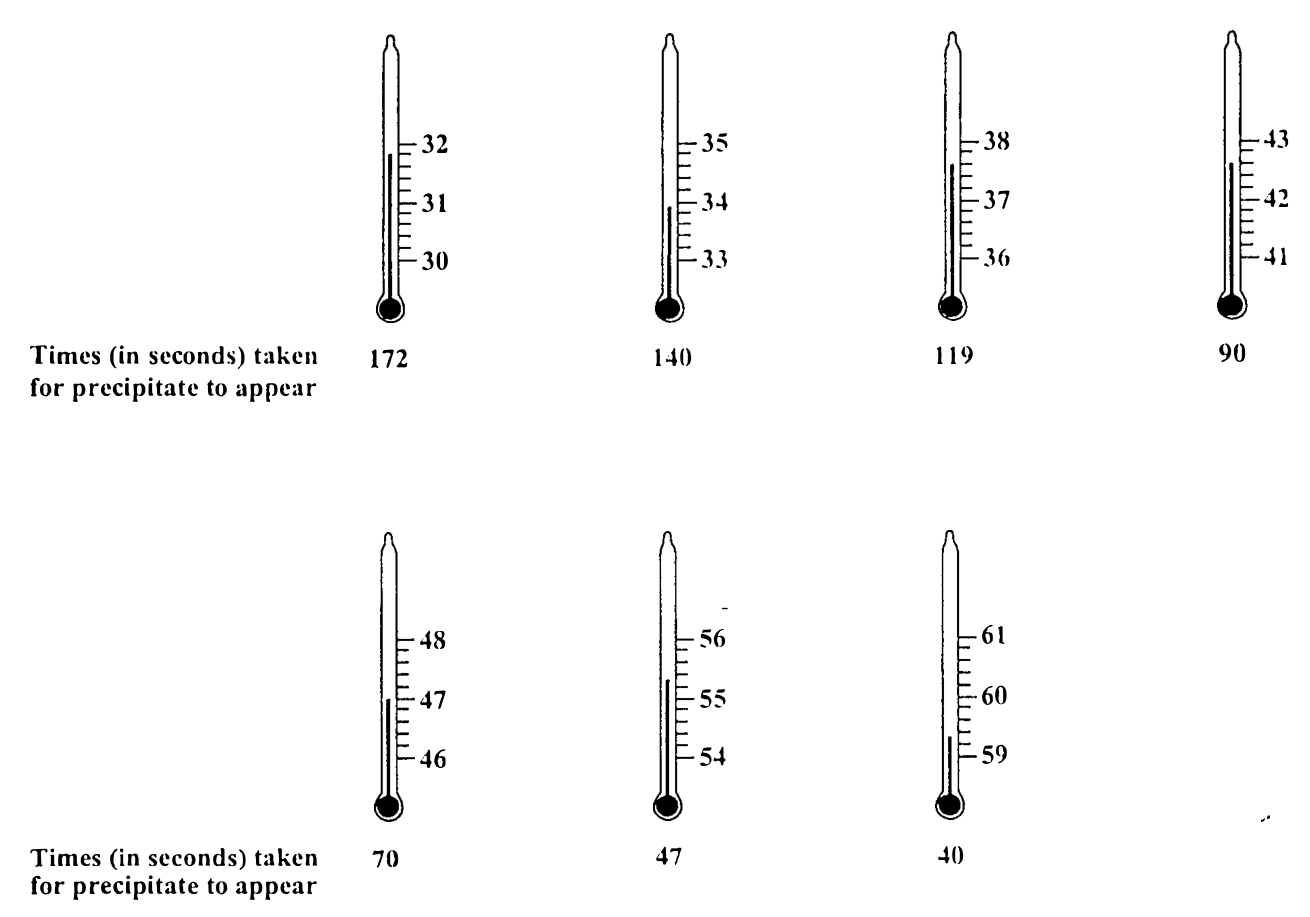
A student investigates the effect of temperature on the rate of this reaction. Figure 1 below shows the stopwatch times taken for a fixed amount of sulphur precipitate to appear and the corresponding thermometer readings. The concentrations of all the reactants are kept constant in these experiments.
Figure 1: The stopwatch times for the appearance of sulphur and the respective thermometer readings.
In the space below, construct a suitable table and record on it, the temperatures at which the reaction took place with the corresponding times in seconds for the formation of sulphur.
[4 marks]
Using the graph paper provided on page 5, plot a graph of temperature versus time in seconds.
[3 marks]
What conclusion can be drawn about the rate of the reaction from the graph?
[1 mark]
From the graph, determine the time expected to be taken for the appearance of the sulphur precipitate if the reaction were carried out at . Indicate on your graph how you arrived at your answer.
[2 marks]
From the information given on page 3 in the introduction to this question, write a balanced chemical equation for the reaction between aqueous sodium thiosulphate and hydrochloric acid.
[2 marks]
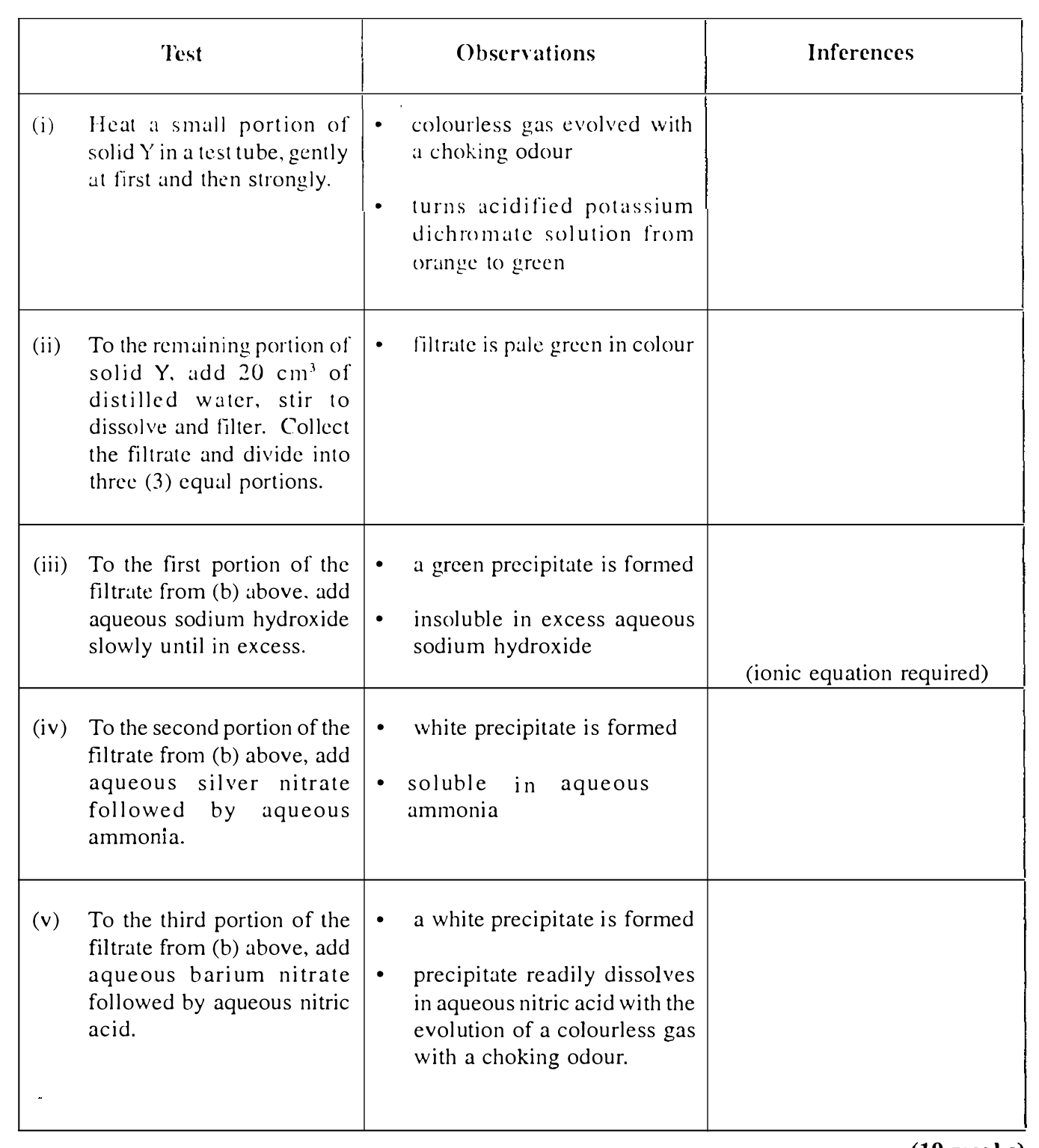
Y is a mixture of two salts. A student carries out a number of tests on a sample of Y. The observations are recorded in Table 1 below. You are required to fill in the inferences that can be made based on the observations recorded.
| Test | Observations | Inferences |
|---|---|---|
| (i) Heat a small portion of solid Y in a test tube, gently at first and then strongly. | • colourless gas evolved with a choking odour <br> • turns acidified potassium dichromate solution from orange to green | |
| (ii) To the remaining portion of solid Y, add of distilled water, stir to dissolve and filter. Collect the filtrate and divide into three (3) equal portions. | • filtrate is pale green in colour | |
| (iii) To the first portion of the filtrate from (b) above, add aqueous sodium hydroxide slowly until in excess. | • a green precipitate is formed <br> • insoluble in excess aqueous sodium hydroxide | (ionic equation required) |
| (iv) To the second portion of the filtrate from (b) above, add aqueous silver nitrate followed by aqueous ammonia. | • white precipitate is formed <br> • soluble in aqueous ammonia | |
| (v) To the third portion of the filtrate from (b) above, add aqueous barium nitrate followed by aqueous nitric acid. | • a white precipitate is formed <br> • precipitate readily dissolves in aqueous nitric acid with the evolution of a colourless gas with a choking odour. |
[10 marks]
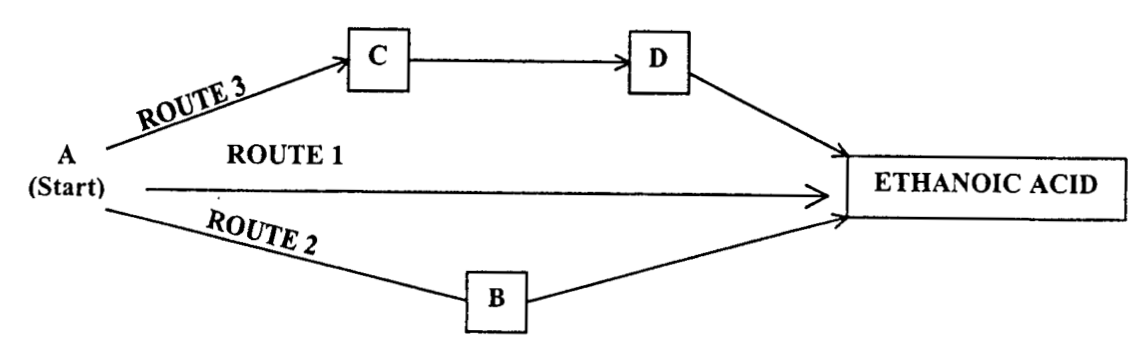
A group of students synthesizes ethanoic acid (acetic acid) by three different routes in the laboratory. Each route involves a different number of steps as shown in Figure 2.
Route 1 involves one step Route 2 involves two steps Route 3 involves three steps
Plan and design an experiment to determine which route yields the highest percentage of ethanoic acid starting from A.
Your answer should include the following: (i) Hypothesis to be tested (ii) Materials and apparatus (iii) Method (iv) Variables controlled (v) Data to be collected (vi) Results linked to hypothesis
[30 marks]
Atoms of an element, , readily combine with those of another element, .
(a) Draw a labelled diagram to illustrate the number of protons, neutrons and electrons present in an atom of B.
[3 marks]
To which group of the periodic table does element A belong? Give a reason for your answer.
[2 marks]
What type of chemical bonding will be formed when A combines with B? Give a reason for your answer.
[3 marks]
Write the chemical formula of the compounds expected to be formed when (i) atoms of element A combine with those of element B (ii) atoms of element A combine with each other.
[2 marks]
atoms of element A combine with those of element B
[1 mark]
atoms of element A combine with each other.
[1 mark]
Based on your answer in (d) (i) on page 9 and the information given in the question, calculate the mass of compound that will be formed when 54g of B reacts completely with A.
[2 marks]
< ![CDATA[State THREE likely differences in the properties of the compound formed in (d) (i) when compared to the compound formed in (d) (ii).
[3 marks]
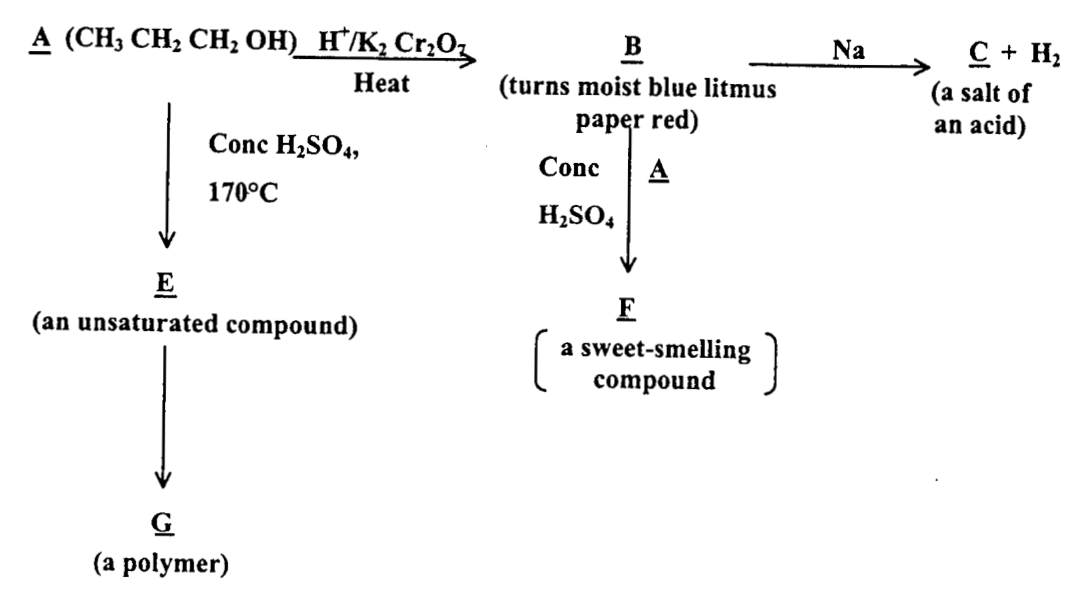
< ![CDATA[Carefully study the information given in the following reaction scheme and answer the questions which follow. The structure of A has been identified for you.
[16 marks]
Draw FULLY DISPLAYED chemical structures for EACH of the following organic compounds identified in the reaction scheme above.
C, E, F
[6 marks]
Draw the partial structure of the polymer G to show THREE repeating units.
[2 marks]
Name the type of reaction involved in the conversion of
[2 marks]
A to E:
[1 mark]
B to F:
[1 mark]
Describe a chemical test to identify the functional group present in compound E.
In your answer you should indicate the reagent to be used and write a chemical equation for the reaction which occurs.
[2 marks]
State the reagents and reaction conditions necessary to convert:
[4 marks]
E to A
[2 marks]
F to B
[2 marks]
When chemical reactions occur, heat may be given off or taken in from the environment.
What changes occur during a reaction that can account for this fact?
[3 marks]
Define the term 'heat of neutralization'.
[1 mark]
It is observed that whenever a strong acid (such as HCl or HNO₃) is completely neutralized by a strong base (such as NaOH or KOH), the heat of neutralization (in kJ mol⁻¹) is the same.
Account for this observation.
[2 marks]
When 12.0 g potassium nitrate (KNO₃) is dissolved in 100 cm³ of water, the temperature drops by 4.20 °C.
Relative atomic mass: K = 39, N = 14; O = 16 Specific heat capacity of water = 4.2 J g⁻¹ K⁻¹ Heat change = M x C x ΔT 1 cm³ of solution = 1 g
Using the above information calculate EACH of the following:
a) The number of moles of KNO₃ used in the experiment
[1 mark]
State ONE assumption you made in your calculation.
[1 mark]
Draw a labelled energy profile diagram to represent the enthalpy change for the reaction.
[3 marks]
The spacecraft Voyager detected the presence of a new element, Q, on the planet Mars. The following data on this element were transmitted back to earth.
Relative Atomic Mass 333 Melting Point 1280 °C Number of valence electrons 2
[8 marks]
Would Q to be electrically conducting or not? Give a reason for your answer.
[2 marks]
State the expected reaction of Q with water. Include a chemical equation.
[3 marks]
Further investigations reveal that on exposure to oxygen, the metal Q becomes chemically inert. State a possible reason for this.
[3 marks]
A compound of Q, suspected to be a nitrate, has also been detected on Mars.
How would the effect of heat on this metal nitrate of Q differ from that of sodium nitrate?
Illustrate your answer by means of suitable chemical equations.
Effect of heat on sodium nitrate:
Effect of heat on the nitrate of Q:
[4 marks]
Briefly outline how a dry sample of the sulphate of Q can be prepared from a sample of the metal nitrate of Q.
Include an ionic equation to illustrate your method of preparation.
[4 marks]