Free CXC Chemistry Paper 2 January 2025 past paper from 2025. Includes a worked answer key. Open the PDF, take a timed test, and study with AI on Caribbean AI.
Answer keys are free on Caribbean AI. View the answers to every past-paper question at no cost - no payment needed - with step-by-step worked solutions and instant AI marking available on Premium.
CSEC Chemistry Paper 2 January 2025 - Free CXC Past Paper with Answers
Free CXC Chemistry Paper 2 January 2025 past paper from 2025. Includes a worked answer key. Open the PDF, take a timed test, and study with AI on Caribbean AI.
Opening the interactive papers…
Every question from this paper as text. See the answers and worked solutions. Questions are the property of the Caribbean Examinations Council; Caribbean AI is not affiliated with CXC.
Define the term 'acid'.
[1 mark]
Define the term 'normal salt'.
[2 marks]
The active ingredient in Gravico and Jestid is sodium carbonate, . A sample of Jestid was added to dilute hydrochloric acid. The volume of gas produced was measured every 30 seconds, for 240 seconds, and the results recorded in Table 1 below. The experiment was repeated with Gravico.
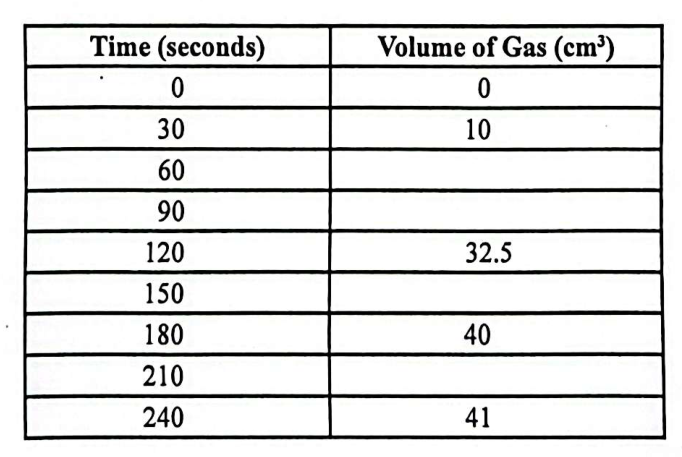
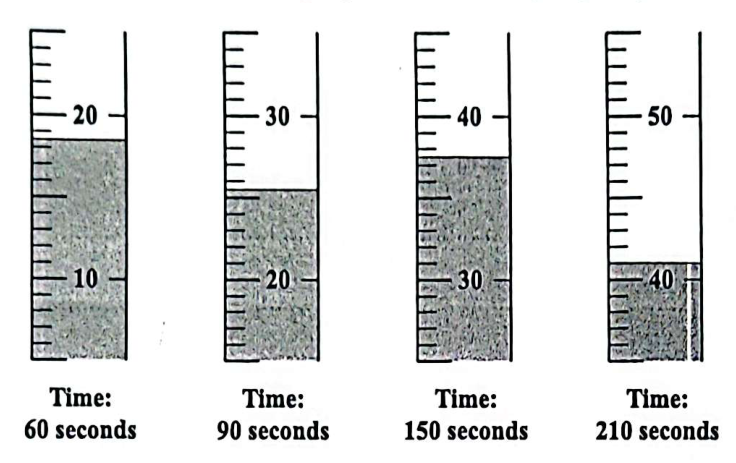
Figure 1 shows the volumes of gas produced in the syringes by Jestid at four time intervals.
Complete Table 1 below by inserting the volume of gas produced as shown in Figure 1.
TABLE 1: GAS PRODUCED BY JESTID
| Time (seconds) | Volume of Gas () |
|---|---|
| 0 | 0 |
| 30 | |
| 60 | 10 |
| 90 | |
| 120 | |
| 150 | 32.5 |
| 180 | 40 |
| 210 | |
| 240 | 41 |
[4 marks]
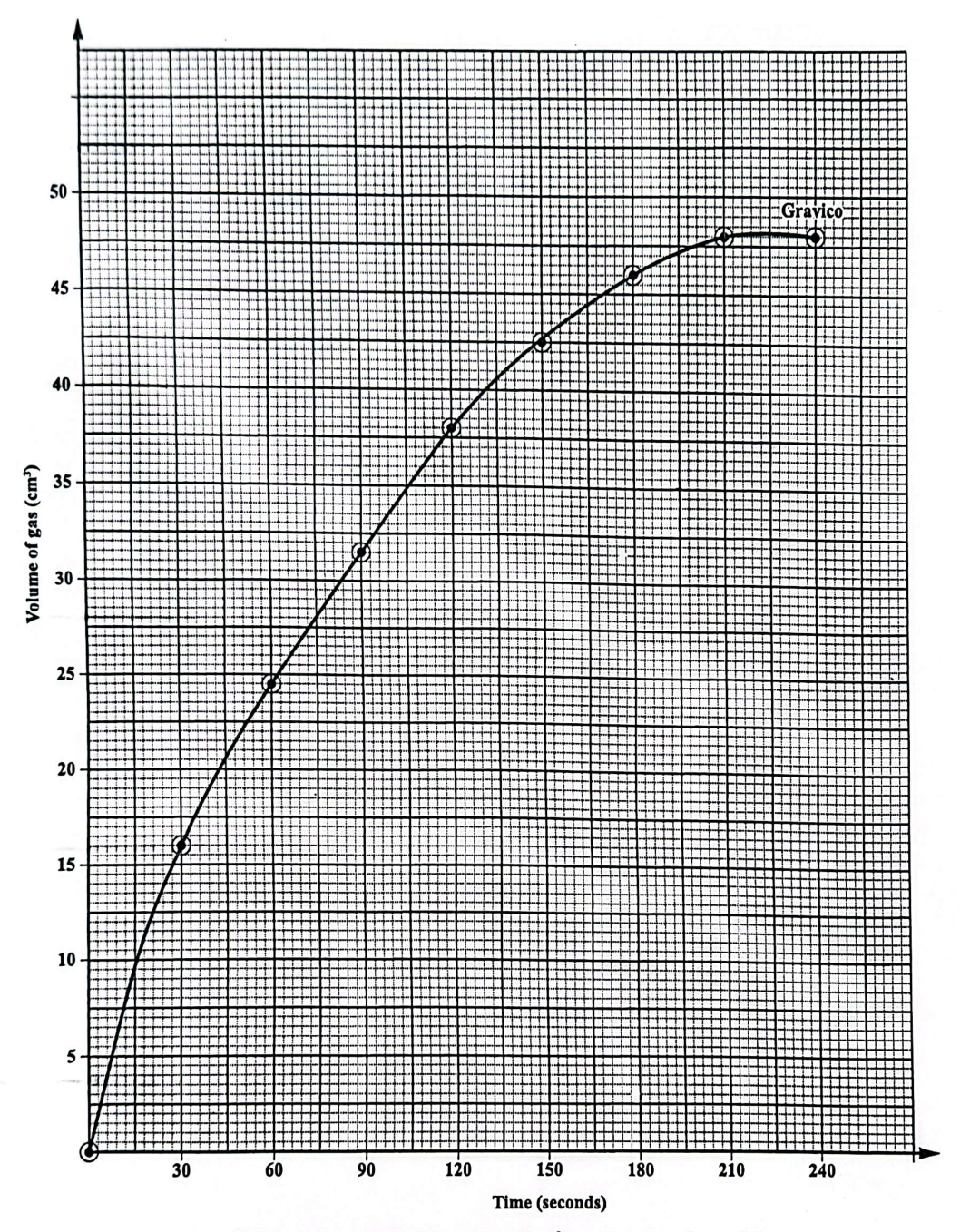
Using the axes provided in Figure 2 on page 7, plot the graph for the data obtained for Jestid in Table 1. The graph of Gravico has already been plotted for you.
[5 marks]
Using the Gravico graph, deduce the volume of gas produced at 135 seconds. [Use dotted lines on your graph to show how you obtained your value.]
[2 marks]
Using your answer in (b) (iii), calculate the number of moles of gas produced at rtp for the Gravico reaction at 135 seconds.
[2 marks]
Write a balanced equation, with state symbols, for the reaction between hydrochloric acid and sodium carbonate.
[3 marks]
Determine the number of moles of sodium carbonate that reacted at 135 seconds for the Gravico reaction.
[2 marks]
Using your answer in (b) (vi) on page 8, calculate the mass of sodium carbonate that reacted at 135 seconds for the Gravico reaction. (Given that RAM of Na = 23; C = 12 and O = 16).
[2 marks]
From the graphs obtained in the investigation, Maxine suggested that Jestid is the stronger antacid. State whether you agree with Maxine and give ONE reason to support your choice.
[2 marks]
Students were asked to observe strips of yam placed in a container of distilled water. After 20 minutes, one student suggested that osmosis was occurring in the yam strips.
(i) Define the term 'osmosis'.
[3 marks]
Define the term 'osmosis'.
[3 marks]
State what the students would have observed after 20 minutes.
[1 mark]
Outline how osmosis supports the particulate theory of matter.
[2 marks]
The yam strip which was a solid was placed into distilled water that is a liquid. State how the arrangement of particles in a liquid differs from that in a solid.
[2 marks]
Account for the observation that the bottles of cold beverages sold at the school canteen often develop drops of water on the sides of the bottles when left to stand.
[2 marks]
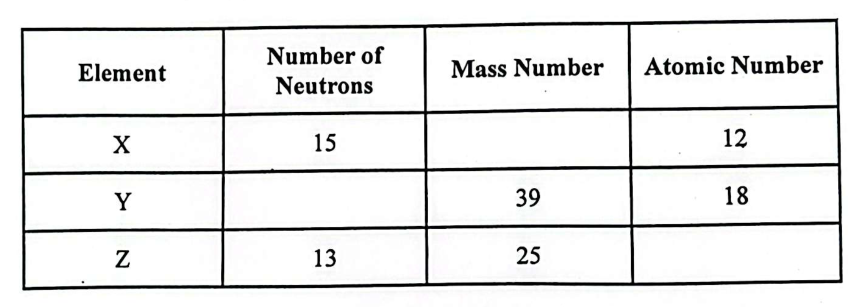
Table 2 contains information related to the atomic structure of three atoms of the elements X, Y and Z.
| Element | Number of Neutrons | Mass Number | Atomic Number |
|---|---|---|---|
| X | 15 | 12 | |
| Y | 39 | 18 | |
| Z | 13 | 25 |
(i) Complete Table 2 below by inserting the missing information for the atomic structure of each of the atoms of the elements shown.
[3 marks]
Complete Table 2 by inserting the missing information for the atomic structure of each of the atoms of the elements shown.
[3 marks]
Identify the isotopes in the table above.
[1 mark]
Identify the element that is a nonmetal.
[1 mark]
State TWO natural sources of hydrocarbons.
[2 marks]
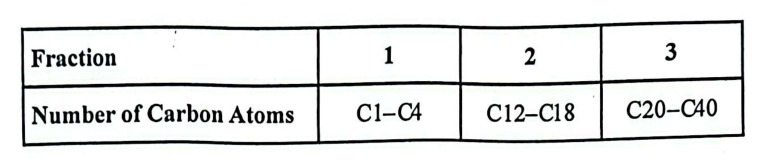
Fractional distillation of crude oil produces several fractions that contain a range of compounds with varying numbers of carbon atoms. Three of these fractions, labelled 1, 2 and 3, are shown in Table 3.
| Fraction | 1 | 2 | 3 |
|---|---|---|---|
| Number of Carbon Atoms | C1–C4 | C12–C18 | C20–C40 |
(i) State the name of ONE of the numbered fractions.
[1 mark]
State the name of ONE of the numbered fractions.
[1 mark]
State ONE use of Fraction 3.
[1 mark]
Compound W shown in Figure 3 has the characteristic odour of pears and is used in fragrances and as a food additive.
$\qquad | \quad // $
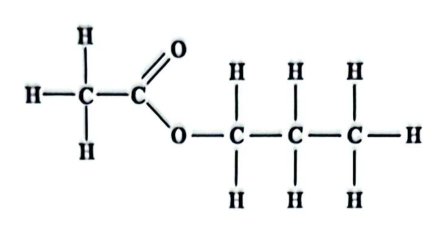
Circle the functional group of Compound W in Figure 3.
[1 mark]
Identify the homologous series to which Compound W belongs.
[1 mark]
List THREE characteristics of a homologous series.
[3 marks]
Draw the FULLY DISPLAYED structural formulae of the two molecules that are produced when Compound W is hydrolysed by dilute hydrochloric acid.
Molecule 1 Molecule 2
[4 marks]
State the names of the TWO molecules drawn in (c) (iv).
Molecule 1 Molecule 2
[2 marks]
SECTION B Answer ALL questions.
[15 marks]
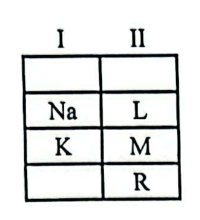
Figure 4 represents an outline of a portion of the periodic table. The position of five unknown elements, L, M, R, Q and T, are shown.
      I   II          III IV V VI VII VIII
    +---+---+       +---+---+---+---+---+---+
    | Na| L |       |   |   |   | Q |   | Ne|
    +---+---+       +---+---+---+---+---+---+
    | K | M |       |   | Si|   | Br| T |
    +---+---+       +---+---+---+---+---+---+
    | R |   |
    +---+---+
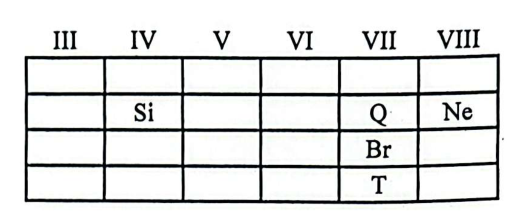
State the name of the horizontal rows and vertical columns in the periodic table.
Rows Columns
[2 marks]
Outline TWO factors used in arranging the elements in the periodic table.
[4 marks]
Based on the position of Element L in the periodic table, state whether it would react more vigorously or less vigorously with dilute hydrochloric acid than Element R.
[1 mark]
Justify your response in (b) (i).
[2 marks]
Write a balanced chemical equation for the reaction between Element L and hydrochloric acid.
[2 marks]
State ONE reaction, other than that with hydrochloric acid that is typical of Element L.
[1 mark]
An oxide of Element L is dissolved in water. State the pH range of the solution formed.
[1 mark]
Some elements can exist in the solid, liquid or gaseous state at room temperature and pressure, based on their position in the periodic table. Predict the physical state of Element T at room temperature.
[1 mark]
Based on the position of Element R, write the formula for its hydrogen carbonate.
[1 mark]
The condensed formulae of two organic compounds, A and B, are shown below.
Compound A: Compound B:
[15 marks]
The condensed formulae of two organic compounds, A and B, are shown below.
Compound A: Compound B:
Deduce the homologous series to which both Compounds A and B belong.
[1 mark]
Write the name of Compound A.
[1 mark]
Draw the FULLY DISPLAYED structure for Compound B.
[2 marks]
State the name of Compound B.
[1 mark]
Compound A displays structural isomerism and one of its isomers is 2-methylbut-2-ene. (i) Define the term 'structural isomers'. (ii) Draw the FULLY DISPLAYED structure of the isomer 2-methylbut-2-ene.
[4 marks]
Define the term 'structural isomers'.
[2 marks]
Draw the FULLY DISPLAYED structure of the isomer 2-methylbut-2-ene.
[2 marks]
State the name of Compound B.
[1 mark]
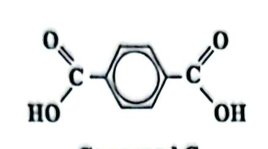
Figure 5 shows the structural formulae for two typical starting materials, Compound C and Compound D, used for making polymers.
(i) Define the term 'polymer'. (ii) Name the functional group of Compound C and Compound D. (iii) State ONE use of EACH of the following polymers.
[5 marks]
Define the term 'polymer'.
[2 marks]
Name the functional group of Compound C and Compound D. Compound C Compound D
[2 marks]
State ONE use of EACH of the following polymers. Nylon Polypropene
[1 mark]
Nitrogen gas is used in the manufacture of ammonia gas.

[5 marks]
State TWO physical properties of nitrogen gas.
[2 marks]
Draw a labelled diagram to show the apparatus used for the laboratory preparation of ammonia gas.
[3 marks]
Write a balanced chemical equation for the reaction that takes place in the laboratory preparation of ammonia gas.
[2 marks]
Explain why concentrated sulfuric acid, a typical drying agent, CANNOT be used in the preparation of ammonia gas and identify an appropriate alternative drying agent that could be used.
[3 marks]
Briefly describe a laboratory test for ammonia gas. Test
Ammonia is used as a raw material in the manufacture of fertilizers such as ammonium nitrate. The excessive use of fertilizers may lead to harmful levels of nitrates in the environment. List THREE harmful effects of excessive nitrates in the environment.
[3 marks]