Free CXC Chemistry Paper 2 May/June 2009 past paper from 2009. Includes a worked answer key. Open the PDF, take a timed test, and study with AI on Caribbean AI.
Answer keys are free on Caribbean AI. View the answers to every past-paper question at no cost - no payment needed - with step-by-step worked solutions and instant AI marking available on Premium.
CSEC Chemistry Paper 2 May/June 2009 - Free CXC Past Paper with Answers
Free CXC Chemistry Paper 2 May/June 2009 past paper from 2009. Includes a worked answer key. Open the PDF, take a timed test, and study with AI on Caribbean AI.
Opening the interactive papers…
Every question from this paper as text. See the answers and worked solutions. Questions are the property of the Caribbean Examinations Council; Caribbean AI is not affiliated with CXC.
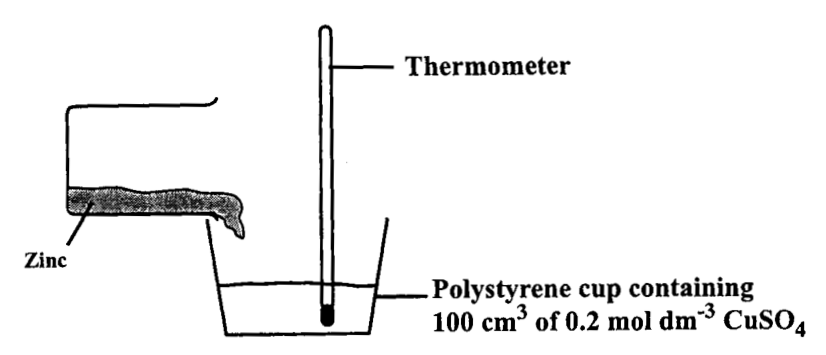
A student conducts an experiment to investigate the temperature changes that occur when various quantities of powdered zinc are added to of copper(II) sulphate. The apparatus used is shown in Figure 1.
The equation for the reaction which occurs is shown below:
[15 marks]
Describe what would be observed in the polystyrene cup in Figure 1.
[2 marks]
What does the observation you described in a) above indicate about the relative positions of zinc and copper in the reactivity series?
[1 mark]
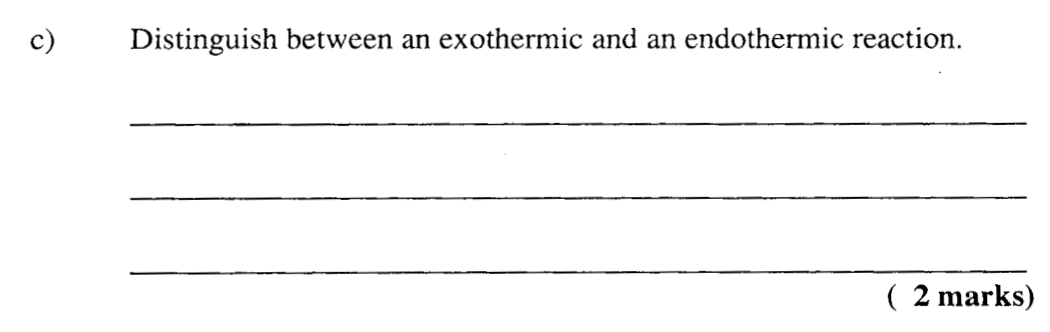
Distinguish between an exothermic and an endothermic reaction.
[2 marks]
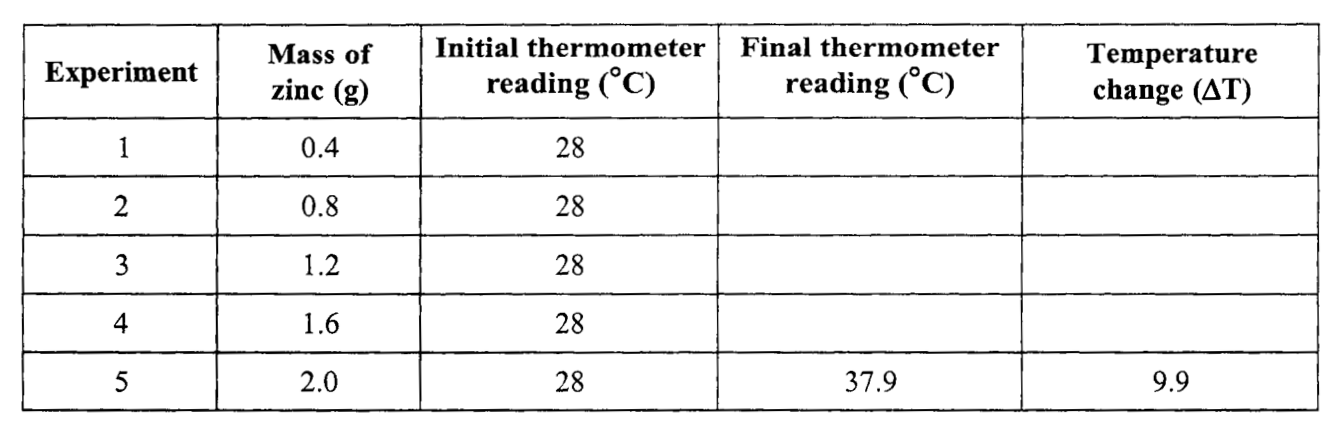
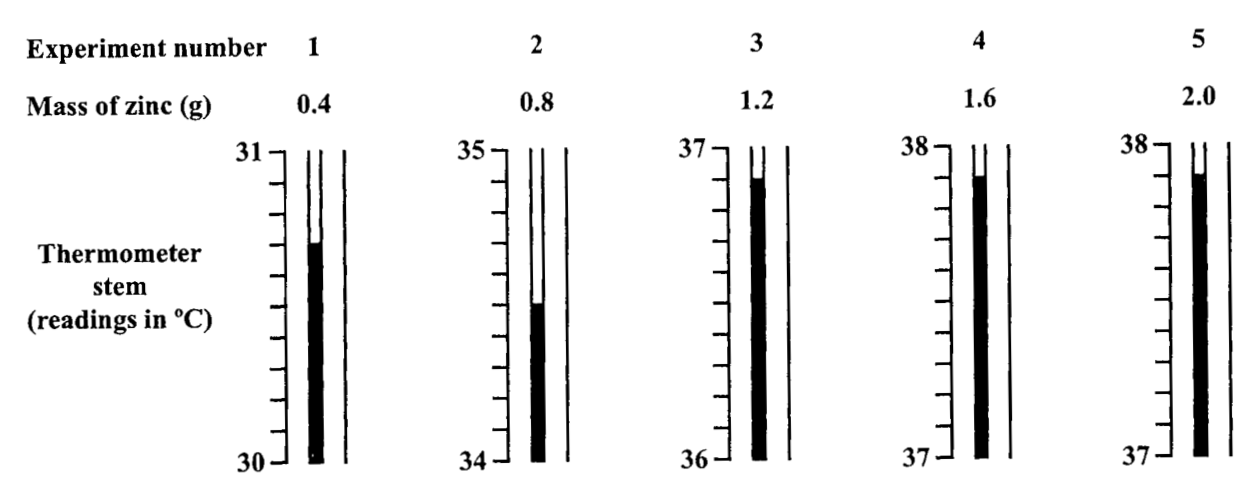
Using the readings in Figure 2, complete Table 1 to show the final thermometer readings, and the changes in temperature.
| Experiment | Mass of zinc (g) | Initial thermometer reading () | Final thermometer reading () | Temperature change () |
|---|---|---|---|---|
| 1 | 0.4 | 28 | ||
| 2 | 0.8 | 28 | ||
| 3 | 1.2 | 28 | ||
| 4 | 1.6 | 28 | ||
| 5 | 2.0 | 28 | 37.9 | 9.9 |
[2 marks]
On the graph paper provided on page 5, plot the temperature change () against mass of zinc added.

[3 marks]
From your graph, deduce the temperature change () that will occur when of zinc is added to the copper(II) sulphate solution.
[1 mark]
Calculate the minimum mass of zinc required to completely react with of copper(II) sulphate. Relative atomic mass of .
[2 marks]
Use the information in (iii) above to explain why the different masses of zinc used in Experiments 4 and 5 give approximately the same change in temperature.
[2 marks]
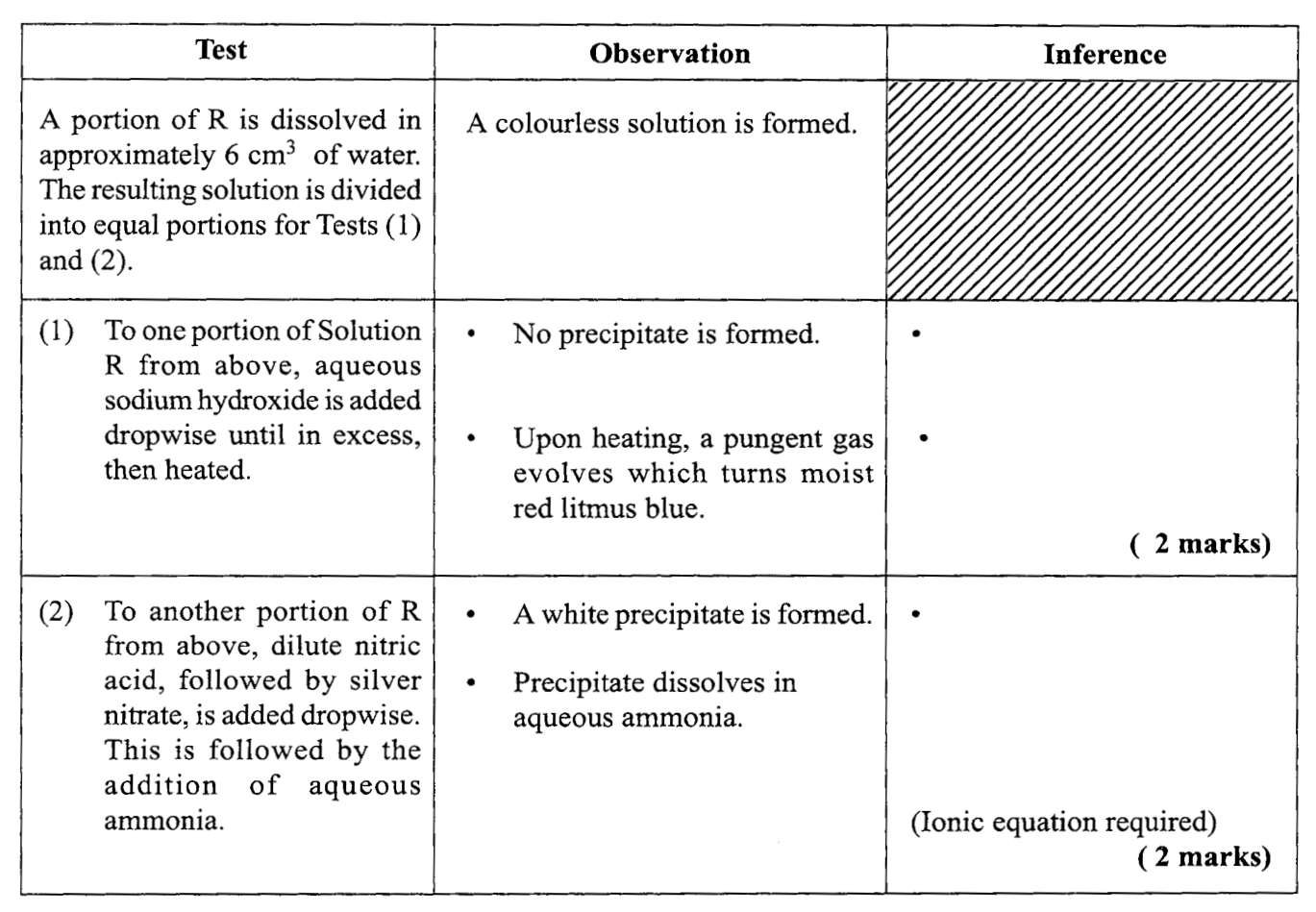
(b) A student conducts the following tests on a solid, R, and makes the observations recorded in Table 2.
(i) Complete Table 2 to show all of the possible inferences and write ionic equations where indicated. (4 marks)
TABLE 2: TESTS PERFORMED ON SOLID R
(ii) Suggest a possible identity of the solid, R: (1 mark)
< ![CDATA[(c) Sally, a cleaner, was preparing to clean Ms George's home. She usually cleans the kettle with vinegar and the tiles and toilet with muriatic acid (hydrochloric acid). However, the labels from the bottles containing the two cleaning agents were removed. Sally attempted to distinguish these two cleaning agents by smelling them. However, she was still unsure.
Plan and design an experiment that one can undertake in the laboratory to determine which bottle contains the vinegar and which contains the muriatic acid.
(i) Outline the procedure for the experiment. (2 marks) (ii) List the materials necessary. (1 mark) (iii) What evidence will result from your procedure to distinguish between the two acids? (1 mark)
< ![CDATA[
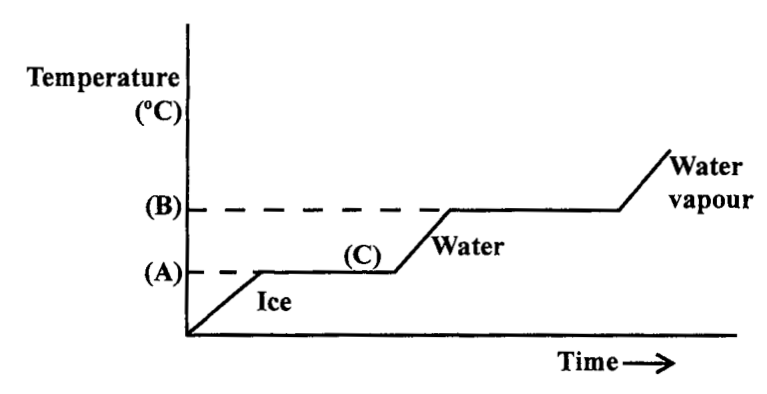
Transitions between the three states of matter can be efficiently illustrated by using water.
Consider the information given in Figure 3 and answer the questions that follow.
Figure 3. States of matter
Name the THREE states of matter.
[1 mark]
Which of the two temperatures, (A) and (B) in Figure 3 represents
melting point? boiling point?
[2 marks]
< ![CDATA[What would be observed at (C) in Figure 3?
[1 mark]
< ![CDATA[Name the process which occurs when the following conversions take place.
Water vapour water Iodine (s) iodine (g)
[2 marks]
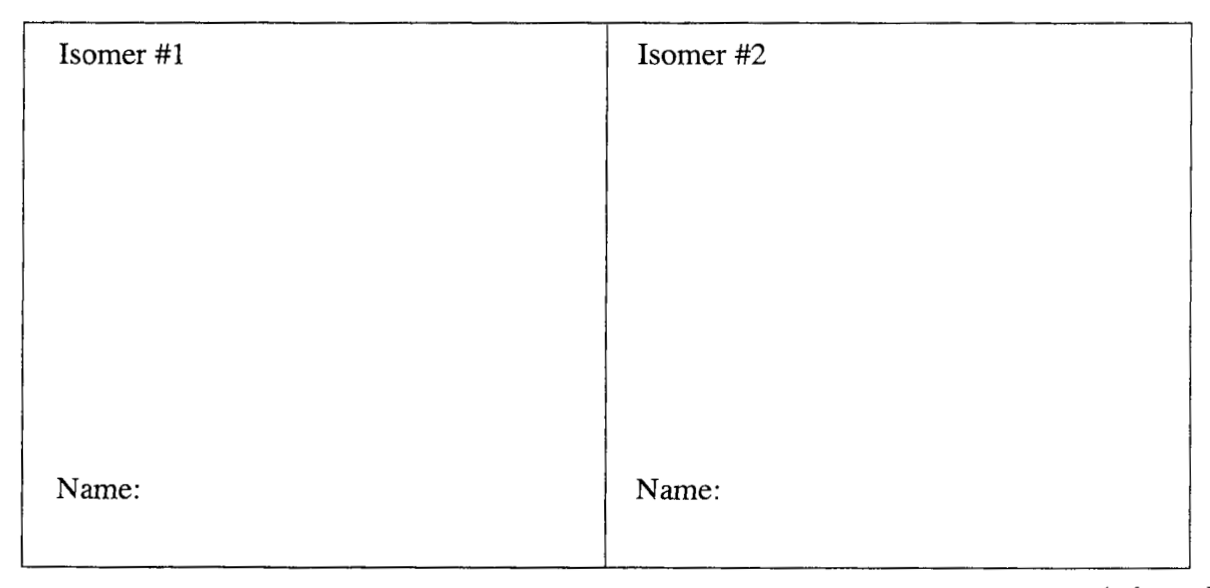
< ![CDATA[Diamond and graphite are both allotropes of carbon.
Explain what is meant by the term 'allotrope'.
[1 mark]
The first stage in the process of refining crude oil to produce more value-added products is fractional distillation.
[15 marks]
Name the property of compounds upon which fractional distillation is based.
[1 mark]
Name the lightest and heaviest fractions that are usually obtained from the fractional distillation of crude oil.
Lightest fraction: Heaviest fraction:
[2 marks]
State ONE use of EACH of the fractions named in (a) (ii) above.
Lightest fraction: Heaviest fraction:
[2 marks]
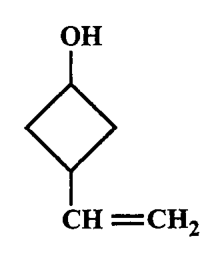
< ![CDATA[Consider the structure of Compound A below and answer the questions which follow.
Compound A
[6 marks]
Draw the structure of the product formed when Compound A reacts with EACH of the following:
Bromine (2 marks)
Sodium (2 marks)
[4 marks]
< ![CDATA[Draw the partial structure of the polymer formed when Compound A undergoes ADDITION polymerisation with other molecules of A.
Use three molecules of A in the representation of the partial polymer structure.
[2 marks]
B represents the partial structure of a polyamide.
Structure B

[4 marks]
Name the type of polymerisation process involved in the formation of B.
[1 mark]
Polyamides of the type B can undergo both acid hydrolysis in the laboratory as well as enzyme hydrolysis in the body.
a) Draw the monomer formed when B undergoes acid hydrolysis. (2 marks)
b) State ONE difference in the reaction conditions required for acid hydrolysis when compared to enzyme hydrolysis of polyamides. (1 mark)
[3 marks]
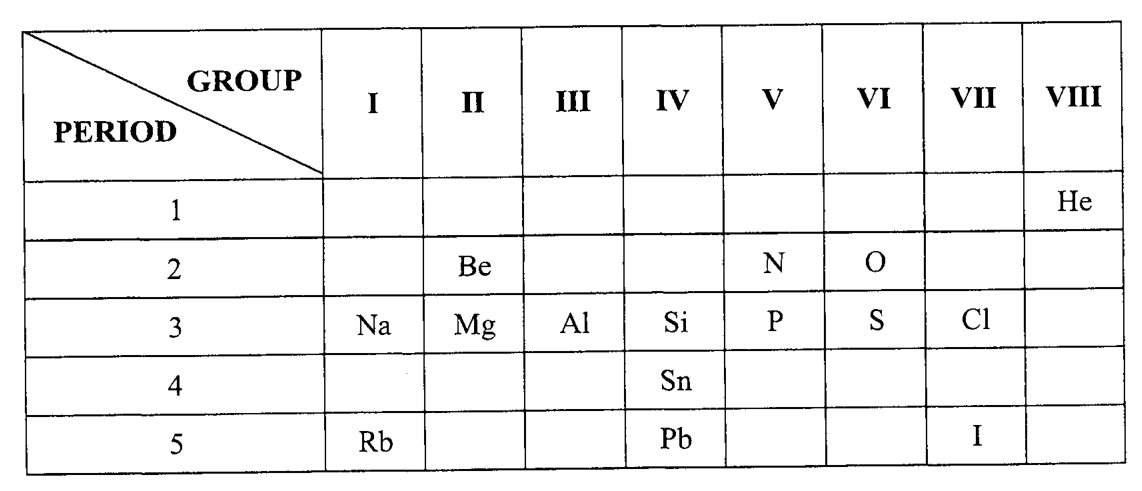
Table 3 illustrates part of the periodic table.
Write your answers in the spaces provided after EACH question in this answer booklet.
[15 marks]
State the basis upon which elements are arranged into groups and periods in the periodic table. Select an element from Table 3 and use its electronic configuration to illustrate your answer.
[4 marks]
Identify from Table 3:
[6 marks]
ONE element which can be extracted from its oxide by electrolytic reduction but NOT chemical reduction with coke. Give a reason for your answer.
[3 marks]
TWO elements, one of which will displace the other from a solution containing its ions. Write an ionic equation to illustrate your answer.
[3 marks]
Iodine and chlorine will combine to form iodine monochloride (ICl). Suggest the type of bonding which would occur in this compound. Give a reason for your answer and use dot-cross diagrams to illustrate your answer.
[5 marks]
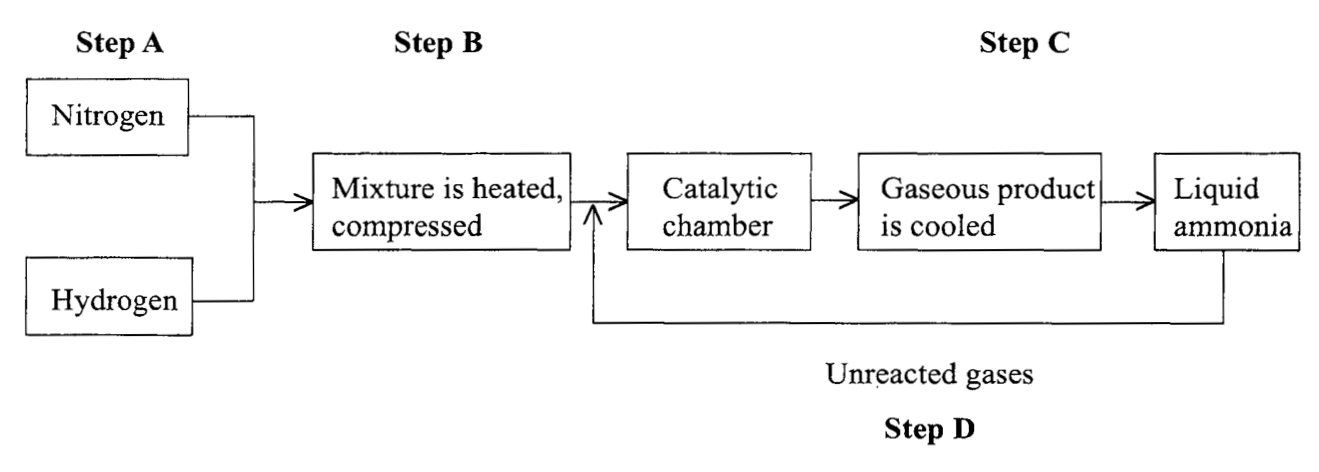
Ammonia is produced industrially by the Haber Process according to the following equation.
Figure 4 shows the steps in the Haber Process used for the industrial preparation of ammonia.
[15 marks]
Name the catalyst and state the temperature used in the manufacture of ammonia.
[2 marks]
The temperatures currently used in the manufacture of ammonia make the process cost-effective. Suggest ONE reason for this.
[2 marks]
Suggest ONE reason for the importance of Step D in Figure 4.
[1 mark]
Ammonia can also be produced in the laboratory.
[4 marks]
Write a balanced equation to show the laboratory preparation of ammonia.
[2 marks]
Describe a suitable test for identifying ammonia.
[2 marks]
Ammonia is used in the industrial preparation of nitric acid. In Step 1, ammonia is heated with oxygen in the presence of a catalyst at to produce nitrogen(II) oxide as shown in the following equation.
Write balanced equations for Steps 2 and 3 to show the production of nitric acid from ammonia.
[4 marks]
State TWO OTHER uses of ammonia.
[2 marks]
SECTION C
Answer ONE question in this section.
Write your answer in the space provided at the end of this section in this answer booklet.
[15 marks]
The properties of clay which make it suitable for pottery production are its plasticity, porosity and its ability to be vitrified.
Briefly explain what is meant by EACH of the following terms as they relate to pottery production.
[3 marks]
Suggest ONE reason why EACH of the following makes clay a suitable substance for the making of pottery.
[2 marks]
Cement is the binding agent in concrete.
Name ONE component of cement.
[1 mark]
Identify TWO OTHER ingredients used to make concrete.
[2 marks]
Maynard, a mason, cast a concrete floor for Mr. Smith. Before leaving, Maynard suggested to Mr. Smith that he should dampen the floor while it was hardening. From your knowledge of the components of cement and its use in making concrete, explain to Mr. Smith why it is necessary to dampen the concrete floor.
Suggest to Mr. Smith what may occur if he decides NOT to dampen the floor.
[4 marks]
Some of the ingredients in clays and cements are quite similar. Suggest if it would be appropriate to dampen clay while hardening. Give ONE reason for your answer.
[3 marks]
Write your answer to EITHER Question 6 OR Question 7 here.
[15 marks]
What is meant by the term 'humus' as it relates to soil?
State THREE reasons why humus is an important component of soil.
[4 marks]
A student puts a sample of soil in a test tube, adds sodium hydroxide and heats the mixture. For which ions is the student MOST likely testing?
[1 mark]
For years farmers in the Caribbean have been using chemicals to control many pests which attack agricultural produce.
Biological control, for example, the use of parasitic wasps to control the pink mealy bug, is another means of controlling pests.
Suggest ONE advantage and ONE disadvantage EACH of biological and chemical control of pests.
[4 marks]
What is meant by the term 'hydroponics'?
[2 marks]
Mrs. Wills is considering setting up a hydroponics farm. Advise Mrs. Wills on TWO advantages and TWO limitations of setting up such a farm.
[4 marks]
In Step 2, the nitrogen(II) oxide is further oxidized to form nitrogen(IV) oxide. In Step 3, nitrogen(IV) oxide reacts with oxygen and water to produce nitric acid.
[6 marks]