Free CXC Chemistry Paper 2 May/June 2015 past paper from 2015. Includes a worked answer key. Open the PDF, take a timed test, and study with AI on Caribbean AI.
Answer keys are free on Caribbean AI. View the answers to every past-paper question at no cost - no payment needed - with step-by-step worked solutions and instant AI marking available on Premium.
CSEC Chemistry Paper 2 May/June 2015 - Free CXC Past Paper with Answers
Free CXC Chemistry Paper 2 May/June 2015 past paper from 2015. Includes a worked answer key. Open the PDF, take a timed test, and study with AI on Caribbean AI.
Opening the interactive papers…
Every question from this paper as text. See the answers and worked solutions. Questions are the property of the Caribbean Examinations Council; Caribbean AI is not affiliated with CXC.
Hydrocarbons are widely used as fuels. They burn in oxygen to form carbon dioxide and water, and energy is released in the process.
List TWO natural sources of hydrocarbons.
[2 marks]
Name ONE hydrocarbon, other than wax, that can be used as fuel.
[1 mark]
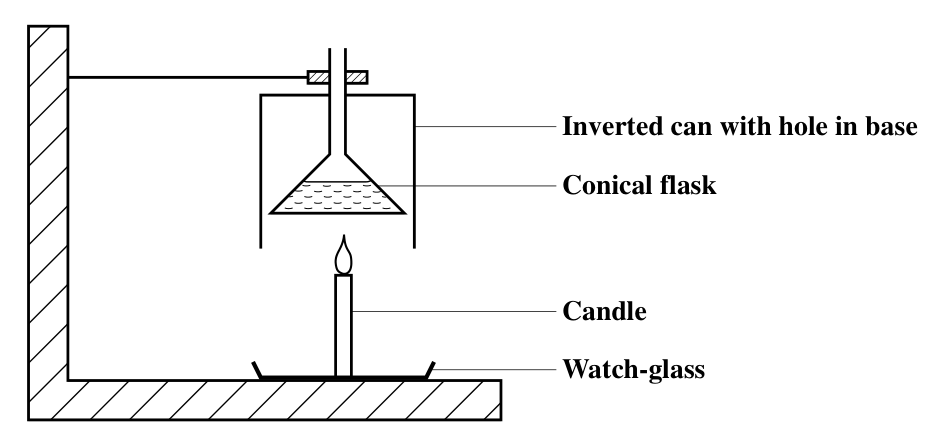
A student carried out an experiment in order to determine the heat of combustion of candle wax (a mixture of solid hydrocarbons) by using the apparatus shown in Figure 1.
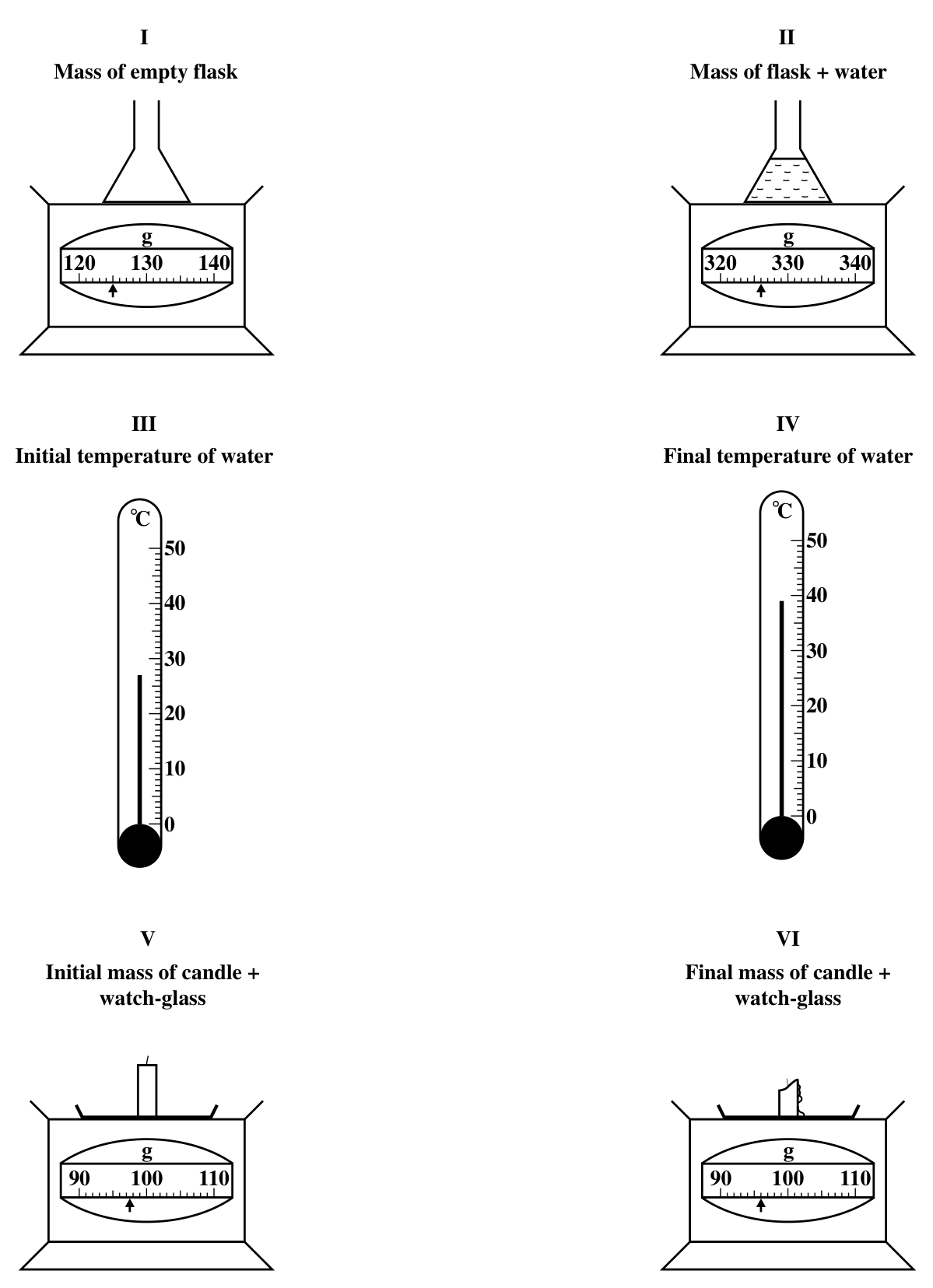
The results for the masses of the candle and water used, and the observed temperatures of the water are shown in Diagrams I–VI of Figure 2 on page 4.
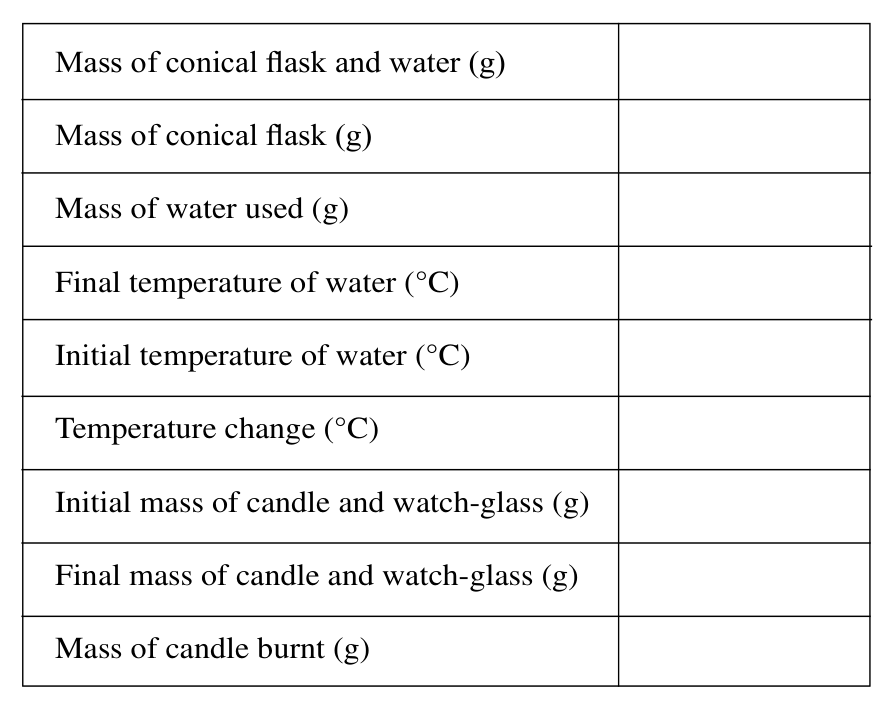
Use the readings shown in Figure 2 to complete Table 1.
| Mass of conical flask and water (g) | |
| Mass of conical flask (g) | |
| Mass of water used (g) | |
| Final temperature of water (C) | |
| Initial temperature of water (C) | |
| Temperature change (C) | |
| Initial mass of candle and watch-glass (g) | |
| Final mass of candle and watch-glass (g) | |
| Mass of candle burnt (g) |
[9 marks]
Assuming that the heat absorbed by the conical flask , calculate the heat absorbed by the conical flask used in the experiment.
Heat absorbed by conical flask: ________________________________ J
[1 mark]
Assuming that the heat absorbed by the water , calculate the heat absorbed by the water in the conical flask.
Heat absorbed by water in conical flask: ________________________________ J
[1 mark]
Calculate the TOTAL heat absorbed by the calorimeter.
Total heat absorbed by the calorimeter $= \text{________________________________ J}$
[1 mark]
Calculate the heat of combustion of the candle wax.
Heat of combustion $= \frac{(\text{total heat absorbed by the calorimeter})}{(\text{mass of candle burnt})} = \text{________________________________ J g}^{-1}$
[1 mark]
What was the role of the can in this experiment?
[1 mark]
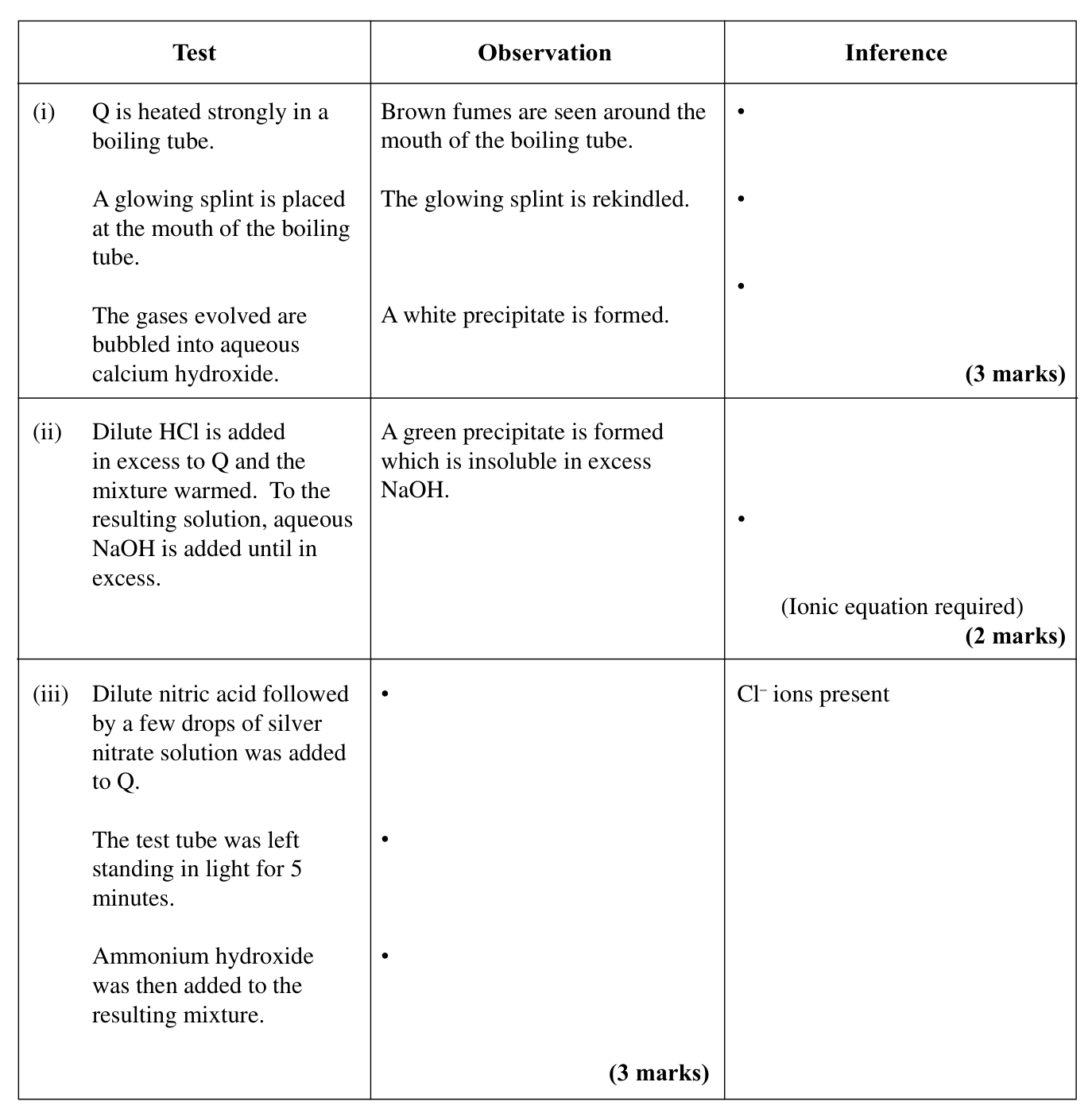
A student carried out a number of tests on a solid mixture labelled Q. Some of the observations and inferences are recorded in Table 2. Complete the table by inserting the observations or observations as necessary.
TABLE 2: OBSERVATIONS AND INFERENCES
| Test | Observation | Inference |
|---|---|---|
| (i) Q is heated strongly in a boiling tube. | Brown fumes are seen around the mouth of the boiling tube. | • |
| The gases evolved are bubbled into aqueous calcium hydroxide. | The glowing splint is rekindled. | |
| A white precipitate is formed. | ||
| (ii) Dilute HCl is added in excess to Q and the mixture warmed. To the resulting solution, aqueous NaOH is added until in excess. | A green precipitate is formed which is insoluble in excess NaOH. | • |
| (iii) Dilute nitric acid followed by a few drops of silver nitrate solution was added to Q. | • | Cl ions present |
| The test tube was left standing in light for 5 minutes. | • | |
| Ammonium hydroxide was then added to the resulting mixture. | • |
[25 marks]
Use the readings shown in Figure 2 to complete Table 1.
[9 marks]
Dilute HCl is added in excess to Q and the mixture warmed. To the resulting solution, aqueous NaOH is added until in excess.
| Test | Observation | Inference |
|---|---|---|
| A green precipitate is formed which is insoluble in excess NaOH. |
(Ionic equation required)
[2 marks]
Complete the table by inserting the observations or inferences as necessary.
| Test | Observation | Inference |
|---|---|---|
| Dilute nitric acid followed by a few drops of silver nitrate solution was added to Q. | Cl ions present | |
| The test tube was left standing in light for 5 minutes. | ||
| Ammonium hydroxide was then added to the resulting mixture. |
[3 marks]
Water exists in three states of matter while iodine exists in two.
List the THREE states of matter in which water exists.
[1 mark]
List the THREE states of matter in which water exists.
[1 mark]
Describe the strength of the forces of attraction present between the particles in EACH of the three states you have mentioned in (a) (i) above.
[3 marks]
When heated, iodine changes from one state into another. What is this process called?
[1 mark]
Describe how the energy of the iodine particles changes as iodine undergoes the process mentioned in (a) (iii) above.
[2 marks]
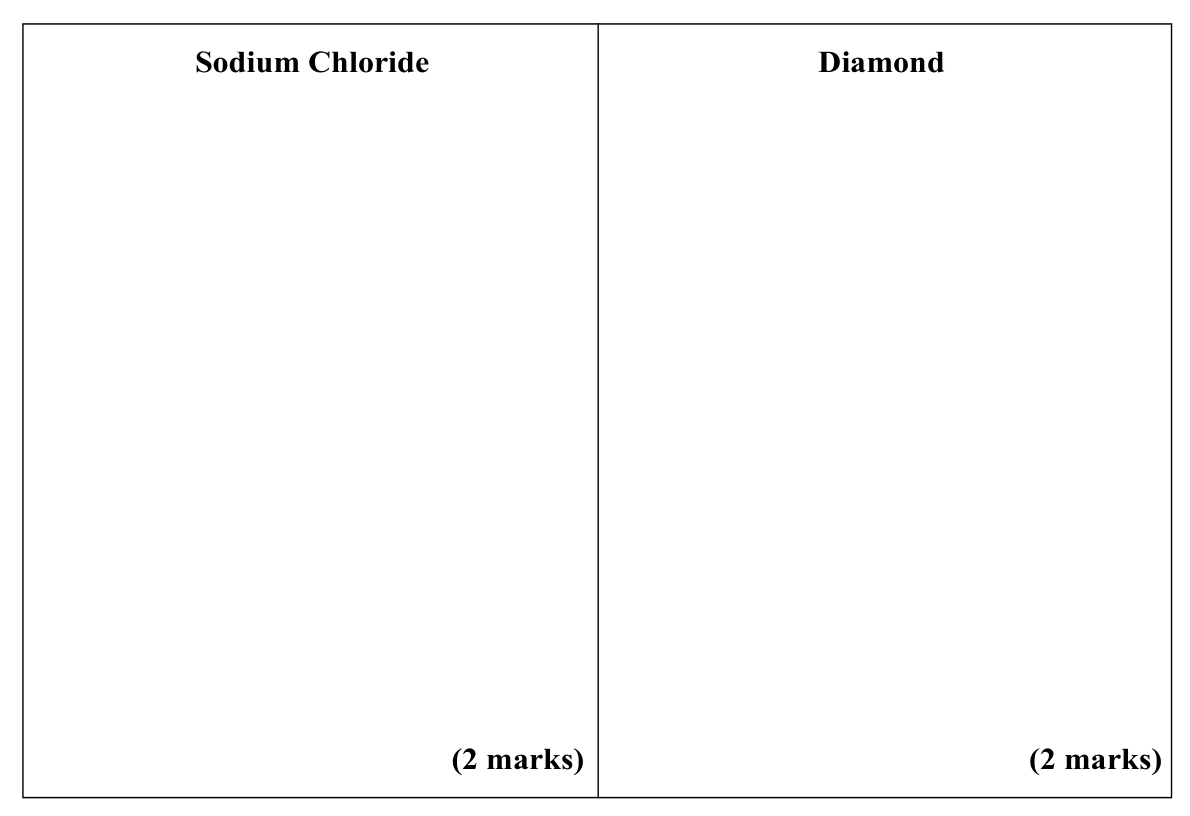
Using appropriate diagrams, illustrate how the bonding in solid sodium chloride differs from that of diamond.
[4 marks]
Describe TWO tests that are performed in the laboratory to distinguish between an 'ionic solid' and a 'molecular solid'. Suggest how the results of the tests described can be used to distinguish between the two solids.
[4 marks]
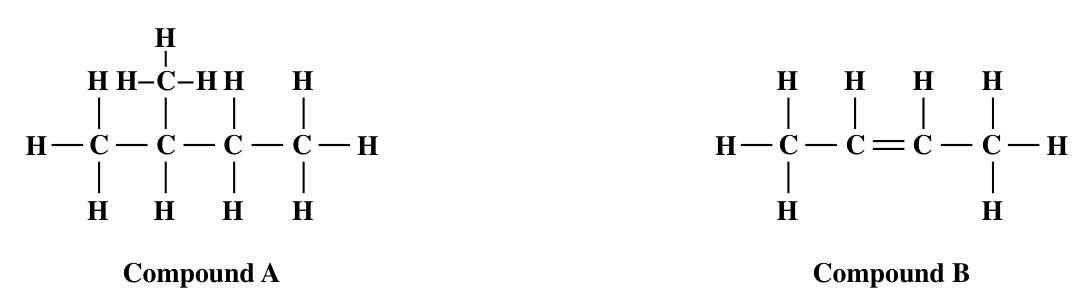
The fully displayed structures for two hydrocarbons, Compound A and Compound B, are shown below.
H H H H
| | | |
H --- C - C - C - C --- H
| | | |
H H H H
Compound A
H H H H
| | | |
H --- C = C - C - C --- H
| | |
H H H
Compound B
[15 marks]
The fully displayed structures for two hydrocarbons, Compound A and Compound B, are shown below.
H
|
H-C-C-H
| | |
H H H H
Compound A
H H H H
| | | |
H-C-C=C-C-H
| |
H H
Compound B
Name the homologous series to which Compounds A and B belong.
Compound A: Compound B:
[2 marks]
State the name of EACH compound.
Compound A: Compound B:
[2 marks]
Define 'structural isomerism'.
[2 marks]
Draw the FULLY DISPLAYED structure of ONE structural isomer for EACH of Compounds A and B.
[4 marks]
Polythene is manufactured in Trinidad and is used extensively throughout the Caribbean.
[7 marks]
Define the term 'polymer'.
[1 mark]
Identify the type of polymerization that is used in the manufacture of polythene.
[1 mark]
State TWO uses of polythene.
[2 marks]
State the name of ONE other polymer.
[1 mark]
SECTION B
Answer ALL questions in this section.
Write your responses in the spaces provided in this booklet.
[15 marks]
Tums® and Epsom salts are items commonly found in most household medicine cabinets. Calcium carbonate is the main active ingredient in Tums®, an antacid used to relieve heartburn, acid indigestion and upset stomach.
Describe ONE method for the preparation of dry calcium carbonate in the laboratory. In your answer, include an equation for the reaction as well as the steps that are involved in its preparation.
[5 marks]
The main ingredient in Epsom salts is magnesium sulfate. List ONE use of Epsom salts.
[1 mark]
In order to effectively use Epsom salts, it is usually made into a solution. Explain why water molecules are able to dissolve Epsom salts.
[3 marks]
When magnesium ions are present in natural water, it is referred to as 'permanent hard water'.
Describe how permanent hard water is formed. Include balanced chemical equations with state symbols to illustrate this process.
[6 marks]
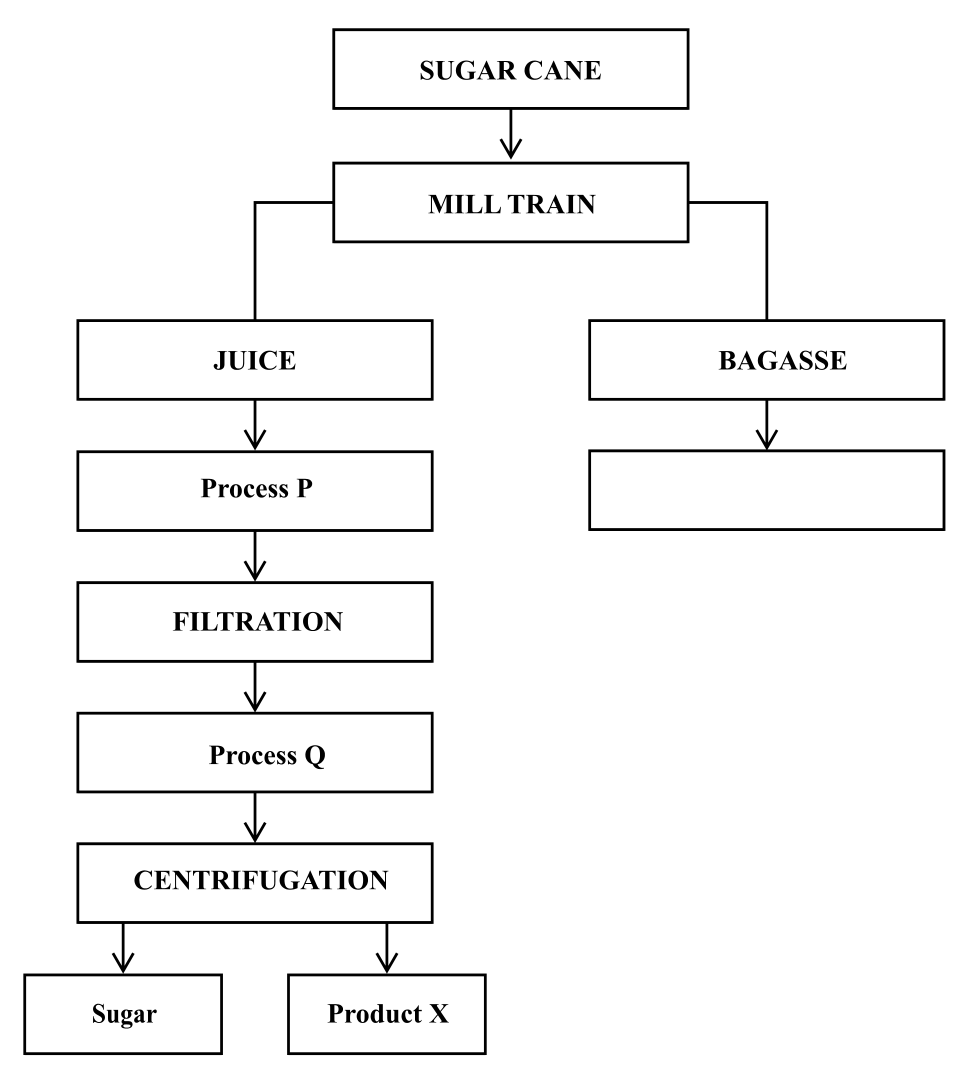
Figure 3 is a flow diagram of the industrial processing of sugar cane to produce crystalline sucrose. Study the figure carefully and answer the questions which follow.
SUGAR CANE
|
v
MILL TRAIN
/ \
v v
JUICE BAGASSE
|
v
Process P
|
v
FILTRATION
|
v
Process Q
|
v
CENTRIFUGATION
/ \
v v
Sugar Product X
[2 marks]
Figure 3 is a flow diagram of the industrial processing of sugar cane to produce crystalline sucrose. Study the figure carefully and answer the questions which follow.
Identify Process P and Process Q.
Process P: Process Q:
[2 marks]
State the importance of the centrifugation process.
[1 mark]
Identify Product X.
[1 mark]
The bagasse produced is used in the factory during the processing of sugar cane. In which part of the factory is this bagasse used and what is it used for?
[2 marks]
Many Caribbean islands are renowned for the quality of rum they produce. The alcohol content of a typical rum averages between 40% and 55%.
During the fermentation process in the making of rum, yeast feeds on the sucrose in molasses converting it into simpler sugars which are then converted to ethanol. Outline, using balanced equations, the formation of ethanol from sucrose.
[3 marks]
Jemina was presented with a flask that contains a mixture of diluted rum. Draw a labelled diagram of the apparatus she should use in the laboratory to obtain a concentrated sample of ethanol.
Space for diagram
[3 marks]
After accidentally leaving a bottle of wine open for several days, Jemina found that the wine tasted slightly sour. She was given magnesium oxide to react with a sample of the sour wine.
Suggest the type of reaction that takes place when the magnesium oxide is mixed with the sour wine. Write a balanced chemical equation for this reaction.
[3 marks]
Sally and Ann live on opposite sides of an island. When Sally visits Ann she observes that the soap takes longer to lather and produces more scum.
Explain to Sally why the soap may be producing more scum at Ann's house than at her house.
[4 marks]
Do you expect that Sally would get the same result if she uses soapless detergent? State a reason for your answer.
[2 marks]
Second generation detergents contained phosphates but their use was banned because of the effect they had on the environment, particularly rivers and streams. Outline the harmful effect that second generation detergents had on the environment.
[3 marks]
In recent years, emphasis has been placed on preserving the environment and as such a new area of chemistry, Green Chemistry, has evolved.
What is meant by the term 'Green Chemistry'?
[2 marks]
Discuss TWO benefits of utilizing the principles involved in Green Chemistry.
[4 marks]