Free CXC Chemistry Paper 2 January 2019 past paper from 2019. Includes a worked answer key. Open the PDF, take a timed test, and study with AI on Caribbean AI.
Answer keys are free on Caribbean AI. View the answers to every past-paper question at no cost - no payment needed - with step-by-step worked solutions and instant AI marking available on Premium.
CSEC Chemistry Paper 2 January 2019 - Free CXC Past Paper with Answers
Free CXC Chemistry Paper 2 January 2019 past paper from 2019. Includes a worked answer key. Open the PDF, take a timed test, and study with AI on Caribbean AI.
Opening the interactive papers…
Every question from this paper as text. See the answers and worked solutions. Questions are the property of the Caribbean Examinations Council; Caribbean AI is not affiliated with CXC.
An experiment was carried out to determine the percentage of iron in an iron salt sample. A 0.500 g sample of iron salt was placed in a conical flask. To it, 25.0 mL of dilute sulfuric acid, 10 mL of phosphoric acid and 8 drops of an indicator were added. The contents of the flask were mixed and titrated against a 0.020 mol solution of potassium dichromate until the end point was reached. The ionic equation for the reaction is given below.
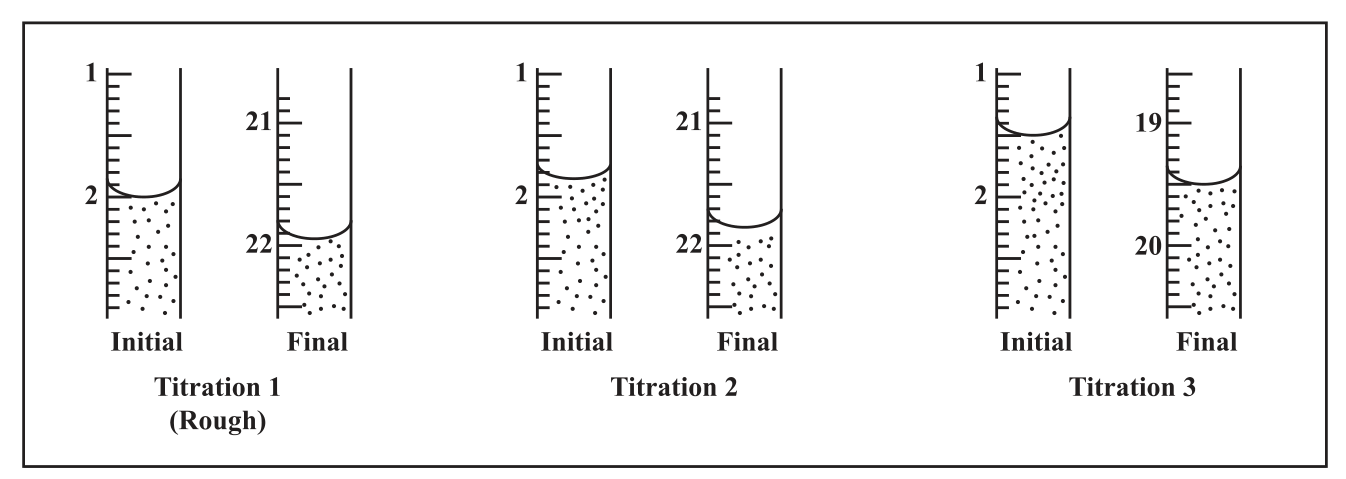
Figure 1 shows the burette readings of the initial and final volumes of EACH titration.
[25 marks]
List the apparatus that would be necessary to carry out the experiment.
[2 marks]
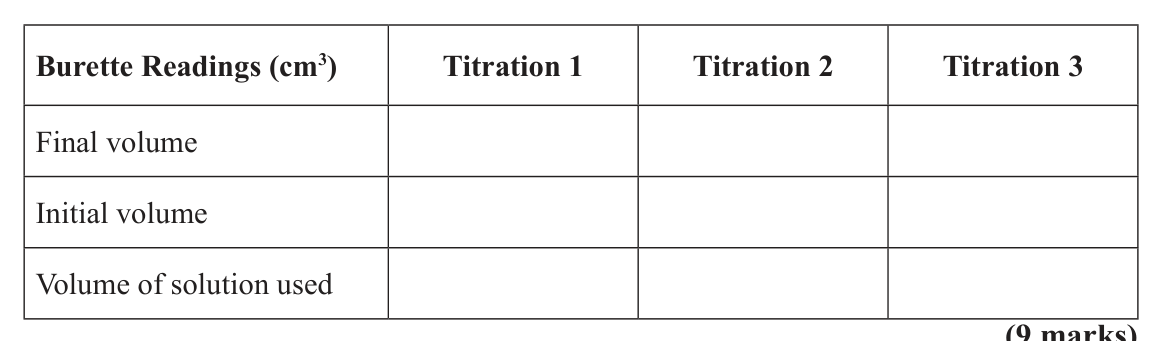
Use the information in Figure 1 to complete Table 1.
| Burette Readings () | Titration 1 | Titration 2 | Titration 3 |
|---|---|---|---|
| Final volume | |||
| Initial volume | |||
| Volume of solution used |
[9 marks]
Use an asterisk (*) to indicate the titration data that should be used to obtain the average titration volume of potassium dichromate used in the experiment.
[1 mark]
Hence, calculate the average volume of potassium dichromate used in the experiment and record the value to two decimal places.
[2 marks]
Using the information from (c) (ii), calculate the average number of moles of potassium dichromate used in the experiment.
[1 mark]
From the equation given on page 4, determine the number of moles of iron ions () that react with 1 mole of dichromate ions ().
[1 mark]
Calculate the number of moles of iron in the iron salt sample.
[1 mark]
Calculate the mass of iron in the iron salt sample. [Molar mass of Fe is 55.8 g ]
[1 mark]
Calculate the percentage of iron in the iron salt sample.
[1 mark]
The reaction between iron and dichromate is considered a reduction-oxidation reaction. Define the term 'reduction' in terms of electrons.
[1 mark]
In the reaction, acts as a reducing agent. Define the term 'reducing agent'.
[2 marks]
Calculate the oxidation state of Cr in .
[2 marks]
State ONE precaution that should be taken when carrying out the experiment.
[1 mark]
Jamelia is in her room studying and smells the scent of curry coming from her mom's cooking in the kitchen area. She thinks to herself, "Ah! Diffusion at work!"
(a) (i) Define the term 'diffusion'.
(ii) Explain how the diffusion of the scent of the curry supports the particulate theory of matter.
(iii) Diffusion is a process that can also occur in liquids. State how the arrangement of particles in a liquid differs from that in a solid and a gas.
(iv) Apart from diffusion, identify ONE process that supports the particulate theory of matter and state ONE example of such a process.
[9 marks]
Jamelia’s mom showed her that in order to cook with curry she first had to mix the curry powder with water. Jamelia observed that the mixture resembled a chalk and water mixture she had seen in class, except the curry mixture was brown in colour.
[8 marks]
State whether the mixture of curry powder and water is a suspension or colloid.
[1 mark]
State the MOST appropriate technique that could be used in a school laboratory to separate this mixture.
[1 mark]
Draw a clearly labelled diagram of the apparatus that could be set up in the school laboratory to separate the mixture of curry powder and water. In your diagram, show the location of the separated components.

[4 marks]
Compound A is a straight-chain hydrocarbon with the molecular formula .
[5 marks]
State ONE natural source of hydrocarbons and TWO possible uses of Compound A.
Source Uses
[3 marks]
Draw the FULLY DISPLAYED structure of Compound A.
Structure of Compound A
[2 marks]
Thermal and catalytic cracking are very useful processes in the petrochemical industry.
Define the term 'catalytic cracking'.
[2 marks]
State the importance of catalytic cracking in petroleum refineries.
[1 mark]
Another hydrocarbon, Compound B with the formula , can be converted to Compound A in a simple one-step reaction.
Draw a possible FULLY DISPLAYED structural formula of Compound B. Structure of Compound B

[2 marks]
State ONE physical property common to both Compound A and Compound B.
[1 mark]
Compound A and Compound B can be distinguished by reacting them with bromine solution in the dark.
State which of the two compounds, A or B, reacts with bromine.
[1 mark]
State the colour change that is observed when the reaction occurs.
[1 mark]
Write a balanced chemical equation for the reaction.
[2 marks]
SECTION B Answer ALL questions in this section.
[15 marks]
Define EACH of the following terms:
[2 marks]
Atomic number
[1 mark]
Mass number
[1 mark]
Sodium is a metal with an atomic number of 11 and mass number of 23.
[5 marks]
Draw a diagram to show the arrangement of electrons in a sodium atom.

[2 marks]
State the period to which the element sodium belongs in the periodic table.
[1 mark]
Describe the type of bonding in sodium metal.
[2 marks]
Sodium chloride is a typical salt of sodium metal. A concentrated sodium chloride solution (brine) can undergo electrolysis when it is used as an electrolyte in an electrolytic cell using inert electrodes.
[8 marks]
Define the term 'electrolysis'.
[2 marks]
Write the half equations, including state symbols, for the reaction that occurs at the anode and cathode during the electrolysis of concentrated sodium chloride solution (brine).
Anode Cathode
[6 marks]
Compound D, , has a very unpleasant smell and bitter taste.
Name the homologous series to which Compound D belongs.
[1 mark]
Draw the FULLY DISPLAYED structural formula of Compound D and write its name.
Structure of Compound D Name of Compound D

[2 marks]
Compound D reacts with ethanol to form the sweet-smelling Compound E.
Write a balanced chemical equation for the reaction between Compound D and ethanol to form Compound E.
[2 marks]
Suggest the conditions for the reaction between Compound D and ethanol.
[2 marks]
State the type of reaction that occurs between Compound D and ethanol.
[1 mark]
Compound D reacts with sodium metal to produce a salt of Compound D and a gas.
Write a balanced chemical equation for the reaction between Compound D and sodium metal.
[2 marks]
Describe ONE test that could be used to identify the gas.
[2 marks]
State whether the salt formed will be soluble in water, giving a reason for your answer.
[2 marks]
Carbon is found in the form of diamond and graphite and is a main component in many naturally occurring compounds such as organic matter and carbon dioxide gas.
[3 marks]
State ONE way in which diamond differs physically from graphite.
[2 marks]
State ONE similarity between diamond and graphite other than they both contain carbon.
[1 mark]
Carbon can react with a limited supply of oxygen to form carbon monoxide, which can negatively affect human health.
[5 marks]
Write a balanced chemical equation, including state symbols, to show the formation of carbon monoxide.
[3 marks]
State TWO effects of carbon monoxide inhalation on the human body.
[2 marks]
Jamal wants to prepare and collect a sample of carbon dioxide gas in the laboratory using calcium carbonate.
[7 marks]
Write a balanced chemical equation, including state symbols, for the laboratory preparation of carbon dioxide gas from calcium carbonate.
[3 marks]
Draw a clearly labelled diagram to show the arrangement of the apparatus and materials that could be used in the laboratory to prepare and collect the carbon dioxide gas.

[3 marks]
State ONE use of carbon dioxide as it relates to the beverage industry.
[1 mark]