Free CXC Chemistry Paper 2 January 2024 past paper from 2024. Includes a worked answer key. Open the PDF, take a timed test, and study with AI on Caribbean AI.
Answer keys are free on Caribbean AI. View the answers to every past-paper question at no cost - no payment needed - with step-by-step worked solutions and instant AI marking available on Premium.
CSEC Chemistry Paper 2 January 2024 - Free CXC Past Paper with Answers
Free CXC Chemistry Paper 2 January 2024 past paper from 2024. Includes a worked answer key. Open the PDF, take a timed test, and study with AI on Caribbean AI.
Opening the interactive papers…
Every question from this paper as text. See the answers and worked solutions. Questions are the property of the Caribbean Examinations Council; Caribbean AI is not affiliated with CXC.
"It is known that potassium nitrate is soluble in water but not soluble in pentane."
Explain why the statement above is true.
[3 marks]
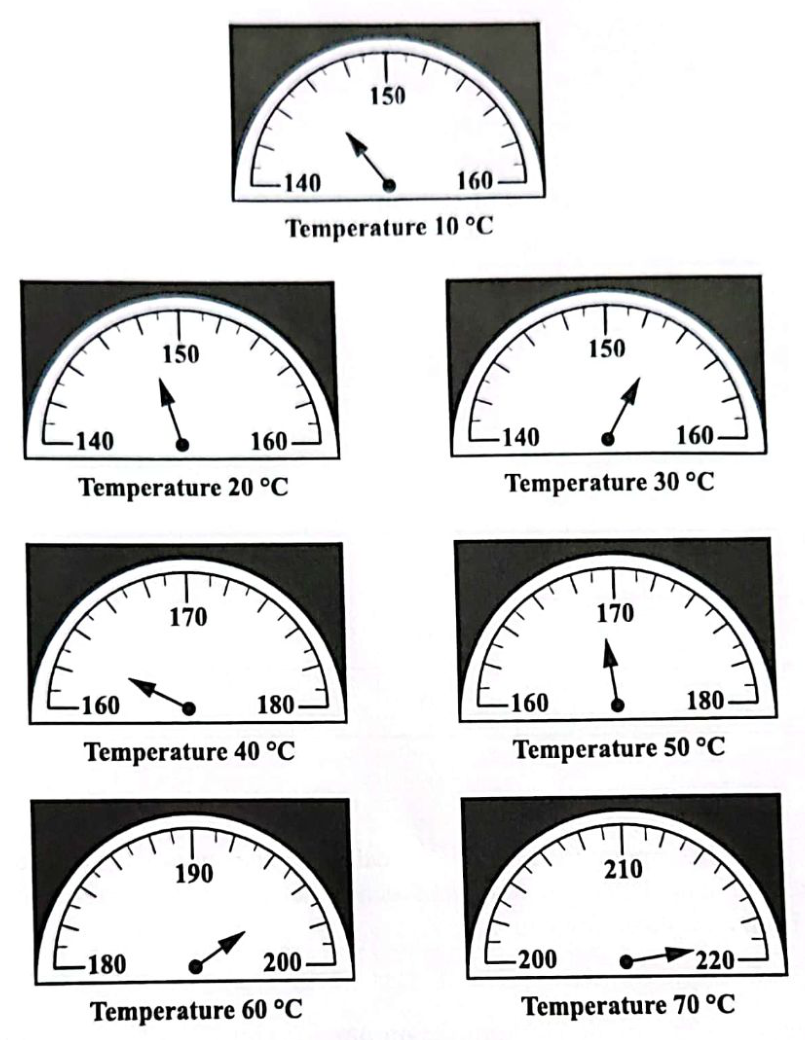
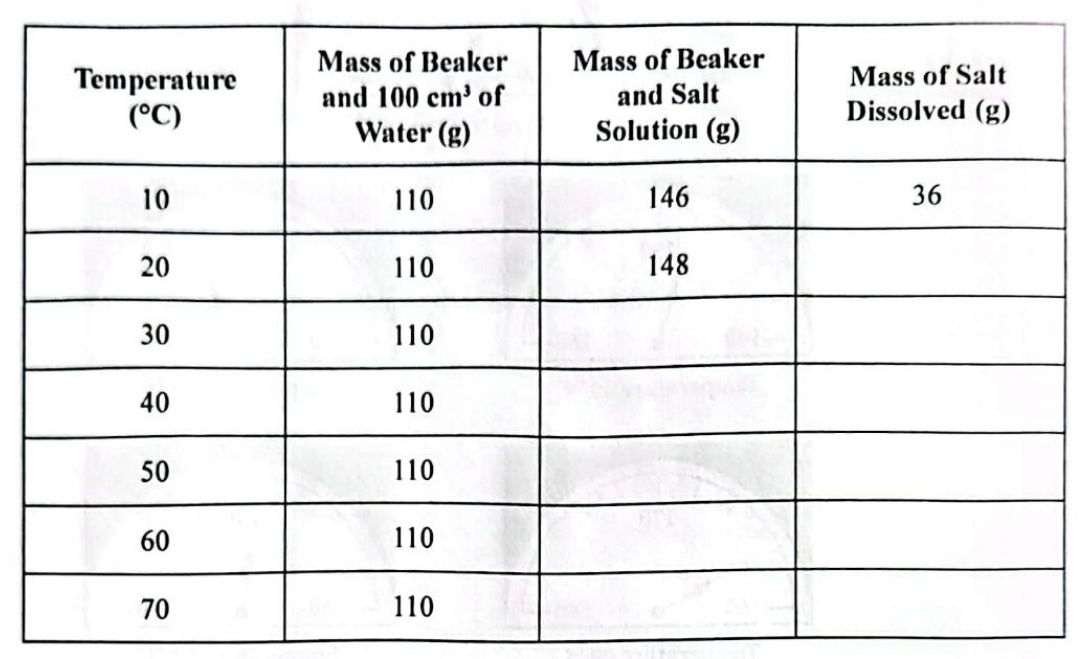
For EACH temperature shown in Figure 1 on page 3, record, in Table 1, the corresponding mass of the beaker and the salt solution.
| Temperature (C) | Mass of Beaker and 100 of Water (g) |
|---|
| Mass of Beaker and Salt Solution (g) |
|---|
| Mass of Salt Dissolved (g) |
|---|
| 10 | 110 | 146 | 36 |
| 20 | 110 | 148 | |
| 30 | 110 | ||
| 40 | 110 | ||
| 50 | 110 | ||
| 60 | 110 | ||
| 70 | 110 |
[5 marks]
For EACH temperature in Table 1, calculate the mass of potassium nitrate that was dissolved in the beaker of water and record the value in the space provided. The first one has been completed for you.
[3 marks]
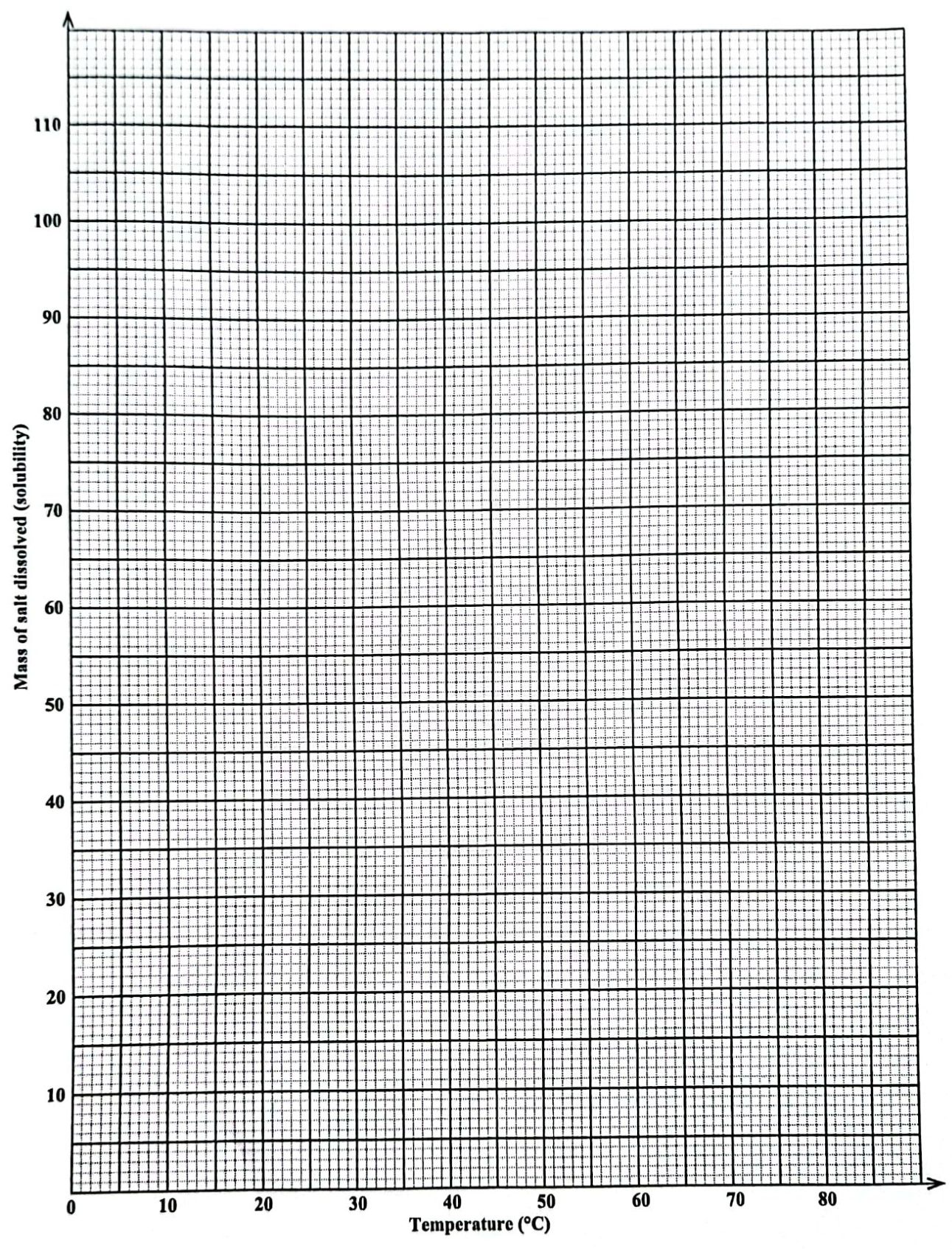
Using the axes provided in Figure 2 on page 7, plot a graph of the mass of salt dissolved (solubility) against temperature and draw a smooth curve.
[5 marks]
Using your graph, describe how the solubility of potassium nitrate varies with temperature.
[2 marks]
determine the solubility (in grams per 100 ) of potassium nitrate at 65 C.
[2 marks]
Using your answer in (e) (ii), calculate the mass of potassium nitrate that will be precipitated out from the solution, if the solution is then cooled down to 35 C.
[4 marks]
Calculate the concentration (mol dm) of a saturated solution of potassium nitrate at C (RAM: K = 39, N = 14, O = 16).
[4 marks]
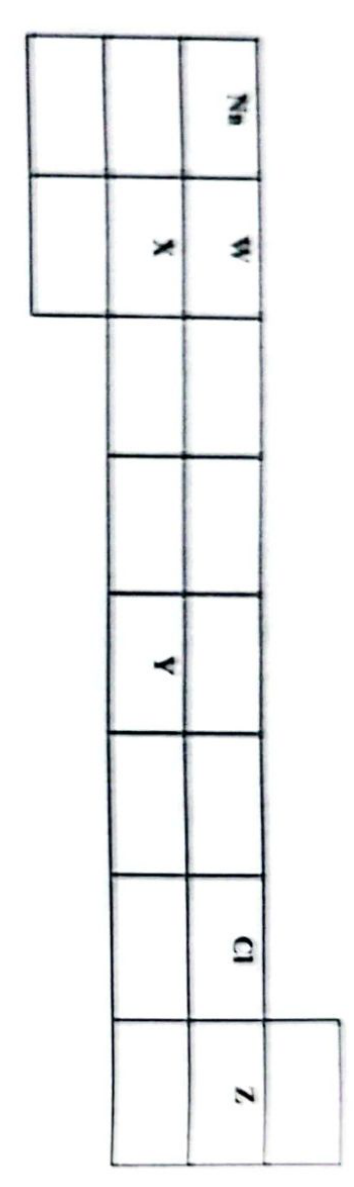
W, X, Y and Z are four elements found in the periodic table. Their positions in the periodic table in relation to the elements sodium (Na) and chlorine (Cl) are shown in Figure 3.
[25 marks]
State how the elements in the periodic table are arranged.
[1 mark]
Using the elements W, X, Y and Z from Figure 3 above,
[2 marks]
state the pair of elements found in the same period.
[1 mark]
identify the elements in Group 2.
[1 mark]
state which element in Group 2 is more reactive.
[1 mark]
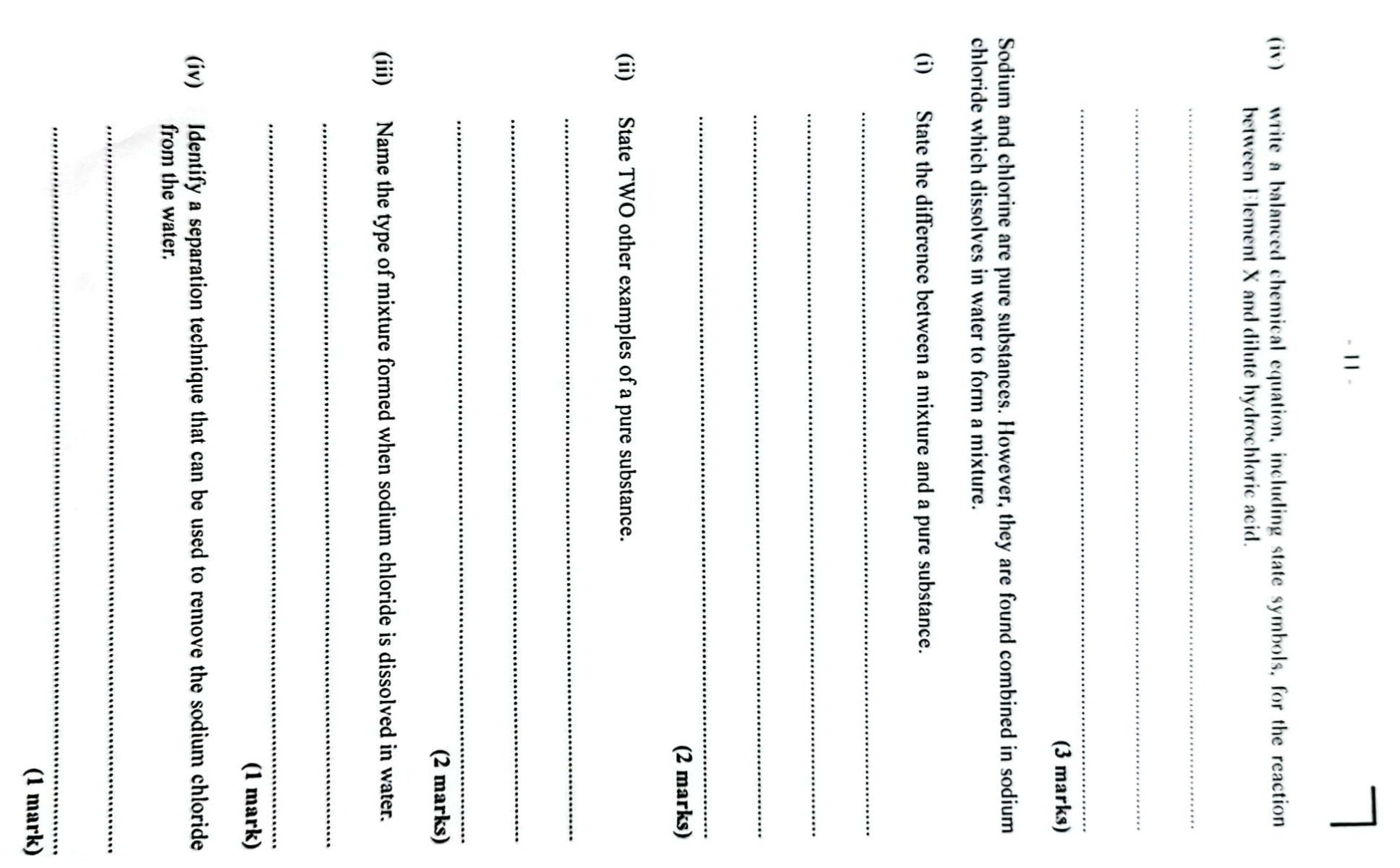
Sodium and chlorine are pure substances. However, they are found combined in sodium chloride which dissolves in water to form a mixture.
[10 marks]
State the difference between a mixture and a pure substance.
[3 marks]
State TWO other examples of a pure substance.
[2 marks]
Name the type of mixture formed when sodium chloride is dissolved in water.
[2 marks]
Identify a separation technique that can be used to remove the sodium chloride from the water.
[4 marks]
Write a balanced chemical equation, including state symbols, for the reaction between Element X and dilute hydrochloric acid.
[4 marks]
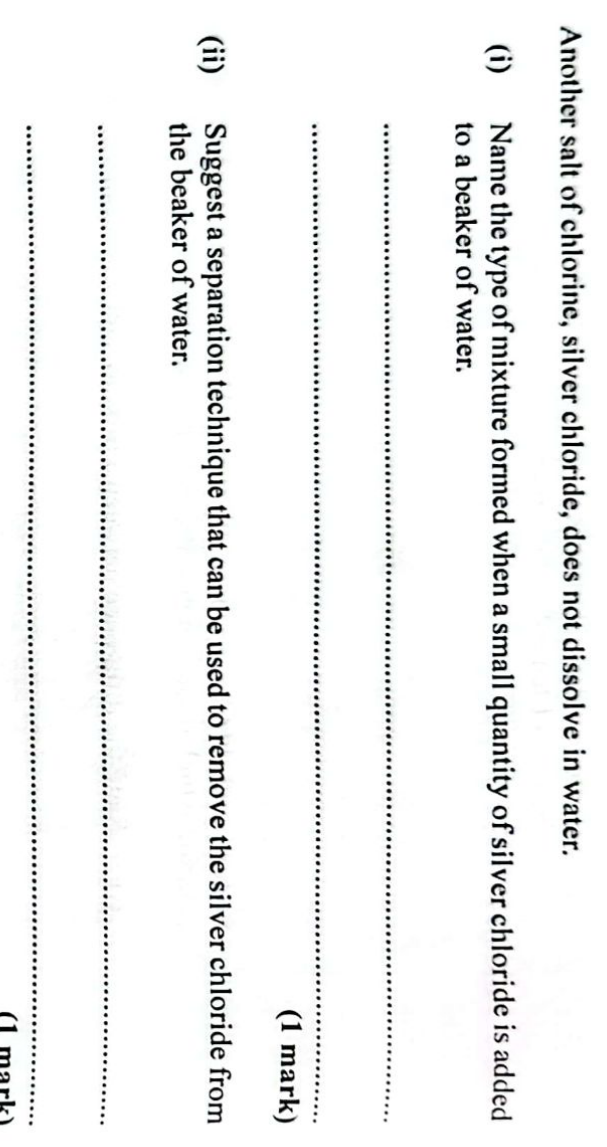
Another salt of chlorine, silver chloride, does not dissolve in water.
Name the type of mixture formed when a small quantity of silver chloride is added to a beaker of water.
[1 mark]
Suggest a separation technique that can be used to remove the silver chloride from the beaker of water.
[1 mark]
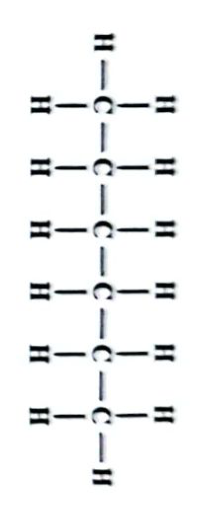
Figure 4 shows Compound A, a hydrocarbon which is often produced from the cracking of petroleum fractions obtained through the distillation of crude oil.
[10 marks]
Define the term 'cracking'.
[2 marks]
State ONE type of cracking that can be used to make hydrocarbons.
[2 marks]
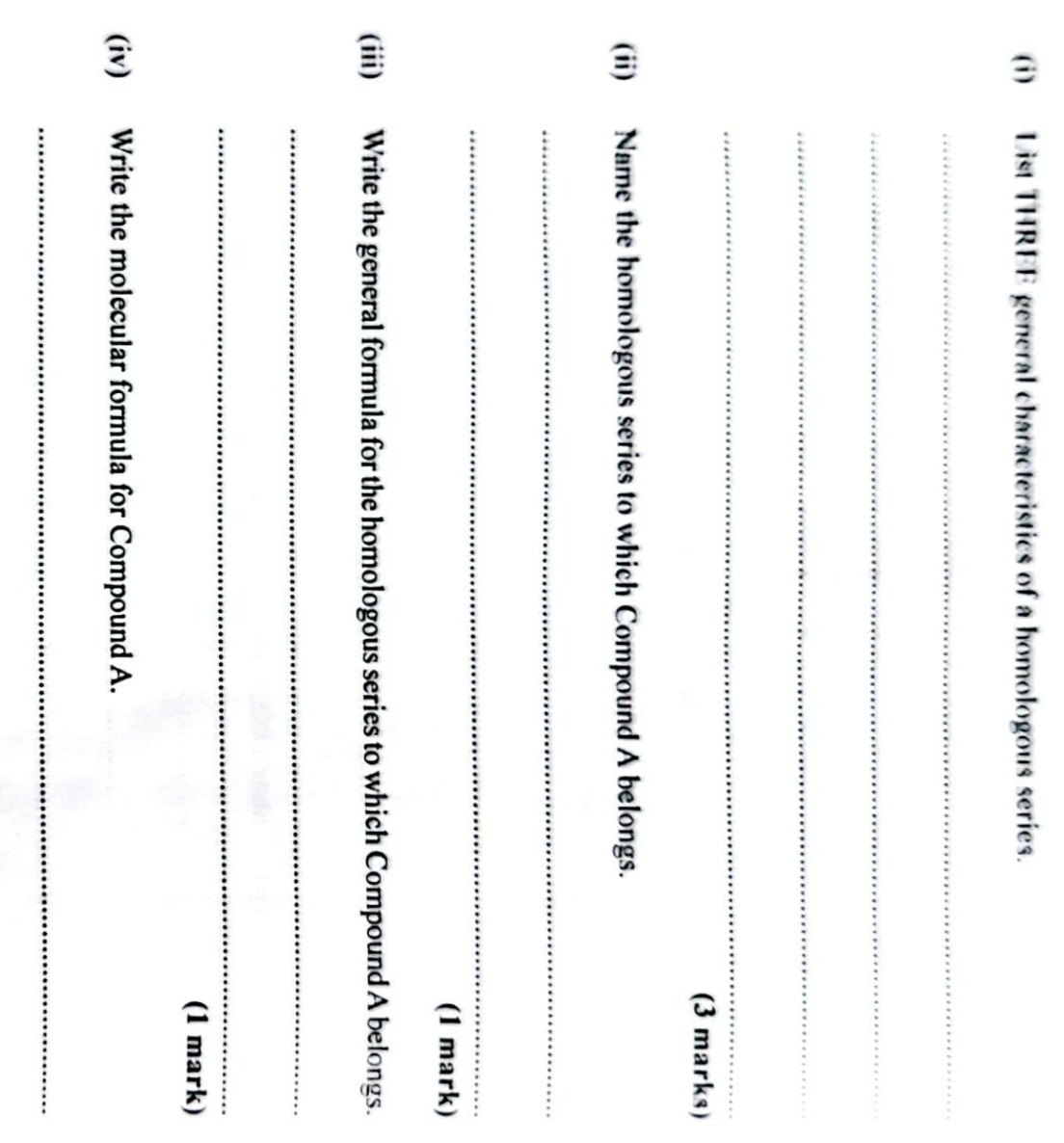
List THREE general characteristics of a homologous series.
[3 marks]
Name the homologous series to which Compound A belongs.
[1 mark]
Write the general formula for the homologous series to which Compound A belongs.
[1 mark]
Write the molecular formula for Compound A.
[1 mark]
In the space provided below, draw the FULLY displayed structure of TWO structural isomers of Compound A.
[4 marks]
State the names of the TWO isomers drawn in (c) (i). Name of Isomer 1 Name of Isomer 2
[1 mark]
SECTION B Answer ALL questions.
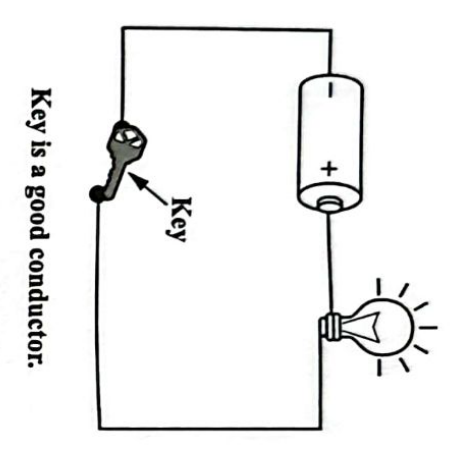
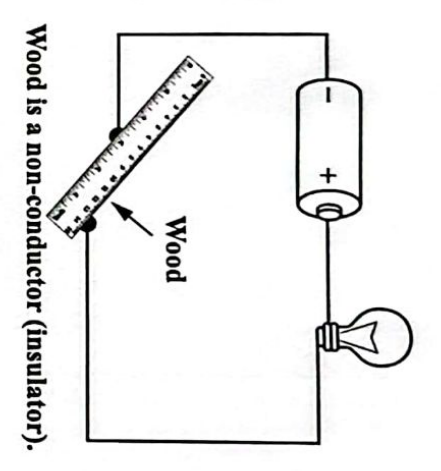
Figure 5 are circuit diagrams which shows the apparatus that was used to conduct an investigation to determine which materials are conductors or non-conductors (insulators) of electricity.
[10 marks]
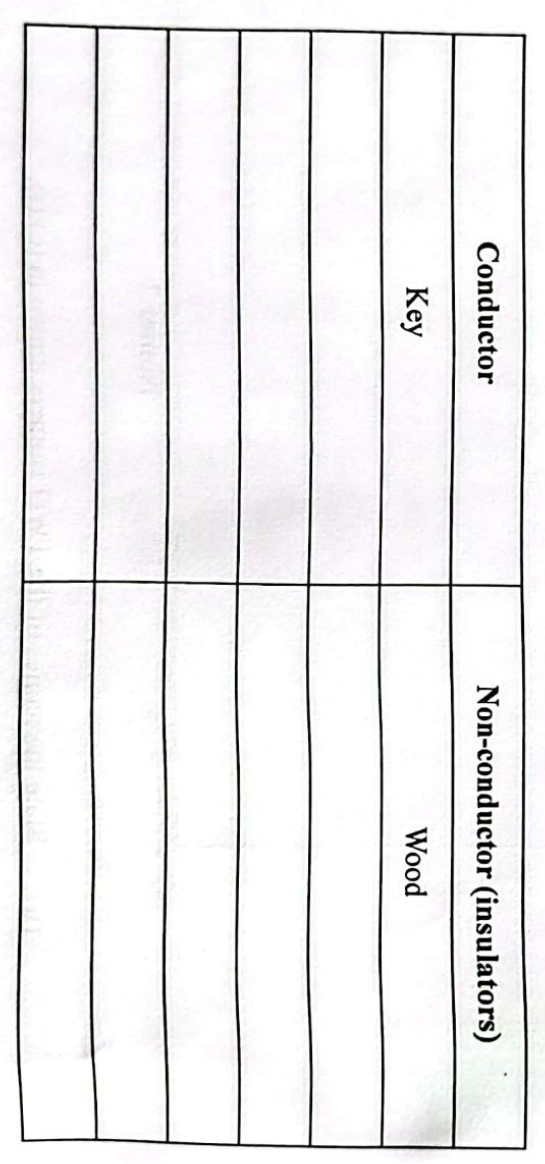
The following materials were tested: copper coil, plastic, glass, aluminium can. Complete the table below by classifying the materials as conductors or non-conductors (insulators). An example has been completed.
| Conductor | Non-conductor (insulators) | |
|---|---|---|
| Key | ||
| Wood |
[2 marks]
Figure 6 shows an electrolytic cell which is used to test a dilute aqueous solution of sodium chloride.
[6 marks]
State ONE way in which the conduction of electricity in the solution of sodium chloride is different from that in the copper coils.
[2 marks]
State which electrode in Figure 6 is the cathode and which electrode is the anode. Cathode Anode
[2 marks]
Write balanced half-equations to show the substances produced at the cathode and the anode. Cathode Anode
[2 marks]
Calculate the volume of hydrogen produced (measured at room temperature and pressure – rtp) during the electrolysis of dilute aqueous sodium chloride if a current of flows for . [ and the molar volume of a gas at rtp ]
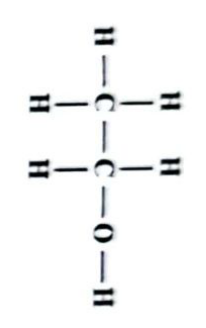
Figure 7 shows the fully displayed structures of Compound B and Compound C, which are from different homologous series.
[10 marks]
State the name of Compound B and Compound C. Compound B Compound C
[2 marks]
State the functional group present in Compound B.
[2 marks]
Which of the two compounds, B or C, is more soluble in water?
[1 mark]
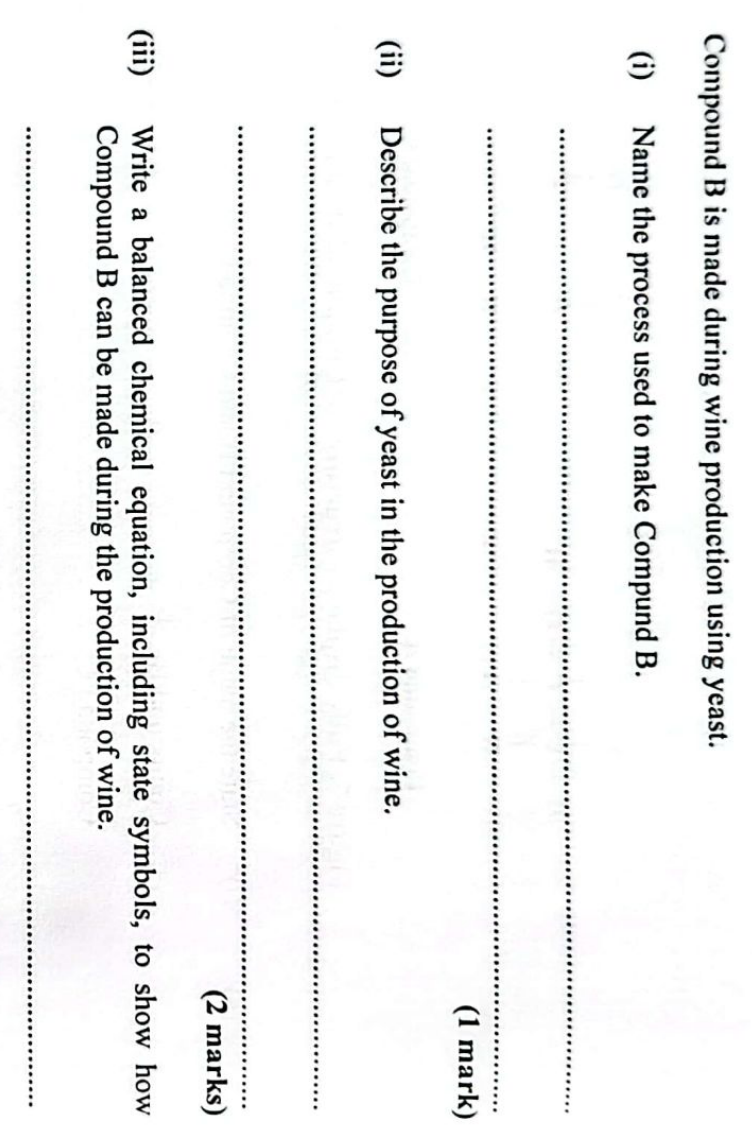
Compound B is made during wine production using yeast. Name the process used to make Compound B. Describe the purpose of yeast in the production of wine.
[4 marks]
Write a balanced chemical equation, including state symbols, to show how Compound B can be made during the production of wine.
[2 marks]
Compound D and water are formed from the reaction between Compound B and Compound C.
Draw the FULLY displayed structure of Compound D.
[2 marks]
Compound D can be used in the production of polymers. Define the term "polymer".
[2 marks]
State the type of polymerization that Compound D engages in.
[1 mark]
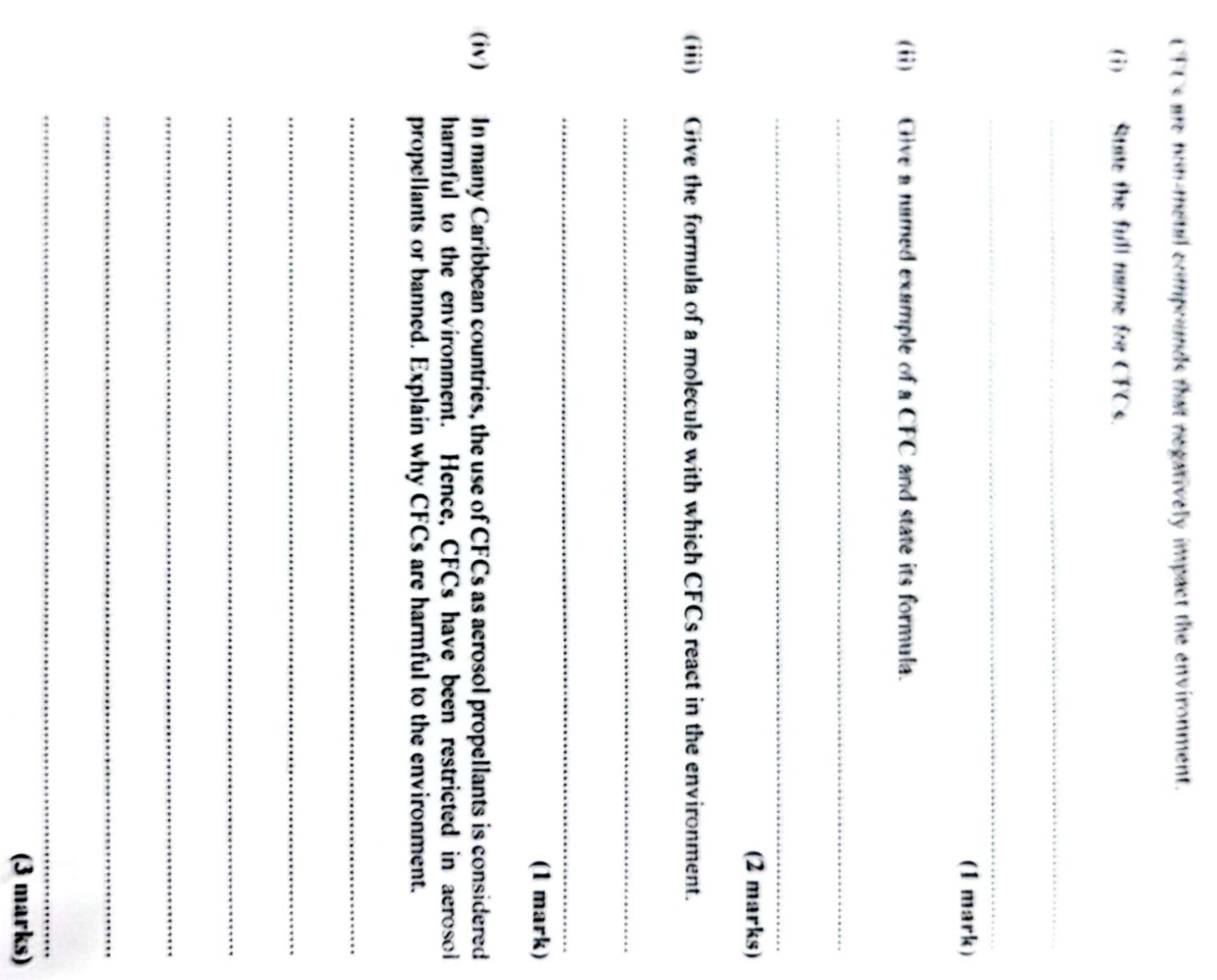
CFCs are man-made compounds that negatively impact the environment.
State the full name for CFCs.
[1 mark]
Give a named example of a CFC and state its formula.
[1 mark]
Give the formula of a molecule with which CFCs react in the environment.
[2 marks]
In many Caribbean countries, the use of CFCs as aerosol propellants is considered harmful to the environment. Hence, CFCs have been restricted in aerosol propellants or banned. Explain why CFCs are harmful to the environment.
[4 marks]
Chlorine is a gas that has many uses.
State ONE use of chlorine gas.
[1 mark]
State a laboratory test that can be used to identify chlorine gas.
[1 mark]
A student reacts chlorine gas with aqueous potassium iodide to produce aqueous potassium chloride and a solid. Write a balanced equation, including state symbols, for the reaction.
[4 marks]
From the balanced equation in (b) (iii), deduce whether chlorine is acting as a reducing or an oxidizing agent by showing the changes in the oxidation states of chlorine.
[3 marks]
[5 marks]