Free CXC Chemistry Paper 2 May/June 2026 past paper from 2026. Includes a worked answer key. Open the PDF, take a timed test, and study with AI on Caribbean AI.
Answer keys are free on Caribbean AI. View the answers to every past-paper question at no cost - no payment needed - with step-by-step worked solutions and instant AI marking available on Premium.
CSEC Chemistry Paper 2 May/June 2026 - Free CXC Past Paper with Answers
Free CXC Chemistry Paper 2 May/June 2026 past paper from 2026. Includes a worked answer key. Open the PDF, take a timed test, and study with AI on Caribbean AI.
Opening the interactive papers…
Every question from this paper as text. See the answers and worked solutions. Questions are the property of the Caribbean Examinations Council; Caribbean AI is not affiliated with CXC.
Define EACH of the following terms.
[3 marks]
Acid
[1 mark]
Normal salt
[2 marks]
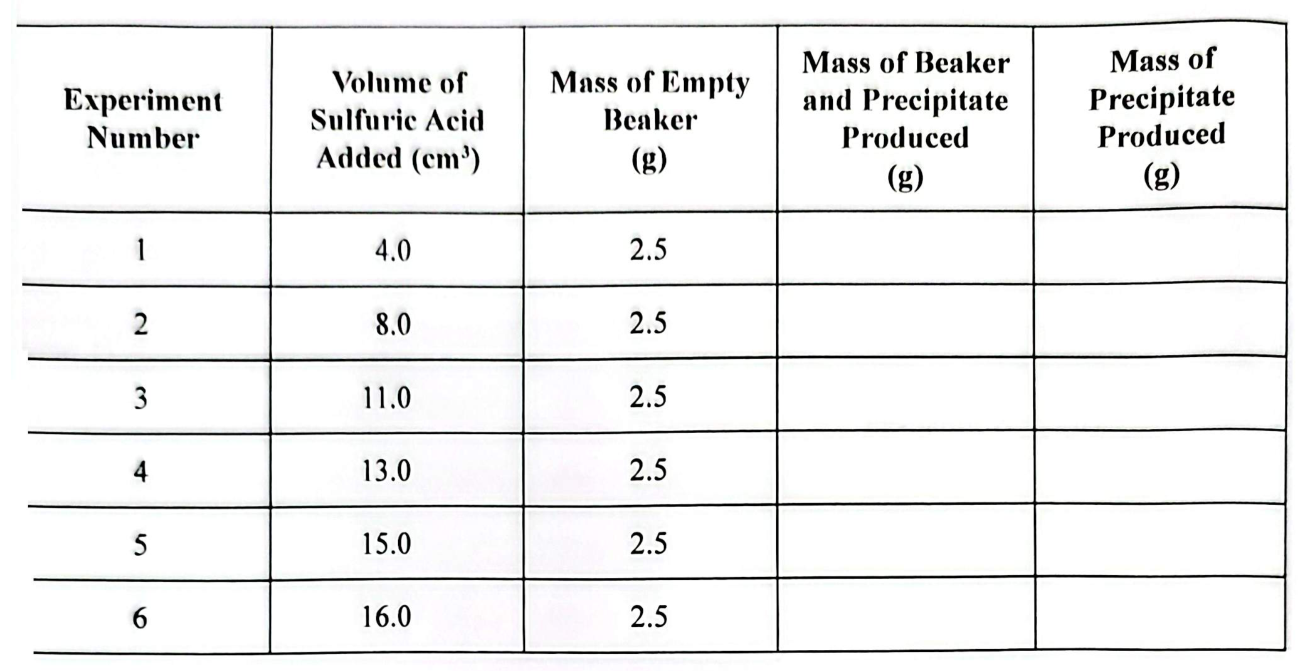
For EACH experiment shown in Figure 1 on page 4, record the corresponding mass of the beaker and the precipitate produced in Column 4 of Table 1.
TABLE 1: MASS OF PRECIPITATE PRODUCED AT VARYING VOLUMES OF SULFURIC ACID
| Experiment Number | Volume of Sulfuric Acid Added () |
|---|
| Mass of Empty Beaker (g) |
|---|
| Mass of Beaker and Precipitate Produced (g) |
|---|
| Mass of Precipitate Produced (g) |
|---|
| 1 | 4.0 | 2.5 | ||
| 2 | 8.0 | 2.5 | ||
| 3 | 11.0 | 2.5 | ||
| 4 | 13.0 | 2.5 | ||
| 5 | 15.0 | 2.5 | ||
| 6 | 16.0 | 2.5 |
[4 marks]
For EACH experiment in Table 1, calculate the mass of precipitate formed and record the value in Column 5.
[4 marks]
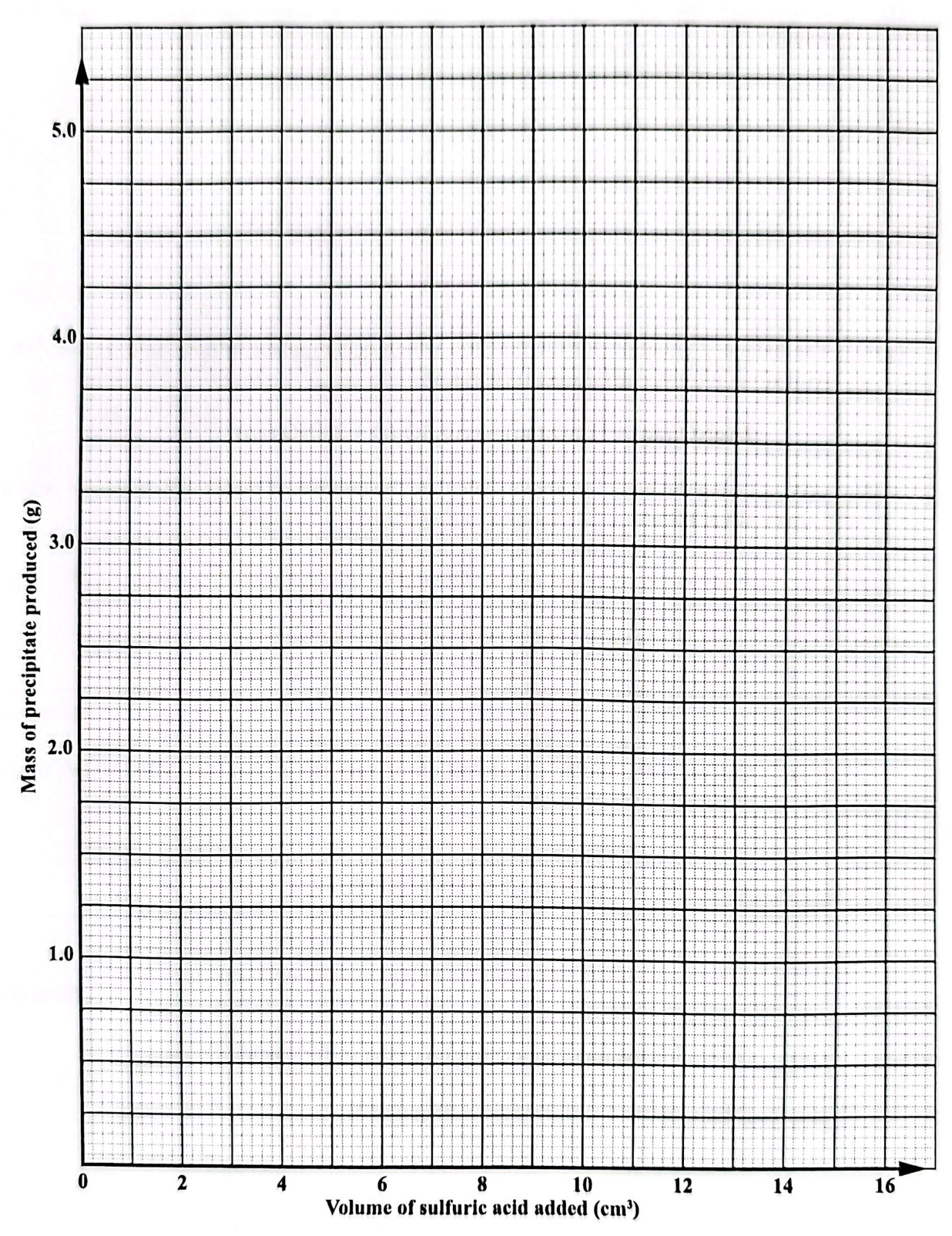
Using the axes provided in Figure 2 on page 5, plot a graph of the mass of precipitate produced against the volume of sulfuric acid added. Your graph should include two intersecting lines.
[5 marks]
On your graph, label the point that indicates the MINIMUM volume of the sulfuric acid required to precipitate ALL the silver ions from the silver nitrate solution and record this volume below.
Volume of the sulfuric acid _________________________________________________________________
[2 marks]
Calculate the number of moles of silver ions in of the of silver nitrate solution.
[2 marks]
The balanced equation for the reaction which occurs when sulfuric acid, , reacts with silver nitrate, , is given below.
[10 marks]
Using the equation above, calculate the number of moles which reacted with the silver nitrate.
[2 marks]
Calculate the molar concentration of sulfuric acid in the MINIMUM volume obtained in (e) on page 4.
[2 marks]
Determine the mass concentration of the sulfuric acid.
[Molar mass of sulfuric acid = ]
[1 mark]
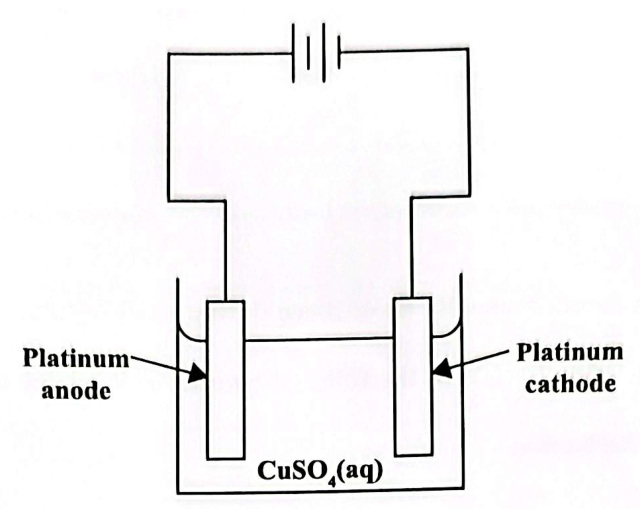
Figure 3 shows a simplified diagram of the apparatus utilized for the electrolysis of aqueous copper (II) sulfate, , when platinum electrodes are used.
[15 marks]
Define the term 'electrolysis'.
[2 marks]
Define the term 'electrolysis'.
[2 marks]
State why the hydroxide ions rather than the sulfate ions are discharged at the anode.
[1 mark]
Write a balanced equation, with state symbols, for the reaction at the cathode.
[2 marks]
State TWO changes that occur in the electrolyte.
[2 marks]
A redox reaction usually takes place during electrolysis. Define EACH of the following terms as it relates to redox reactions.
[4 marks]
Define EACH of the following terms as it relates to redox reactions. Reduction Reducing agent
Deduce the oxidation state of sulfur in .
[2 marks]
Deduce the oxidation state of sulfur in .
[2 marks]
Calculate the mass of copper (in grams) which will be deposited at the cathode when of current passes through the electrolytic cell for minutes, as shown in Figure 3 on page 9.
[R.A.M. Cu = ; Faraday = ]
[4 marks]
Cracking is a very important process in the petroleum industry.
Define the term 'cracking'.
[2 marks]
Several fractions are obtained from the fractional distillation of petroleum. State ONE use of bitumen.
[1 mark]
Compound A () and Compound B () were produced from cracking.
Compound A () and Compound B () were produced from cracking.
Draw the FULLY displayed structure of Compound A.

[2 marks]
State the homologous series to which Compound B belongs.
[1 mark]
State ONE test that could be used to distinguish between Compound A and Compound B. Write the expected observations.
Test
Observations
[3 marks]
Compound B () can exist as structural isomers.
Compound B () can exist as structural isomers.
Define the term 'structural isomers'.
[2 marks]
In the space provided below, draw a FULLY displayed structure of ONE isomer of Compound B.

[2 marks]
Radioisotopes are very useful in everyday life. For example, Uranium-235 is used in energy generation because it produces large amounts of energy when the atoms split.
Radioisotopes are very useful in everyday life. For example, Uranium-235 is used in energy generation because it produces large amounts of energy when the atoms split.
Define the term 'isotopes'.
[2 marks]
State TWO uses of radioisotopes, other than energy generation.
[2 marks]
The properties of elements can be explained based on their position in the Periodic Table. The electronic configurations of four elements, W, X, Y and Z, are as follows W: 2, 7 X: 2, 8, 2 Y: 2, 8, 6 Z: 2, 8, 8, 2
The properties of elements can be explained based on their position in the Periodic Table.
The electronic configurations of four elements, W, X, Y and Z, are as follows W: 2, 7 X: 2, 8, 2 Y: 2, 8, 6 Z: 2, 8, 8, 2
State the TWO criteria which determine the position of elements in the Periodic Table.
[2 marks]
State the appropriate group and period for Element Y.
Group Period
[2 marks]
Elements W and X react together to form a compound.
Elements W and X react together to form a compound.
Deduce whether the compound formed is ionic or covalent.
[1 mark]
Use dot and cross diagrams to show the bonding in the compound formed.

[3 marks]
Element Z can react with dilute hydrochloric acid. Write a balanced equation, including state symbols, for this reaction.
[3 marks]
Ethanol, (), is the second compound found in the alcohol homologous series. It is an important organic compound that can be produced via the fermentation of carbohydrates in the laboratory.
[15 marks]
Ethanol, (), is the second compound found in the alcohol homologous series. It is an important organic compound that can be produced via the fermentation of carbohydrates in the laboratory.
State THREE characteristics of a homologous series.
[3 marks]
Describe the fermentation process by which ethanol is produced from carbohydrates.
[3 marks]
Write a balanced equation, with state symbols, showing all the products formed by the fermentation of carbohydrates.
[3 marks]
A sweet-smelling product is formed when ethanol reacts with ethanoic acid.
State the name of the product formed.
[1 mark]
State the homologous series to which the product named in (b) (i) belongs.
[1 mark]
The sweet-smelling product can also be hydrolysed in the laboratory. Draw the FULLY DISPLAYED structural formulae of the hydrolysis products.
Product 1 Product 2

[4 marks]
List FOUR physical properties of metals.
[4 marks]
Chlorophyll and haemoglobin are two important organometallic compounds found in plants and animals respectively.
Identify the metal that is present in EACH of the following organometallic compounds.
Chlorophyll Haemoglobin
[2 marks]
State the importance of EACH of the following in plants and animals respectively.
Chlorophyll Haemoglobin
[2 marks]
Explain how the broken mercury thermometers caused the death of the large fishes.
[3 marks]
Recommend TWO ways in which the personnel at the Easygoing Chemical Laboratory could correctly dispose of broken thermometers.
[2 marks]
While working on an experiment in the chemistry laboratory at your school, the mercury thermometer you were using accidentally broke. State TWO actions you should take to avoid contamination.
[2 marks]
State the names of Compound A and Compound B.
Compound A Compound B
[2 marks]