Free CXC Chemistry Paper 2 January 2018 past paper from 2018. Includes a worked answer key. Open the PDF, take a timed test, and study with AI on Caribbean AI.
Answer keys are free on Caribbean AI. View the answers to every past-paper question at no cost - no payment needed - with step-by-step worked solutions and instant AI marking available on Premium.
CSEC Chemistry Paper 2 January 2018 - Free CXC Past Paper with Answers
Free CXC Chemistry Paper 2 January 2018 past paper from 2018. Includes a worked answer key. Open the PDF, take a timed test, and study with AI on Caribbean AI.
Opening the interactive papers…
Every question from this paper as text. See the answers and worked solutions. Questions are the property of the Caribbean Examinations Council; Caribbean AI is not affiliated with CXC.
Deniel is provided with two solutions, M and N. Solution M is aqueous hydrochloric acid containing . Solution N is an aqueous sodium hydroxide solution which has been prepared by using a certain mass of sodium hydroxide in of solution.
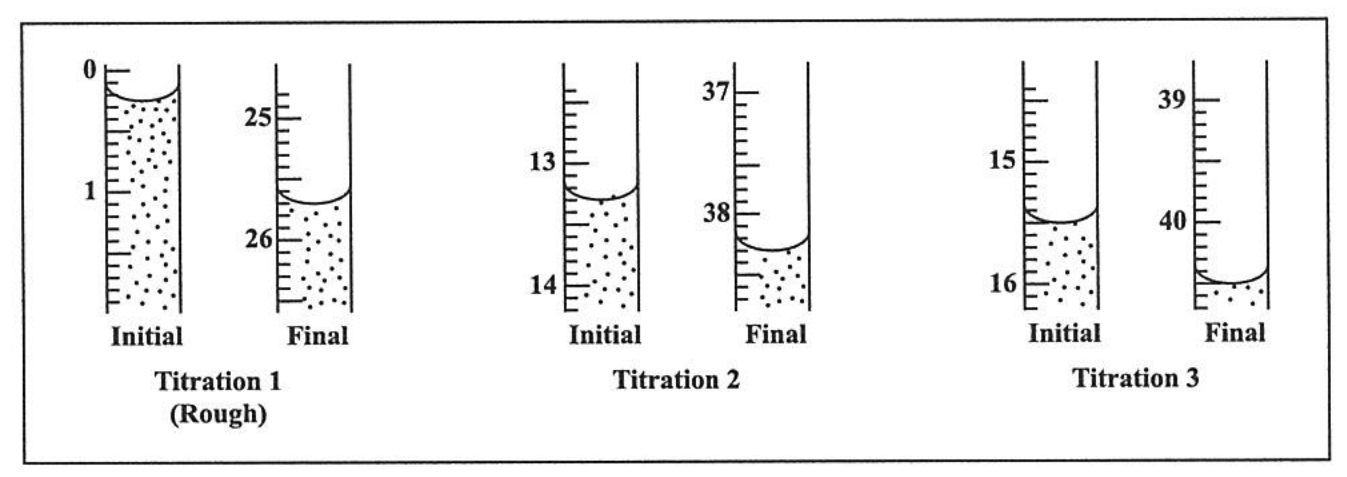
Deniel is asked to titrate solution M against of solution N in order to determine the concentration of sodium hydroxide.
Figure 1 shows the burette volume readings Deniel obtained before (initial) and after (final) EACH of three titrations.
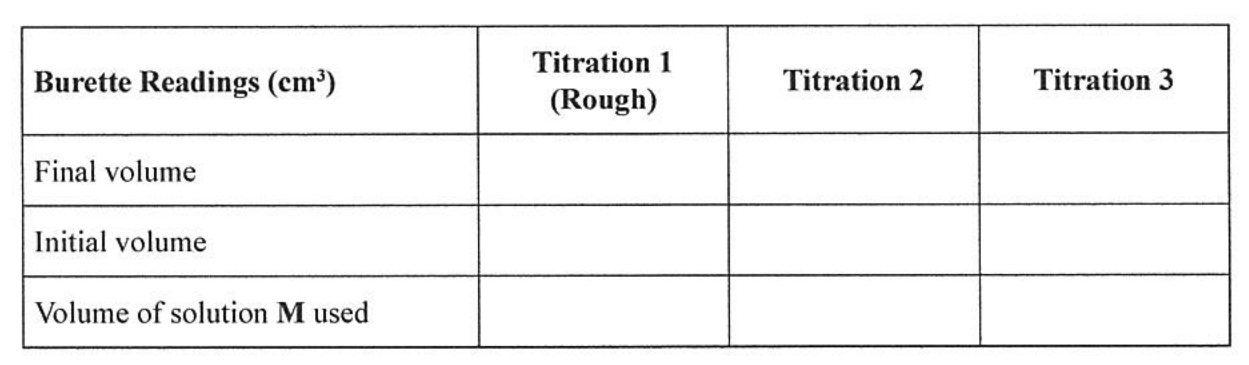
(i) Complete Table 1 by recording the titration results obtained from the experiment in Figure 1.
| Burette Readings () | Titration 1 (Rough) | Titration 2 | Titration 3 |
|---|---|---|---|
| Final volume | |||
| Initial volume | |||
| Volume of solution M used |
[9 marks]
Calculate the average volume of solution M used in the titration.
[1 mark]
Calculate the concentration of hydrochloric acid in solution M, in . (Relative atomic mass: H = 1; Cl = 35.5)
[2 marks]
Calculate the number of moles of hydrochloric acid used in the titration.
[1 mark]
Write a balanced equation for the reaction between the hydrochloric acid and sodium hydroxide solutions.
[1 mark]
Determine the number of moles of sodium hydroxide in the of solution used.
[2 marks]
Calculate the concentration of sodium hydroxide, in . (Molar mass of sodium hydroxide = )
[2 marks]
Deneil also conducted an experiment to determine the effect of temperature on stearic acid. Stearic acid is an organic acid that exists as a 'molecular solid' with a melting point less than . Table 2 shows the data she collected.
TABLE 2: RESULTS OF EXPERIMENT
| Time (min) | 0 | 1.5 | 2.0 | 2.5 | 3.0 | 5.0 | 7.0 |
|---|---|---|---|---|---|---|---|
| Temperature () | 19 | 40 | 48 | 53 | 55 | 55 | 55 |
[25 marks]
Identify the forces that exist in a 'molecular solid'.
[1 mark]
Sodium chloride, another solid, has a higher melting and boiling point than stearic acid. Explain why this is so.
[2 marks]
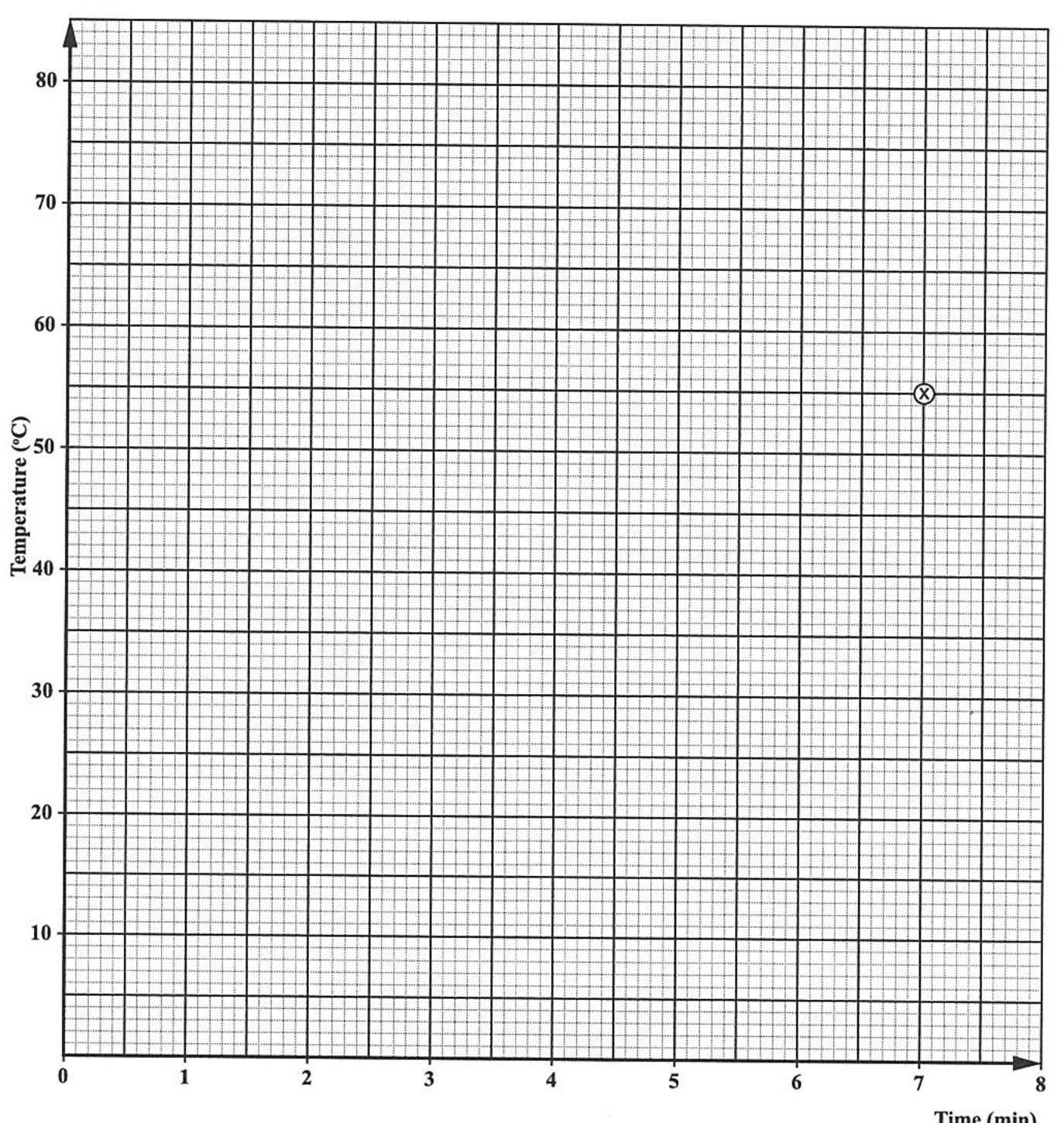
Using the axes provided in Figure 2 on page 9, plot a graph of temperature against time from the information in Table 2. One point has already been plotted. Draw the best fit curve through your points.
[4 marks]
Phosphoric acid, , is a common additive in most soft drinks. It can react with sodium hydroxide, an alkali, to form both normal and acid salts.
[15 marks]
Phosphoric acid, , is a common additive in most soft drinks. It can react with sodium hydroxide, an alkali, to form both normal and acid salts.
[7 marks]
Define the terms 'acid' and 'alkali'. Acid Alkali
[2 marks]
Define the terms 'acid salts' and 'normal salts'. Acid salts Normal salts
[2 marks]
State the molecular formula for the normal salt formed from the reaction between phosphoric acid and sodium hydroxide.
[1 mark]
Write a balanced equation to show the formation of the normal salt stated in (a) (iii).
[2 marks]
A solution of 0.05 M phosphoric acid has a pH of 4, and a solution of 0.05 M sulfuric acid has a pH of 1.
Which of the two acids is stronger?
[1 mark]
Jeffrey complains of pains due to excess stomach acid after consuming too much orange juice.
[7 marks]
Name TWO acids present in orange juice.
[2 marks]
State the type of chemical reaction that takes place in the treatment of excess stomach acid.
[1 mark]
Hence, name ONE substance that can be used to treat excess stomach acid.
[1 mark]
Ethene undergoes a halogenation reaction to form 1,2-dichloroethane.
[6 marks]
Ethene undergoes a halogenation reaction to form 1,2-dichloroethane.
[6 marks]
Draw the FULLY DISPLAYED structure of ethene.
[2 marks]
Draw the FULLY DISPLAYED structure of the 1,2-dichloroethane.
[2 marks]
Is the halogenation of ethene an addition or substitution reaction?
[1 mark]
Dichloromethane can be obtained from methane. This reaction takes place in two steps.
[5 marks]
Write balanced chemical equations to show EACH step in the formation of dichloromethane.
[4 marks]
Is the halogenation of methane an addition or substitution reaction?
[1 mark]
Ethene and propene are typical monomers which are used as starting materials for making polymers. In forming polymers, ethene and propene undergo addition polymerization.
[5 marks]
Define the term 'polymer'.
[1 mark]
Define what is meant by 'addition polymerization.'
[1 mark]
State ONE use of EACH of the following polymers: Polyvinyl chloride Teflon Poly(ethene)
[3 marks]
SECTION B
Answer ALL questions in this section.
[4 marks]
When a reaction is accompanied by energy changes, it can be categorized as either endothermic or exothermic.
[4 marks]
Distinguish between the terms 'endothermic' and 'exothermic.'
[2 marks]
Generally, when chemical reactions take place, existing bonds are broken and new bonds are formed. Classify bond making AND bond breaking as either endothermic or exothermic processes.
Bond making Bond breaking
[2 marks]
In an experiment, when 12.0 g of potassium nitrate, , is dissolved in of water, the temperature drops by . Calculate the number of moles of used in the experiment. (RMM: )
[1 mark]
Calculate the heat change for the reaction. Specific heat capacity of water ; Heat change ; Density of water
Calculate the enthalpy change for 1 mole of potassium nitrate.
[1 mark]
List TWO pieces of apparatus necessary to conduct the experiment in a school laboratory. State how EACH piece of apparatus is used.
[4 marks]
Draw a labelled energy profile diagram to represent the enthalpy change for the reaction. On your diagram, indicate the sign of for the reaction.
[3 marks]
The compound responsible for the odour of apples is ethyl pentanoate, . State the homologous series to which ethyl pentanoate belongs.
[1 mark]
Draw the FULLY DISPLAYED structure of ethyl pentanoate and circle the functional group.
[3 marks]
Write the molecular formulae for the alcohol and carboxylic acid that will react to produce ethyl pentanoate.
[2 marks]
Name the catalyst involved in the reaction between the alcohol and carboxylic acid stated in (c) (iii).
[1 mark]
Explain why an ester has low solubility in water whereas a simple alcohol is very soluble in water.
[2 marks]
State the reaction condition and reagent used for the alkaline hydrolysis of ethyl ethanoate. Hence, write a balanced chemical equation for this reaction.
Condition and Reagent:
Balanced chemical equation:
[4 marks]
Commercial soaps are usually manufactured using natural esters. Name the process used to make soap and state ONE source of these natural esters.
Process: Source:
[2 marks]
List FOUR unique properties of water as it relates to the human body.
[4 marks]
Water exists in liquid, solid and gaseous states. Describe a laboratory test for water vapour.
[2 marks]
In some Caribbean islands, calcium hydrogen carbonate causes temporary hardness in water. This can be treated by the use of washing soda (sodium carbonate).
Write a balanced chemical equation, including state symbols, to show the removal of temporary hardness from water using this treatment.
[3 marks]
Pure water does not conduct electricity but can be acidified using dilute sulfuric acid for this to occur. Predict the ions that will migrate to the anode and cathode during the electrolysis of dilute sulfuric acid (acidified water). Write a balanced chemical equation, including state symbols, for the electrolysis of dilute sulfuric acid (acidified water).
Ions to anode: Ions to cathode:
Balanced equation:
[6 marks]
[2 marks]