Free CXC Chemistry Paper 2 May/June 2012 past paper from 2012. Includes a worked answer key. Open the PDF, take a timed test, and study with AI on Caribbean AI.
Answer keys are free on Caribbean AI. View the answers to every past-paper question at no cost - no payment needed - with step-by-step worked solutions and instant AI marking available on Premium.
CSEC Chemistry Paper 2 May/June 2012 - Free CXC Past Paper with Answers
Free CXC Chemistry Paper 2 May/June 2012 past paper from 2012. Includes a worked answer key. Open the PDF, take a timed test, and study with AI on Caribbean AI.
Opening the interactive papers…
Every question from this paper as text. See the answers and worked solutions. Questions are the property of the Caribbean Examinations Council; Caribbean AI is not affiliated with CXC.
Complete Figure 1 to show how the gas was collected and measured during the experiment.
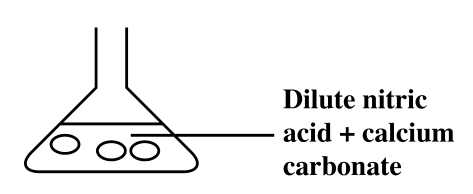
[2 marks]
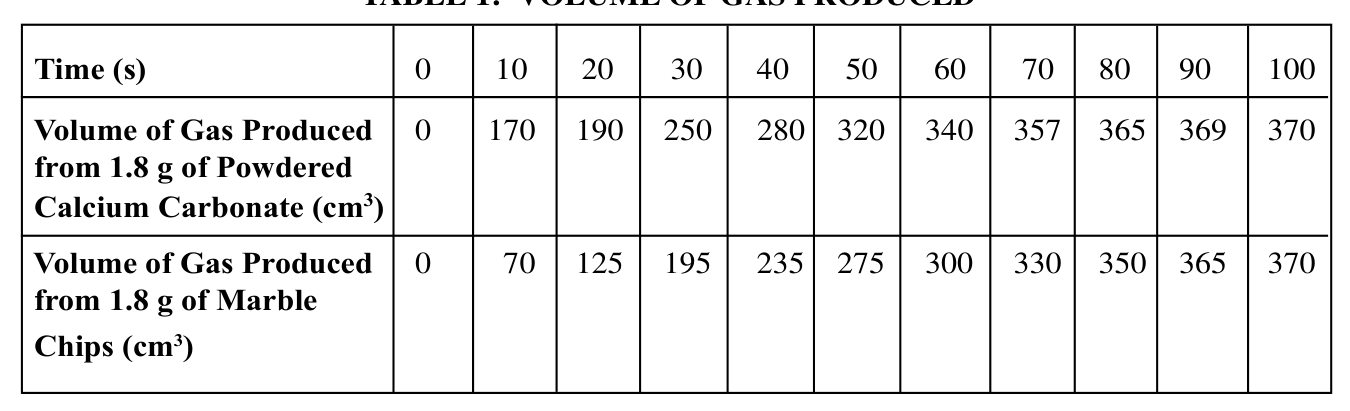
Using the same axes in Figure 2, plot a graph of the volume of gas produced versus time for the reaction with marble chips. Four of the points have already been plotted on the graph.
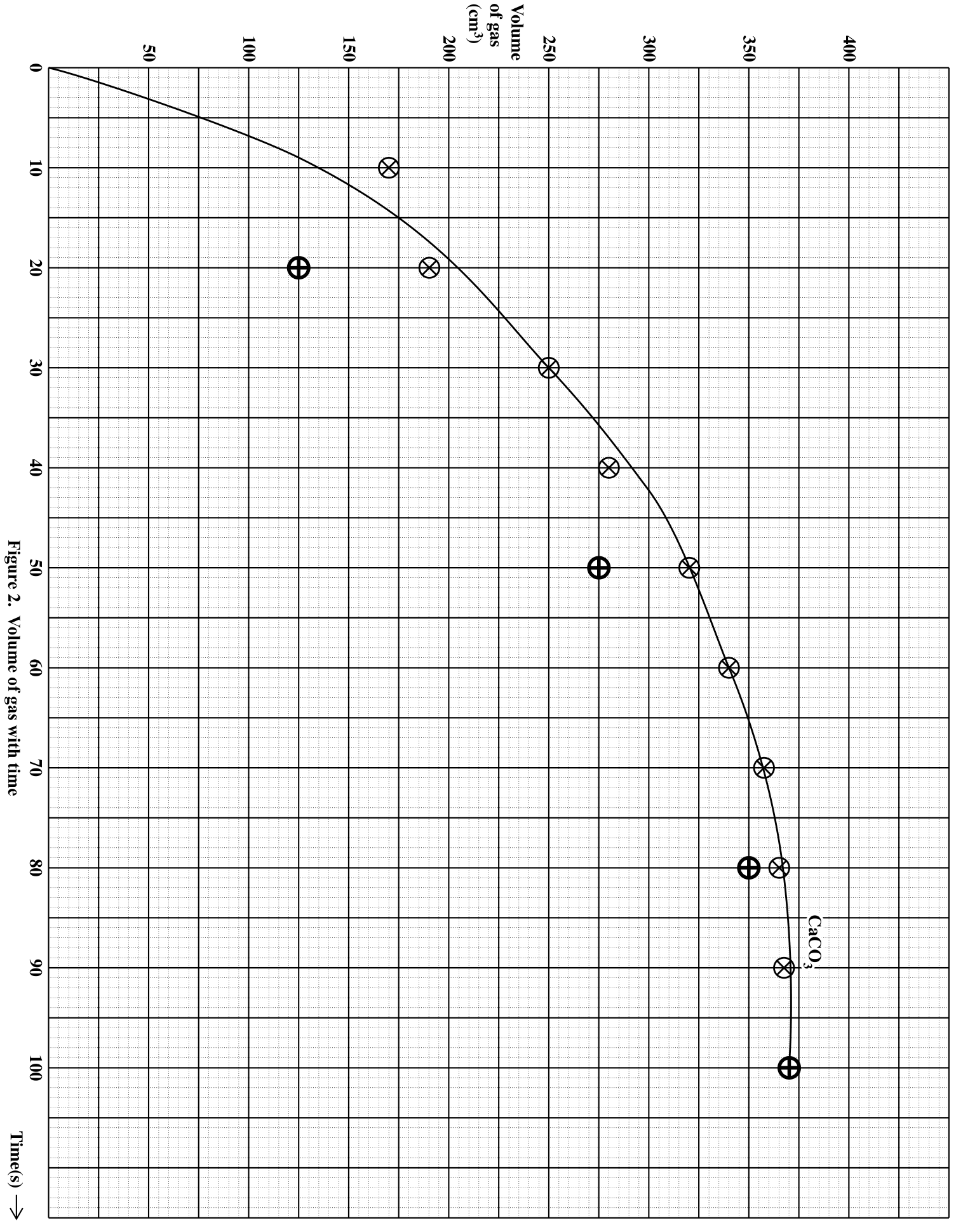
[3 marks]
With reference to the volume of gas produced and the slopes along the two curves on the graph, outline ONE similarity and ONE difference in the volume of carbon dioxide produced from powdered calcium carbonate and from marble chips. Include a reason in EACH case.
[4 marks]
Write a balanced equation for the reaction between calcium carbonate and nitric acid.
[2 marks]
Calculate the volume of gas that can be obtained from reacting of calcium carbonate with dilute nitric acid at R.T.P.
[3 marks]
From the graph, the total volume of gas produced is . Suggest a possible reason for the difference in your answer obtained in (v) on page 4 and the volume of gas obtained from the graph.
[1 mark]
State TWO other factors (than the one given in (vi) above) that can affect the rate of reaction between nitric acid and calcium carbonate.
[2 marks]
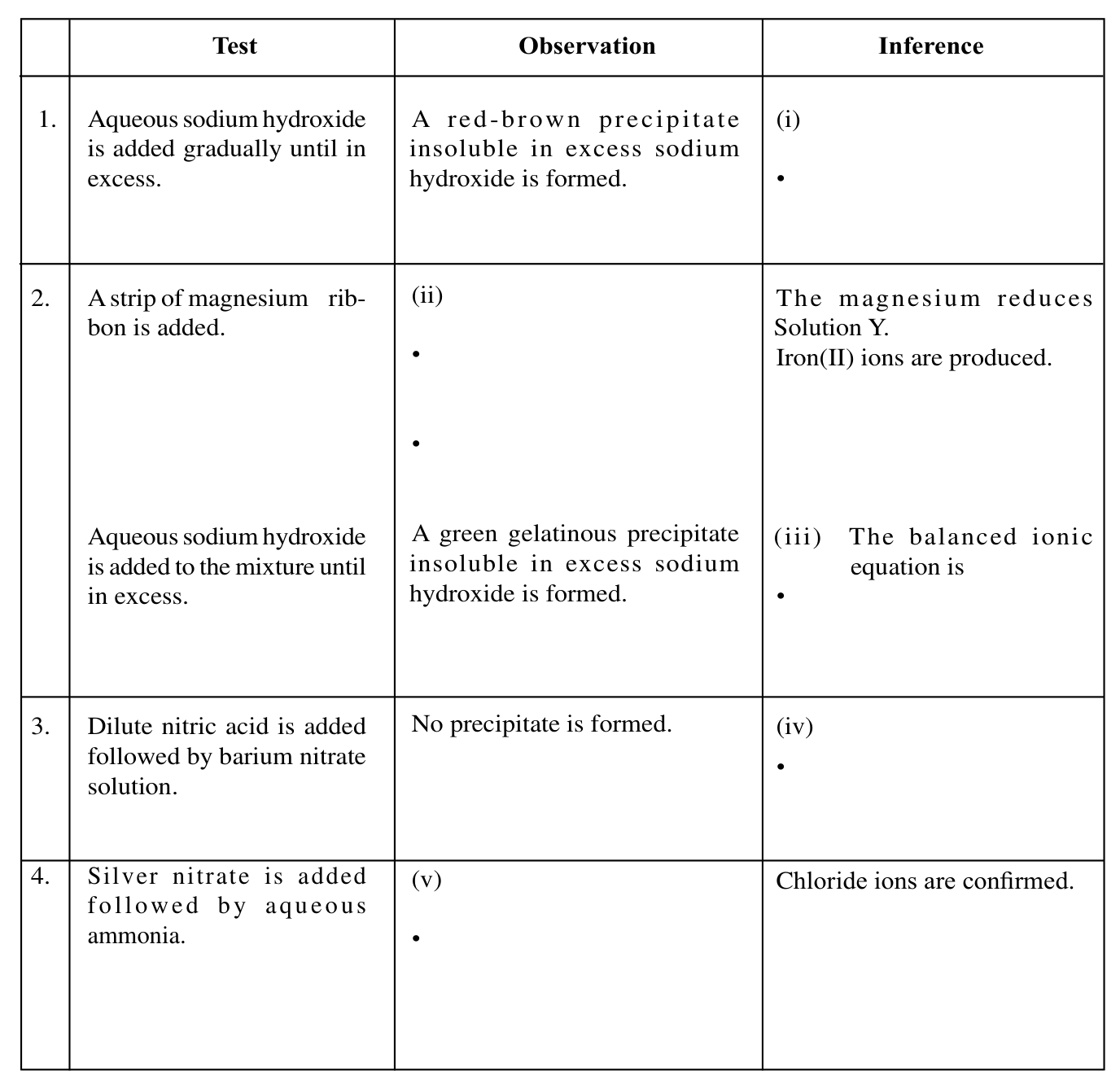
A student conducts a number of tests on a solution of Compound Y. Some of the observations and the inferences made from these tests are recorded in Table 2. Complete Table 2 by writing in the observations and inferences numbered (i) – (v).
TABLE 2: RESULTS OF TESTS CARRIED OUT ON SOLUTION OF COMPOUND Y
| Test | Observation | Inference |
|---|---|---|
| 1. Aqueous sodium hydroxide is added gradually until in excess. | A red-brown precipitate insoluble in excess sodium hydroxide is formed. | (i) |
| 2. A strip of magnesium ribbon is added. | (ii) | The magnesium reduces Solution Y. Iron(II) ions are produced. |
| Aqueous sodium hydroxide is added to the mixture until in excess. | A green gelatinous precipitate insoluble in excess sodium hydroxide is formed. | |
| 3. Dilute nitric acid is added followed by barium nitrate solution. | No precipitate is formed. | (iv) |
| 4. Silver nitrate is added followed by aqueous ammonia. | (v) | Chloride ions are confirmed. |
[8 marks]
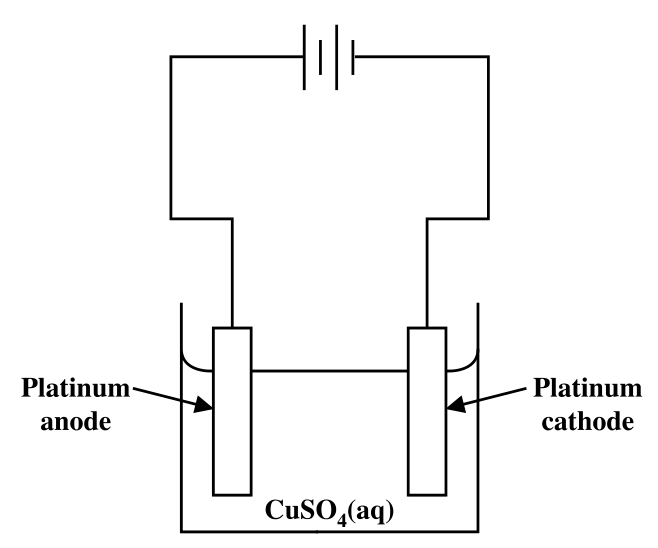
Figure 3 shows a simplified diagram of the apparatus used for the electrolysis of aqueous copper(II) sulphate, , using platinum electrodes.
Figure 3. Electrolysis of (aq)
[15 marks]
Deduce the oxidation state of sulphur in .
[1 mark]
At the anode, the hydroxide ions are discharged in preference to the sulphate ions. State a reason for this.
[1 mark]
Write a balanced equation for the reaction at the anode.
[2 marks]
From the equation written in (c) above, state whether the reaction at the anode is oxidation or reduction. Give an explanation for your answer.
Reaction at the anode: Explanation:
[2 marks]
State TWO changes that occur in the electrolyte.
[2 marks]
Determine the mass of copper (in grams) which will be deposited at the cathode when 5A of current passes through the electrolytic cell for half an hour.
[R.A.M. Cu = 64; 1 Faraday = ]
[4 marks]
Indicate below how the apparatus in Figure 3 can be modified to obtain pure copper from impure copper. If no modification is required write "no modification required" in the relevant space.
Anode: Cathode: Electrolyte:
[3 marks]
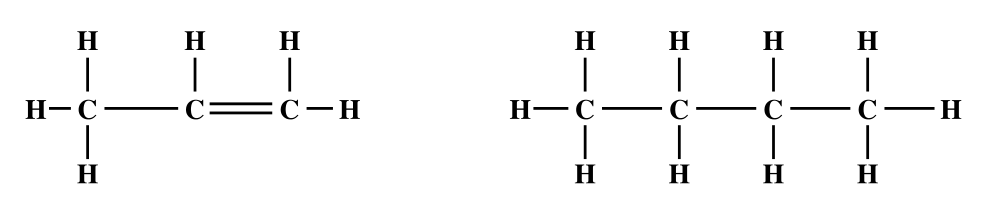
The fully displayed structures of two hydrocarbons, A and B, are shown below.
[15 marks]
The fully displayed structures of two hydrocarbons, A and B, are shown below.
[7 marks]
Write the names of the homologous series to which A and B belong.
Homologous series for A: Homologous series for B:
[2 marks]
Write the general formulae for EACH homologous series named in (i) above.
General formula for homologous series of A: General formula for homologous series of B:
[2 marks]
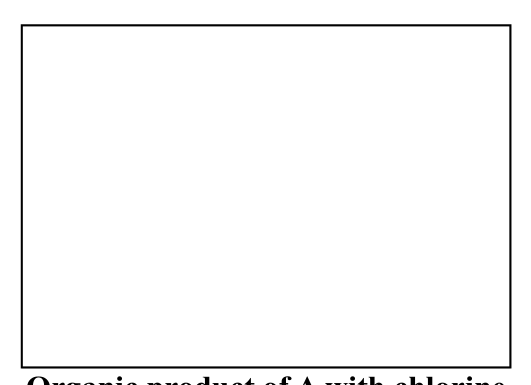
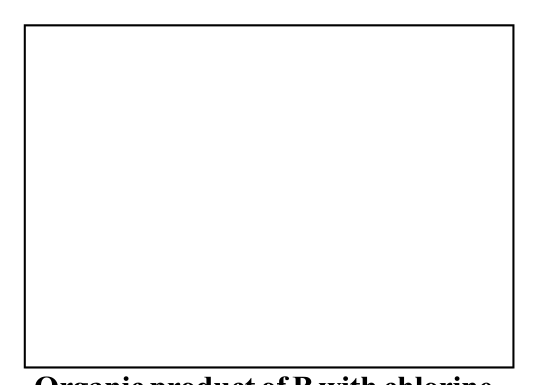
Both A and B react with chlorine, but under different conditions. a) State ONE necessary condition for B to react with chlorine. b) Draw the FULLY displayed structures of the organic products for the reactions of A and B with chlorine.
[5 marks]
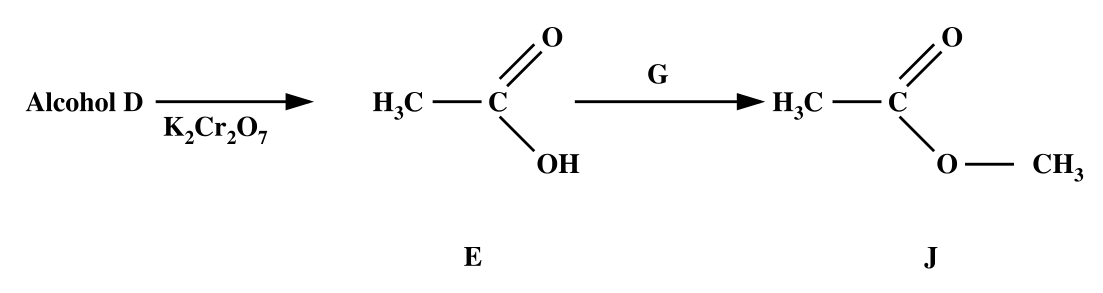
The questions below are based on the following reaction scheme.
Alcohol D HC OH HC O CH E J
State the role of in the conversion of D to E.
[1 mark]
Write a balanced equation for the reaction of E with solid magnesium oxide (MgO).
Equation:
[2 marks]
Describe ONE chemical test that could be used to identify the gas given off from the reaction of Compound E with solid calcium carbonate. Include the expected observation.
[2 marks]
State the name of the homologous series to which Compound J belongs.
[1 mark]
SECTION B Answer ALL questions in this section.
Write your answers in the space provided after EACH question in this booklet.
[15 marks]
Radioisotopes are very useful in everyday life. For example, Uranium - 235 is used in energy generation because it produces large amounts of energy when the atoms split.
State TWO other uses of radioisotopes and explain the importance of EACH.
[4 marks]
The properties of elements can be explained based on their electronic configuration and hence their position in the Periodic Table.
The electronic configurations of four elements P, Q, R and S are:
[11 marks]
Outline the criteria for placing elements in the Periodic Table. Hence, state the appropriate group and period for EACH of the elements P, Q, R and S.
[4 marks]
Elements P and Q react together to form a compound. Deduce whether this compound is ionic or covalent. Use 'dot cross' diagrams to show the bonding in the compound formed and write its formula.
[4 marks]
Compare the reactivity of EACH of elements Q and S with dilute hydrochloric acid. Write a balanced equation for EITHER of these reactions with dilute hydrochloric acid.
[3 marks]
Most metals undergo corrosion. In the case of aluminium, this can be beneficial to the metal while in the case of iron, it may be harmful and quite costly.
[15 marks]
State the property of metals that is responsible for corrosion and describe the process of corrosion.
[3 marks]
Write THREE relevant chemical equations for the corrosion of iron.
[3 marks]
Explain why the corrosion of aluminium is beneficial while that of iron is not. In your answer, you should refer to the products of corrosion and their properties.
[7 marks]
Aluminium is widely used to make cookware. Explain why it is NOT advisable to use aluminium pots to prepare acidic foods.
[2 marks]
"Scientists believe that without water all life would cease to exist."
[15 marks]
"Scientists believe that without water all life would cease to exist." Outline THREE properties of water and relate them to its function in maintaining life on earth.
[6 marks]
State the meaning of the term 'hard water'.
[1 mark]
Describe ONE way in which water can be softened. Include a chemical equation with state symbols in your description.
[4 marks]
It is important that communities and individual households play a part in the management and preservation of the environment. Suggest FOUR practical ways in which households or communities can manage or preserve the environment. At least ONE way must be related to water.
[4 marks]
[15 marks]