Free CXC Chemistry Paper 2 May/June 2008 past paper from 2008. Includes a worked answer key. Open the PDF, take a timed test, and study with AI on Caribbean AI.
Answer keys are free on Caribbean AI. View the answers to every past-paper question at no cost - no payment needed - with step-by-step worked solutions and instant AI marking available on Premium.
CSEC Chemistry Paper 2 May/June 2008 - Free CXC Past Paper with Answers
Free CXC Chemistry Paper 2 May/June 2008 past paper from 2008. Includes a worked answer key. Open the PDF, take a timed test, and study with AI on Caribbean AI.
Opening the interactive papers…
Every question from this paper as text. See the answers and worked solutions. Questions are the property of the Caribbean Examinations Council; Caribbean AI is not affiliated with CXC.
When a strong acid is titrated with a strong base, the change in pH which occurs can be used to determine the end point of the titration. The pH will change sharply at 7.0 at the end point of the titration.
A pH meter can be used to measure the changes in pH during the reaction.
Figure 1 on page 3 shows ten pH readings obtained when a student uses pH changes to determine the end point of an acid-base reaction. The acid used is of a sulphuric acid solution. The base is sodium hydroxide of unknown concentration.
Reading I represents the pH of of sulphuric acid at the start of the experiment. Readings II to X represent the pH readings when various volumes of sodium hydroxide are added to the sulphuric acid solution. The volumes of sodium hydroxide solution added are indicated in Figure 1 on page 3.
What is meant by EACH of the following?
[4 marks]
pH scale
[2 marks]
The end point of an acid-base titration
[2 marks]
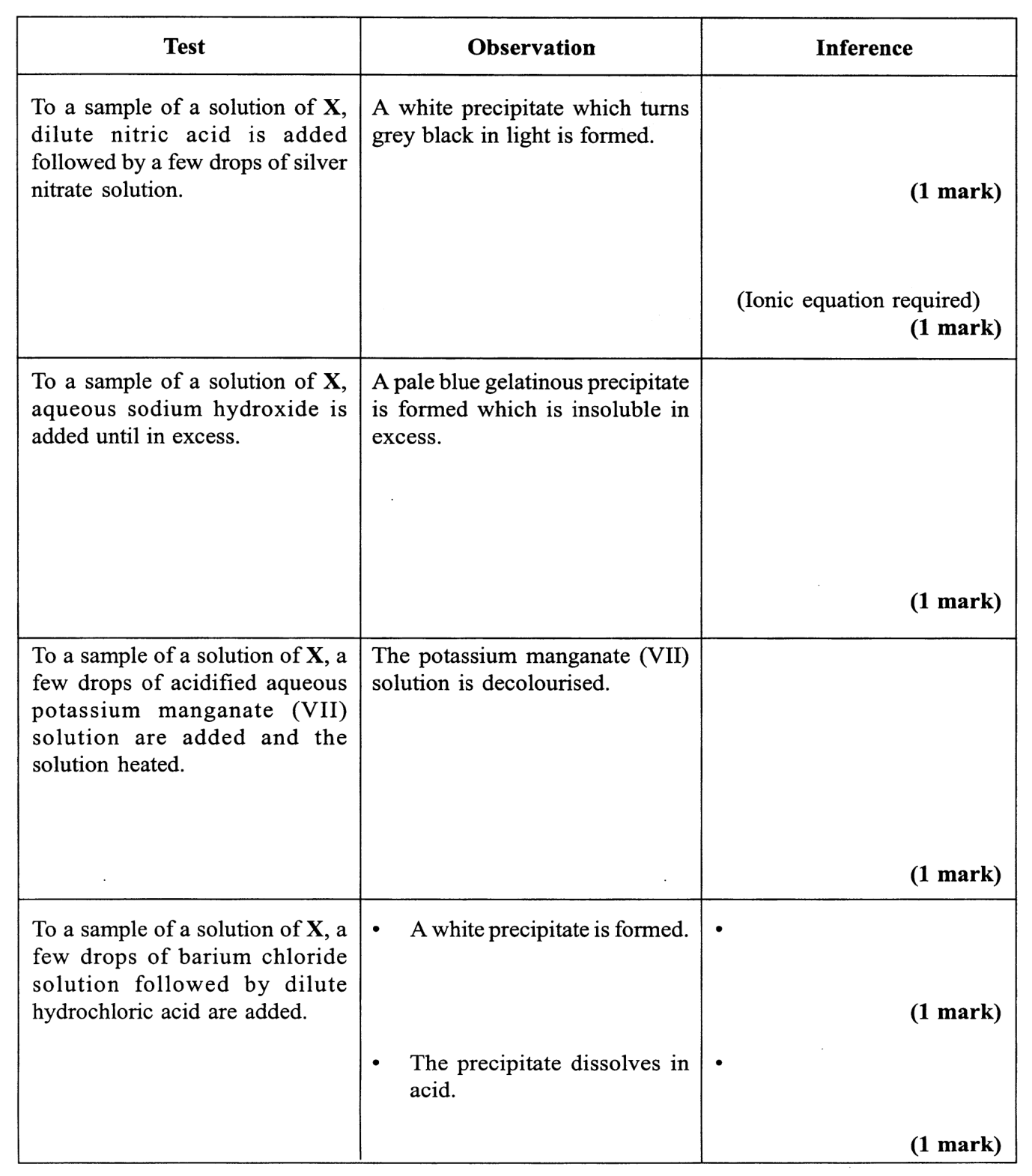
A student conducts a number of tests on an aqueous solution of Compound X. The observations made are recorded in Table 2 below. Complete Table 2 by filling in the inferences that could be made based on the observations recorded.
TABLE 2: RESULTS OF TESTS ON A SOLUTION OF COMPOUND X
| Test | Observation | Inference |
|---|---|---|
| To a sample of a solution of X, dilute nitric acid is added followed by a few drops of silver nitrate solution. | A white precipitate which turns grey black in light is formed. | |
| To a sample of a solution of X, aqueous sodium hydroxide is added until in excess. | A pale blue gelatinous precipitate is formed which is insoluble in excess. | |
| To a sample of a solution of X, a few drops of acidified aqueous potassium manganate (VII) solution are added and the solution heated. | The potassium manganate (VII) solution is decolourised. | |
| To a sample of a solution of X, a few drops of barium chloride solution followed by dilute hydrochloric acid are added. | • A white precipitate is formed. <br> • The precipitate dissolves in acid. |
[6 marks]
Inference for the first test (observation: A white precipitate which turns grey black in light is formed).
[1 mark]
Ionic equation required for the first test.
[1 mark]
Inference for the second test (observation: A pale blue gelatinous precipitate is formed which is insoluble in excess).
[1 mark]
Inference for the third test (observation: The potassium manganate (VII) solution is decolourised).
[1 mark]
Inference for the fourth test (observations: A white precipitate is formed; The precipitate dissolves in acid).
[2 marks]
Hydrogen peroxide will decompose slowly at room temperature to produce water and oxygen. The rate of decomposition can be increased by using a catalyst.
Manganese (IV) oxide, copper oxide, liver extracts and potato extracts have been used to catalyse various reactions.
Plan and design an experiment to determine which of the four catalysts above will be most effective in increasing the rate of decomposition of hydrogen peroxide. Write your answer in the spaces provided.
Outline of method (include the variables controlled):
[2 marks]
Use the graph to determine the volume of sodium hydroxide which reacts completely with the of sulphuric acid.
Volume of NaOH = $\text{__________ cm}^3$
[1 mark]
Calculate EACH of the following:
[5 marks]
The number of moles of sulphuric acid in of the sulphuric acid used
[2 marks]
The number of moles of sodium hydroxide in the volume of sodium hydroxide used in (d)
[2 marks]
The number of moles of sodium hydroxide in of this solution
[1 mark]
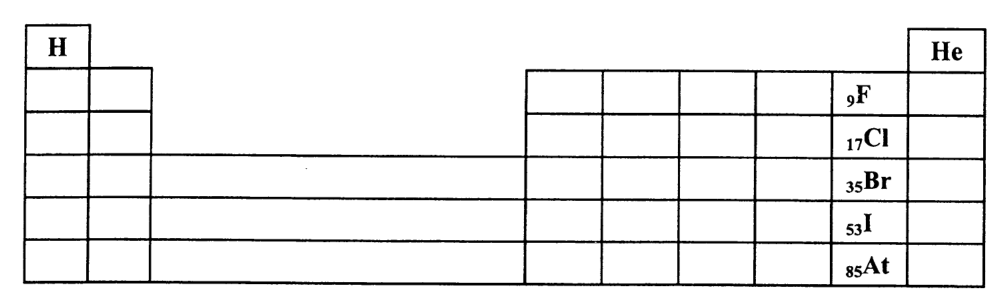
Figure 2 represents a part of the periodic table showing the location of fluorine (F), chlorine (Cl), bromine (Br), iodine (I) and astatine (At).
Figure 2. Part of the periodic table
[15 marks]
Identify the group in the periodic table in which fluorine (F), chlorine (Cl), bromine (Br), iodine (I) and astatine (At) are placed. Give ONE reason for your answer.
Group: Reason:
[2 marks]
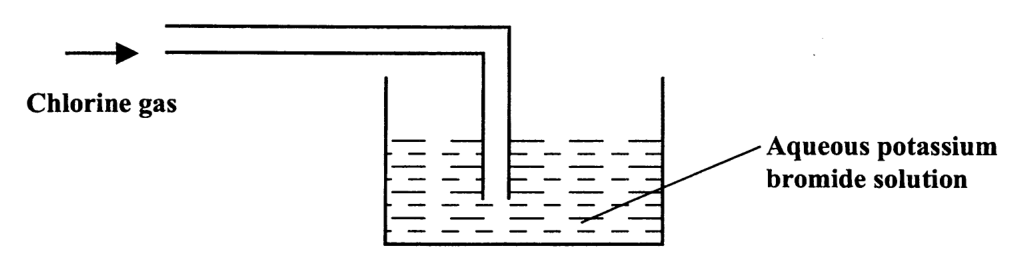
Figure 3 represents the experimental set up used by a group of students who are investigating the reactivity of halogens.
What would the students observe when they conduct the experiment represented in Figure 3? Illustrate your answer by means of an equation.
Figure 3. Experiment to investigate the reactivity of halogens
[3 marks]
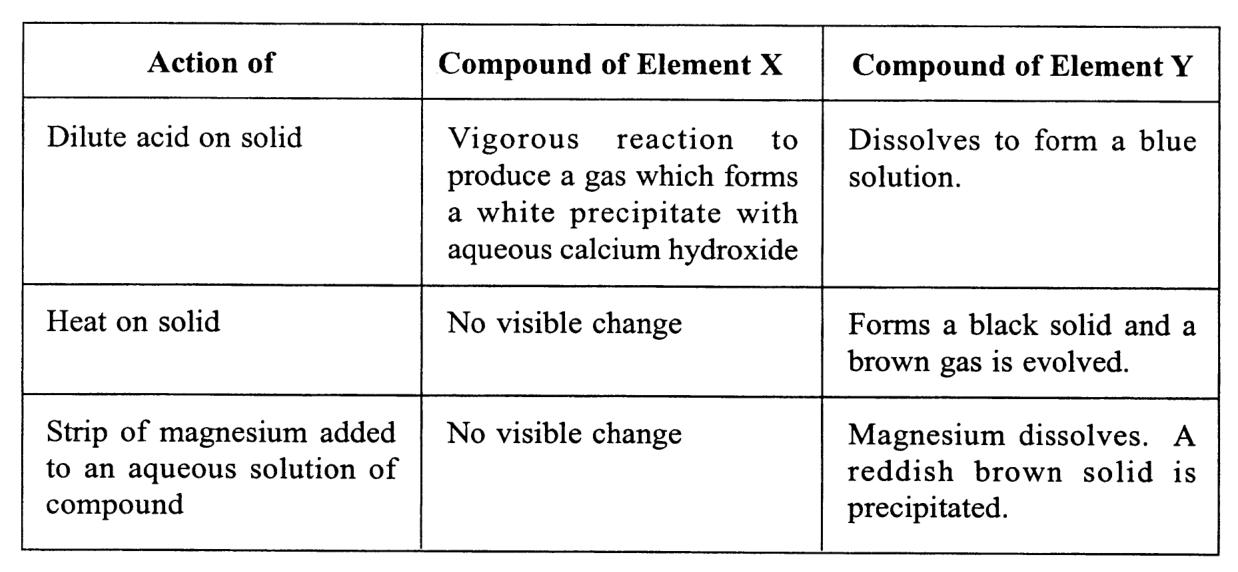
Two compounds of Elements X and Y undergo the reactions recorded in Table 3. Study the information carefully and answer the questions that follow.
TABLE 3: REACTIONS OF COMPOUNDS OF ELEMENTS X AND Y
| Action of | Compound of Element X | Compound of Element Y |
|---|---|---|
| Dilute acid on solid | Vigorous reaction to produce a gas which forms a white precipitate with aqueous calcium hydroxide | Dissolves to form a blue solution. |
| Heat on solid | No visible change | Forms a black solid and a brown gas is evolved. |
| Strip of magnesium added to an aqueous solution of compound | No visible change | Magnesium dissolves. A reddish brown solid is precipitated. |
[10 marks]
Deduce whether X and Y are metals or nonmetals.
X is _________________________________________________________________________ Y is _________________________________________________________________________
[2 marks]
Based on your answer to (c) (i) above, describe the bonding in Element Y.
[2 marks]
Predict the type of bond that would be formed between X and oxygen. Give a reason for your answer.
Type of bonding: _________________________________________________________________ Reason: _________________________________________________________________________
[2 marks]
Based on the information given in Table 3, arrange the elements Mg, X and Y in order of decreasing activity. Explain your answer.
Order of activity (most reactive first): ___________________________________________ Explanation: ____________________________________________________________________
[4 marks]
But-1-ene (1-butene) and but-2-ene (2-butene) are structural isomers of molecular formula .
[10 marks]
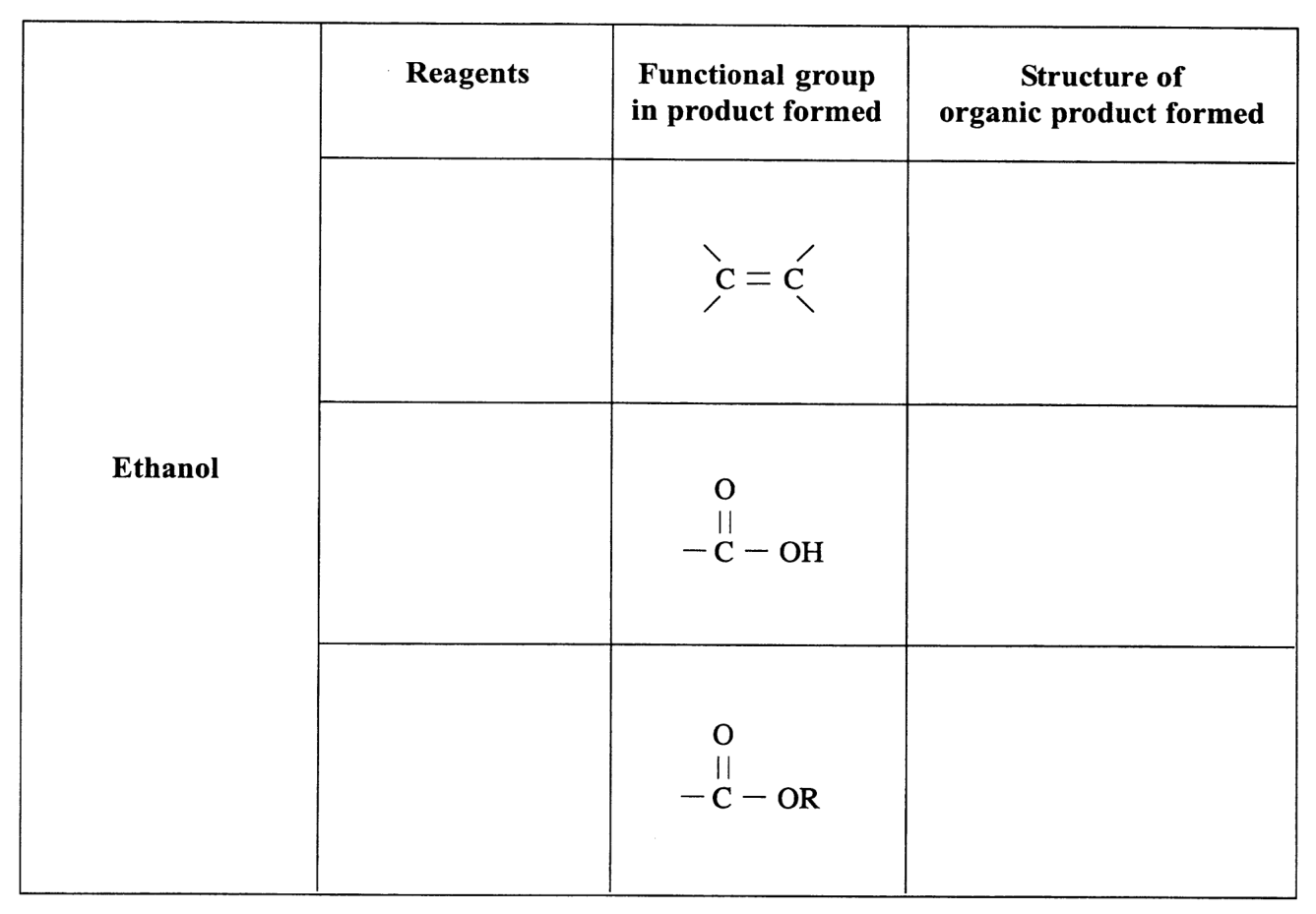
Complete Table 4 by a) identifying the reagents b) drawing the fully displayed structures of the products.
[8 marks]
Define 'structural isomerism'.
[1 mark]
Draw fully displayed structures of but-1-ene and but-2-ene.
But-1-ene But-2-ene
[2 marks]
Draw and name ONE OTHER structural isomer of .
[2 marks]
State ONE physical property of .
[1 mark]
Ethanol will react under different conditions to produce compounds with the following functional groups:
What is meant by a 'functional group'?
[1 mark]
Ethanol reacts with different reagents to form products with the functional groups shown in Table 4.
Complete Table 4 by a) identifying the reagents b) drawing the fully displayed structures of the products.
| Reagents | Functional group in product formed | Structure of organic product formed |
|---|---|---|
| Ethanol | <br> $\text{ | |
| <br> $\text{ |
[8 marks]
SECTION B
Answer ALL questions in this section.
Write your answers in the answer booklet provided.
Barium (Ba) is below calcium in the same group in the periodic table.
[15 marks]
Barium (Ba) is below calcium in the same group in the periodic table.
[12 marks]
Draw a fully labelled diagram of the apparatus which could be used in the electrolysis of molten . You should indicate the material from which the electrodes are made.
[3 marks]
Write equations to indicate the chemical reactions which occur at the electrodes.
[4 marks]
A current of 5A is passed for 2 minutes through the molten . Calculate the mass of the product that will be formed at the cathode.
(Relative atomic mass: Ba = 137, Br = 80) (1 Faraday = 96 500 C )
[5 marks]
List TWO factors which can in general affect the products formed during electrolysis of compounds.
[2 marks]
State ONE reason why the reaction of barium with water is faster than the reaction of calcium with water.
[1 mark]
Organic compounds may be classified as either saturated or unsaturated. Their characteristic reactions are quite different and are related to the type of bonding present in these molecules.
Consider the following compounds, A to D below, and answer the questions which follow.
A
B
C
D
[15 marks]
From the compounds A to D above, select ONE compound which is saturated and ONE compound which is unsaturated.
[6 marks]
From the compounds A to D above, select ONE compound which is saturated and ONE compound which is unsaturated.
[2 marks]
Name AND give the general formula for the homologous series to which EACH of the two compounds selected in (a) (i) above belongs.
[4 marks]
Nitrogen constitutes about 78% of the gases in the atmosphere. It exists as very stable diatomic molecules. It undergoes very few but important reactions (called fixation reactions) to produce nitrogenous compounds required by plants.
Nitrogen is "fixed" by the Haber process according to the following equation:
With reference to the nitrogen cycle:
[2 marks]
Name ONE process by which nitrogen in the atmosphere can be converted into nitrates.
[1 mark]
Name ONE process by which nitrogen in the nitrates in soil is released back into the atmosphere.
[1 mark]
Two metal nitrates, P and Q, are separately heated. P gives off a colourless gas which rekindles a glowing splint. Q gives off a brown gas.
[4 marks]
Which of these two metal nitrates, P or Q, possibly contains
[2 marks]
Write a chemical equation to show the reaction taking place when Q is heated.
[2 marks]
SECTION C
Answer ONE question from this section.
Write your answers in the answer booklet provided.
When silica is mixed with sodium carbonate and calcium carbonate and heated strongly, the mixture forms a transparent liquid which, when cooled, becomes glass. Different types of glass can be produced by varying the proportions of these reactants and by adding other substances.
[15 marks]
When silica is mixed with sodium carbonate and calcium carbonate and heated strongly, the mixture forms a transparent liquid which, when cooled, becomes glass. Different types of glass can be produced by varying the proportions of these reactants and by adding other substances.
[6 marks]
State TWO benefits of adding sodium carbonate or calcium carbonate to silica in the manufacture of glass.
[2 marks]
State how the basic components of glass are modified to produce
[4 marks]
Glass is a non-crystalline solid which melts over a wide range of temperatures. It consists mainly of silicates (). The chemical bonds in the tetrahedron are not all of the same strength.
[9 marks]
Why is it important that glass does NOT crystallize as it cools?
[2 marks]
Suggest how the bonding in affects what happens when glass melts. Explain why this is important for blowing and moulding glass.
[3 marks]
Although no scarce and vital raw material is used in the manufacture of glass, recycling of glass is strongly recommended. Suggest TWO reasons for this.
[2 marks]
Glass is now widely used as a construction material in buildings. State ONE advantage and ONE disadvantage of using glass in this way.
[2 marks]
Soil is the most important medium required for plant growth. It consists mainly of mineral and organic matter. Some of the organic matter does not decompose. It remains in the soil for a long time as humus. The optimum pH range of soil is 6.0 to 6.8.
[15 marks]
State the importance of EACH of the following factors in plant growth:
[4 marks]
Mineral balance
[1 mark]
pH
[1 mark]
Humus content of the soil
[2 marks]
A farmer observes that the leaves of his bean crop are few in number and yellow in colour. The Agricultural Extension Officer decides to test the farmer's soil for ammonium and iron (III) ions, as well as for its pH.
[6 marks]
Briefly describe the test for the presence of ammonium ions in a soil sample.
[2 marks]
The Officer finds the soil to be acidic and recommends the addition of lime.
[4 marks]
In addition to adding the recommended lime to the soil, also decides to add an ammonium fertilizer, thinking that it would increase his crop yield.
Do you think that the farmer's decision to add both lime and ammonium fertilizer to the soil at the same time is a wise one? Give ONE reason for your answer. Include any relevant chemical equation.
[5 marks]
[8 marks]
The pressure used in ammonia plants today is about 200 – 300 atmospheres and the temperature about 400 – 500°C.
Suggest reasons for using these reaction conditions. Explain your answer in terms of the equation above.
[3 marks]