
Free CXC Chemistry Paper 2 May/June 2014 past paper from 2014. Includes a worked answer key. Open the PDF, take a timed test, and study with AI on Caribbean AI.
Answer keys are free on Caribbean AI. View the answers to every past-paper question at no cost - no payment needed - with step-by-step worked solutions and instant AI marking available on Premium.
CSEC Chemistry Paper 2 May/June 2014 - Free CXC Past Paper with Answers
Free CXC Chemistry Paper 2 May/June 2014 past paper from 2014. Includes a worked answer key. Open the PDF, take a timed test, and study with AI on Caribbean AI.
Opening the interactive papers…
Every question from this paper as text. See the answers and worked solutions. Questions are the property of the Caribbean Examinations Council; Caribbean AI is not affiliated with CXC.
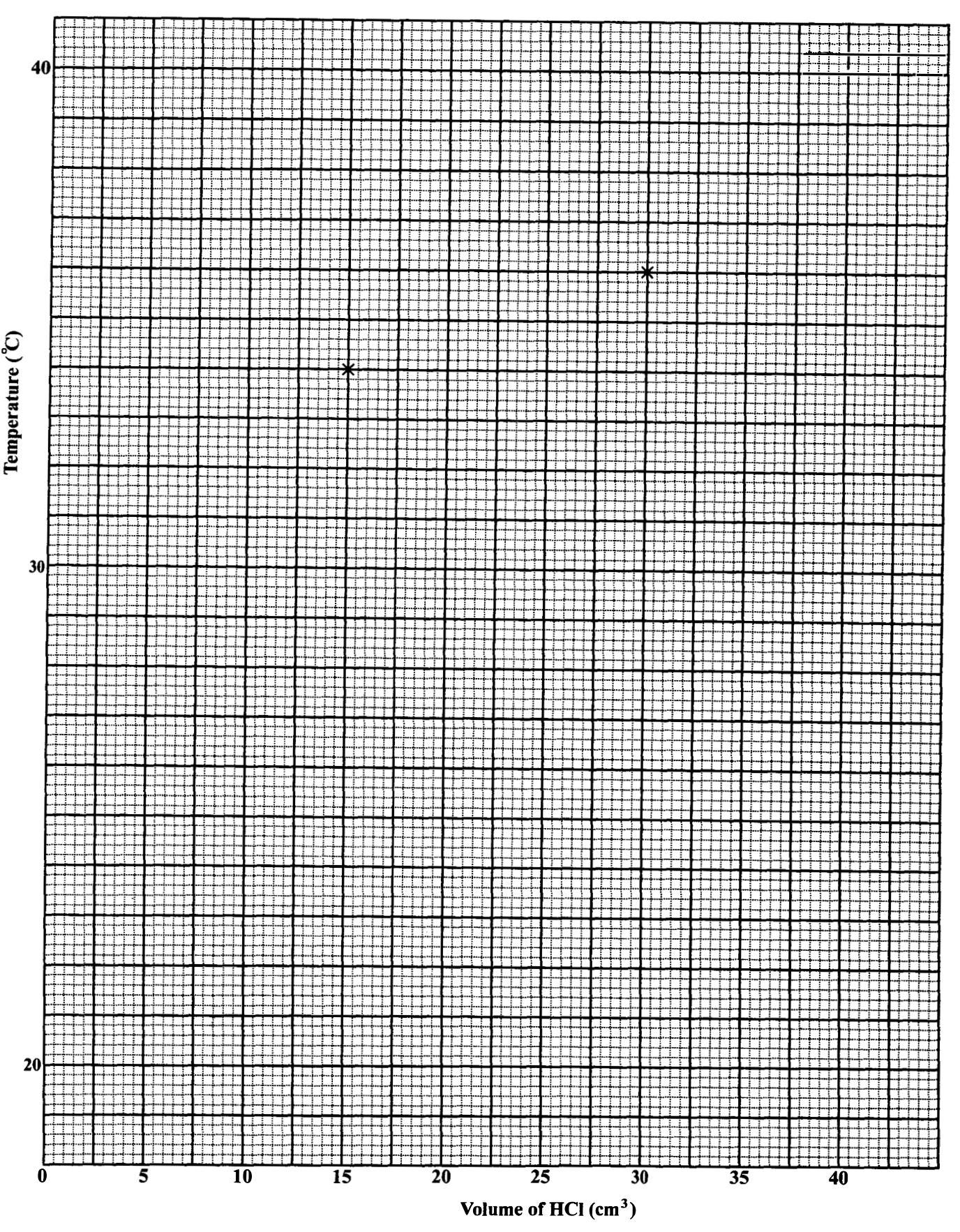
The heat of neutralization can be determined by measuring the temperature change when various volumes of acid are reacted with a base. Experiment 1 was carried out to determine the heat of neutralization for the reaction between potassium hydroxide and dilute hydrochloric acid. Portions of hydrochloric acid were added to of aqueous potassium hydroxide in a plastic cup and stirred. The highest temperature reached after each addition was recorded and the results obtained are presented in Table 1.
TABLE 1: RESULTS FROM EXPERIMENT 1
| Volume of Hydrochloric Acid Added () | 0 | 5 | 10 | 15 | 20 | 25 | 30 | 35 |
|---|---|---|---|---|---|---|---|---|
| Temperature of Mixture () | 27 | 29 | 31 | 34 | 36 | 38 | 36 | 33 |
[3 marks]
Use the data from Table 1 to plot a graph of temperature against volume of acid using the axes provided in Figure 1 on page 3. Two of the points have been plotted for you.
[4 marks]
From the graph in (a) (i), determine the volume of acid required to neutralize of potassium hydroxide.
[1 mark]
Determine the temperature difference during the reaction.
[1 mark]
Calculate the heat change at the point of neutralization for the reaction between potassium hydroxide and hydrochloric acid.
[The specific heat capacity of solution is . Assume that the density of the solution is , .]
[3 marks]
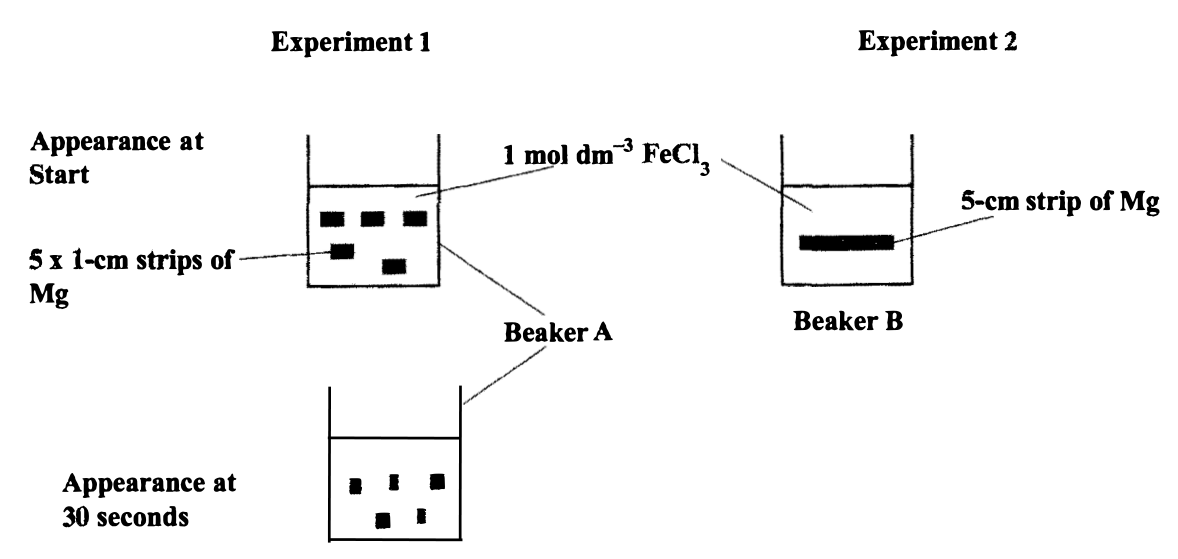
Sam conducted a series of experiments to investigate the effects of various factors on the rate of the reaction between magnesium and iron(III) chloride solution. Two strips of magnesium ribbon were measured.
One of the strips was further cut into five strips and placed into of the iron(III) chloride solution.
The other strip was placed into an equal volume of the iron(III) chloride solution.
Figure 2 shows the reactants that were used to investigate the effect of one factor on the rate of reaction at the start and after 30 seconds.
[11 marks]
Suggest a suitable aim for this experiment.
[2 marks]
Describe what will happen to the contents of Beaker A after 30 seconds.
[2 marks]
Write a suitable ionic equation for the reaction occurring in Beaker A.
[2 marks]
How would the contents of Beaker B differ from the contents of Beaker A after each is left for 30 seconds?
[2 marks]
Explain your answer in (iv) above.
[3 marks]
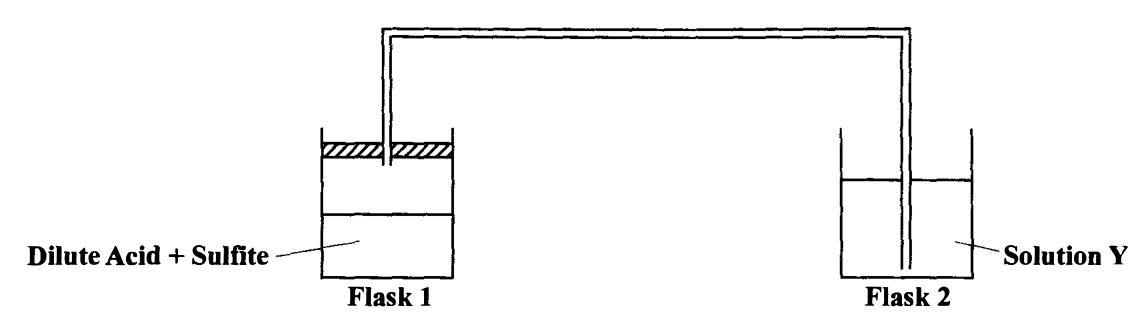
Some students were required to determine whether an unknown substance contained the sulfite ion. Figure 3 shows the arrangement of apparatus for the procedure used to carry out the test.
[8 marks]
Identify Solution Y.
[1 mark]
With reference to Solution Y identified in (i) above, explain the changes that would be observed in Flask 2 if the unknown substance contained the sulfite ion.
Expected changes:
Explanation:
[3 marks]
How would you modify the experiment to confirm the presence of carbonate instead of the sulfite ion?
[1 mark]
The positions of three unknown elements, X, Q and Z, are shown in the Periodic Table in Figure 4.
| I | II | III | IV | V | VI | VII | VIII | ||
|---|---|---|---|---|---|---|---|---|---|
| Na | Mg | O | |||||||
| K | Z | ||||||||
| X |
Figure 4. A part of the Periodic Table
[15 marks]
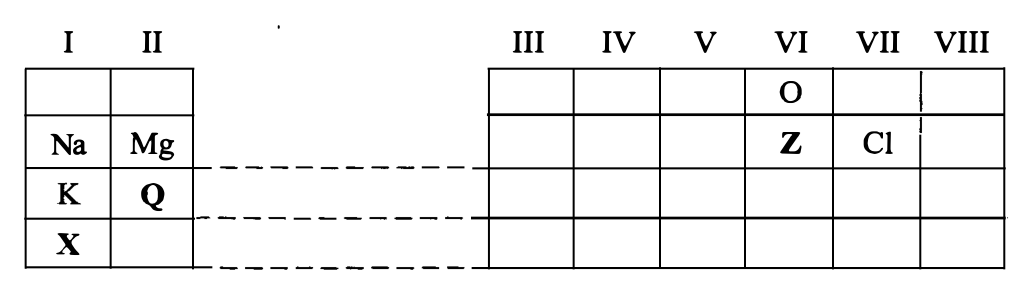
Based on the position of Element X in the Periodic Table, state whether it would react more vigorously or less vigorously with water than K would react.
[1 mark]
Would the solution formed from the reaction of X with water be acidic or basic?
Explain your answer.
[2 marks]
Write the electronic configuration for magnesium.
[1 mark]
Based on the position of Element Q, write the formula for its carbonate.
Formula:
[1 mark]
Write a balanced chemical equation for the reaction of the carbonate of Q with dilute hydrochloric acid.
Equation:
[2 marks]
Sodium reacts with Element Z to form a compound. State whether this compound is ionic or covalent, and explain your answer.
[3 marks]
Calcium nitrate decomposes under strong heat according to the following equation:
What visible change would be observed when calcium nitrate decomposes?
[1 mark]
If grams of calcium nitrate are decomposed completely, calculate the volume of nitrogen dioxide produced at RTP.
[One mole of a gas occupies at RTP; RMM of ]
Organic molecules can exist as different structural isomers. Define the term 'structural isomers'.
Definition:
[2 marks]
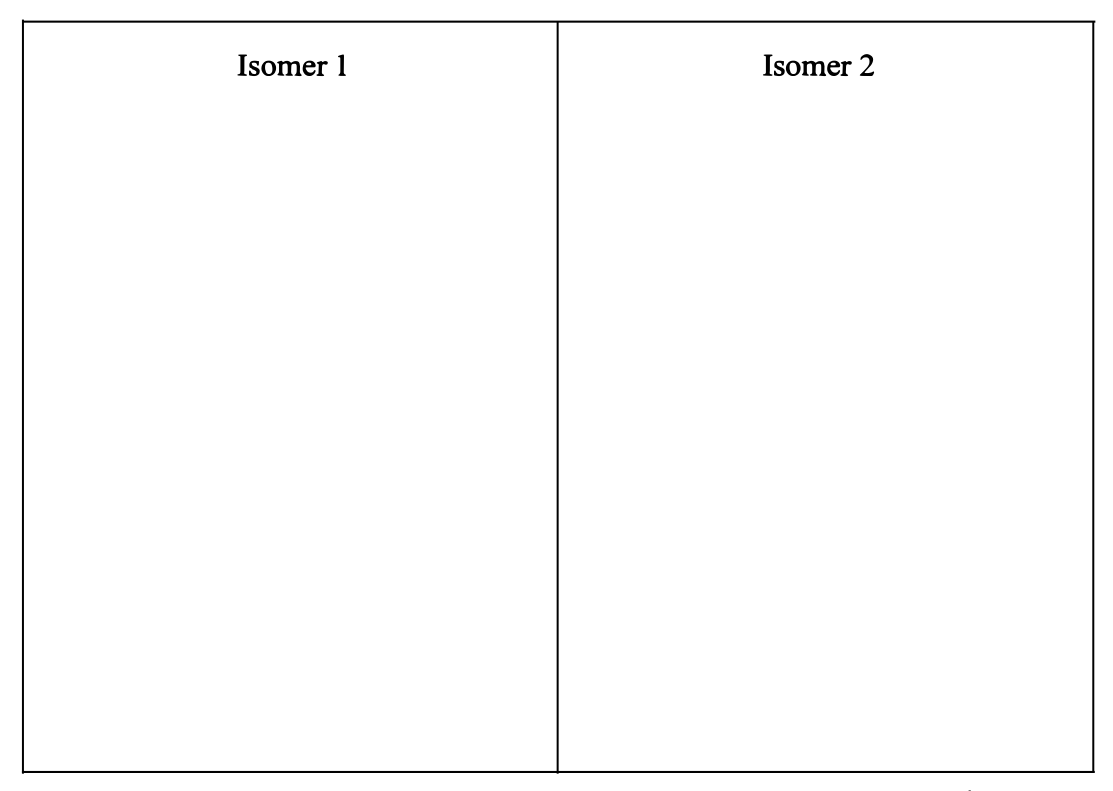
Molecules with the formula can exist as structural isomers. In the space provided below, draw FULLY DISPLAYED structures of TWO isomers with formula .
Isomer 1 Isomer 2
[4 marks]
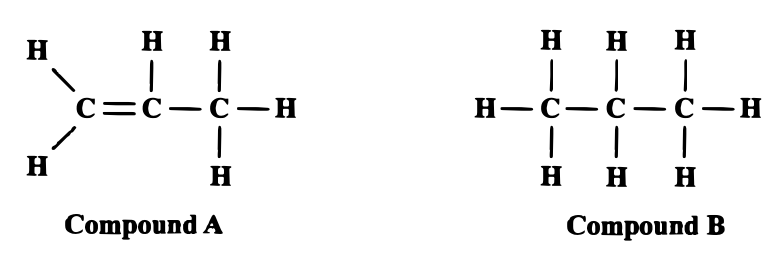
The two hydrocarbons, Compound A and Compound B, shown below are gases at room temperature.
[4 marks]
Describe briefly ONE test that could be used to distinguish between Compound A and Compound B. Test: Observation:
[2 marks]
Both Compound A and Compound B burn in oxygen. Write a balanced chemical equation for the burning of Compound B in excess oxygen. Equation:
[2 marks]
Give ONE use for Compound A and Compound B. Use for Compound A: Use for Compound B:
[2 marks]
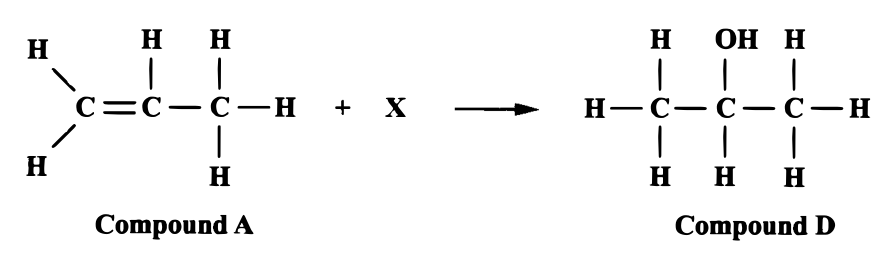
Compound A reacts with X, in the presence of concentrated at , to form Compound D, as shown in the following equation.
Identify X.
[1 mark]
State the name of Compound D and the homologous series to which it belongs. Name: Homologous series:
[2 marks]
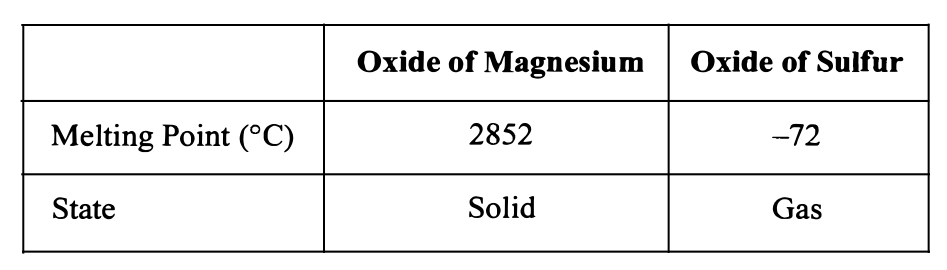
SECTION B Write your responses in the spaces provided in this booklet. Magnesium and sulfur are two elements in the same period of the Periodic Table. The oxides of these elements show different properties as presented in Table 2.
| Oxide of Magnesium | Oxide of Sulfur | |
|---|---|---|
| Melting Point () | 2852 | -72 |
| State | Solid | Gas |
[10 marks]
With reference to the bonding, account for the differences in states and melting points of the oxides of magnesium and sulfur.
[6 marks]
Explain whether the oxides will conduct electricity and, if so, under what conditions.
[4 marks]
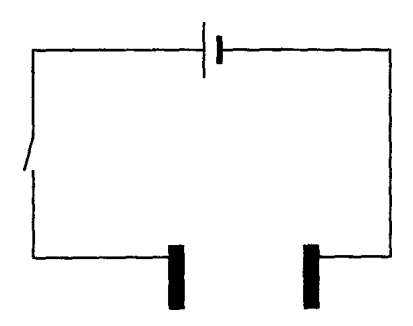
Figure 5 is a diagram of the apparatus proposed by a group of students to investigate whether aqueous lead(II) nitrate, ethanol and aqueous ammonia would conduct electricity.
[5 marks]
Why is the circuit as represented in Figure 5 not suitable to achieve the aim of the experiment?
[1 mark]
Modify the diagram to produce a circuit that is suitable for achieving the aim of this experiment.
[2 marks]
Classify the three substances to be investigated (aqueous lead(II) nitrate, ethanol and aqueous ammonia) EITHER as conductors OR non-conductors.
[2 marks]
Figure 6 shows an experiment that was set up with copper(II) sulfate solution and two metal foils: zinc and silver.
<image: Figure 6. Reaction of silver and zinc foils with copper(II) sulfate>
[15 marks]
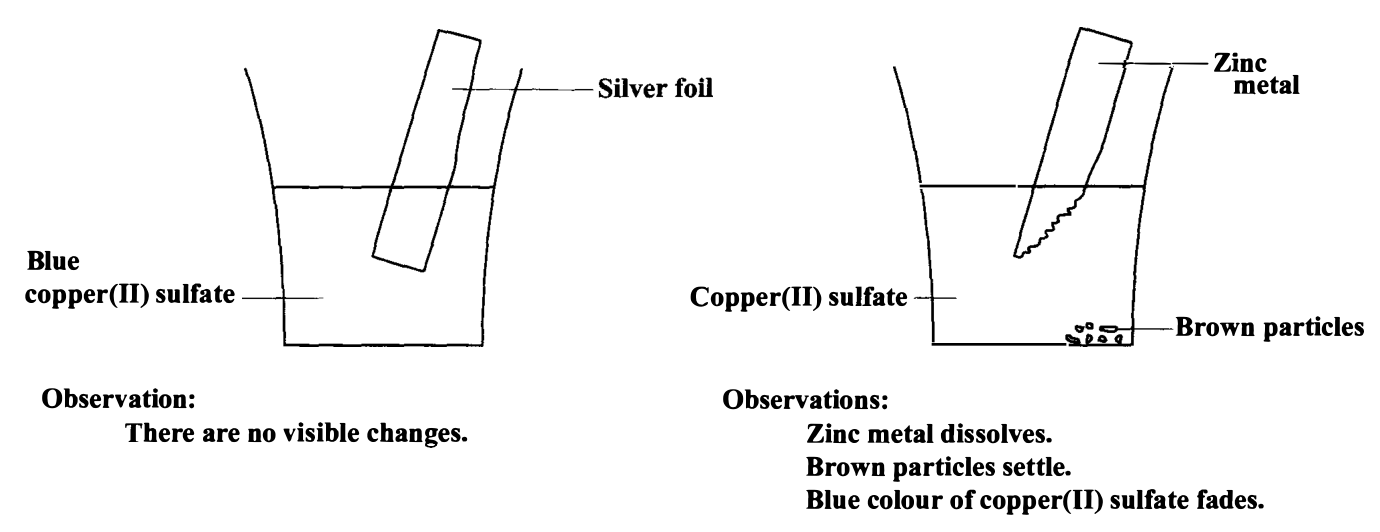
Write a balanced equation with state symbols for the reaction that occurs between zinc and the copper(II) sulfate solution.
[6 marks]
Explain why the zinc foil reacted with the copper(II) sulfate solution but the silver foil did not.
[4 marks]
Would aluminium displace copper from the copper(II) sulfate solution? Give a reason for your answer.
[2 marks]
Iron corrodes easily under the appropriate conditions to form rust. There are various methods that can be used to prevent the corrosion of iron.
[3 marks]
List the conditions necessary for the corrosion of iron.
[2 marks]
Why is painting effective in preventing iron from rusting?
[1 mark]
Explain why duralumin is used in preference to aluminium for the manufacture of aircraft.
[4 marks]
A group of farmers noticed that their crops were yellowing and the leaf tips curling. One of the farmers suggested that the soil lacked nutrients and that fertilizers would help. Another suggested that the soil was too acidic and that adding lime would help.
As a consultant, you are required to make a presentation advising the farmers on how to address the problem.
In your presentation you should include: (a) A suggestion of which nutrients the soil could be missing. Give a reason for your suggestion. (b) TWO advantages of using organic manure rather than commercial fertilizers. (c) ONE disadvantage of using organic manure rather than commercial fertilizers. (d) A description of a test of soil acidity. (e) The chemical name and formula for lime. Advise when lime should be used. (f) A reason why lime should NOT be added to the soil at the same time as a commercial ammonium fertilizer. Include a balanced chemical equation to support your answer.
Write your answer to Question 6 here.
[15 marks]
A suggestion of which nutrients the soil could be missing. Give a reason for your suggestion.
[4 marks]
TWO advantages of using organic manure rather than commercial fertilizers.
[2 marks]
ONE disadvantage of using organic manure rather than commercial fertilizers.
[1 mark]
A description of a test of soil acidity.
[3 marks]
The chemical name and formula for lime. Advise when lime should be used.
[2 marks]
A reason why lime should NOT be added to the soil at the same time as a commercial ammonium fertilizer. Include a balanced chemical equation to support your answer.
[3 marks]
[4 marks]
[3 marks]
[3 marks]