(a)(i) 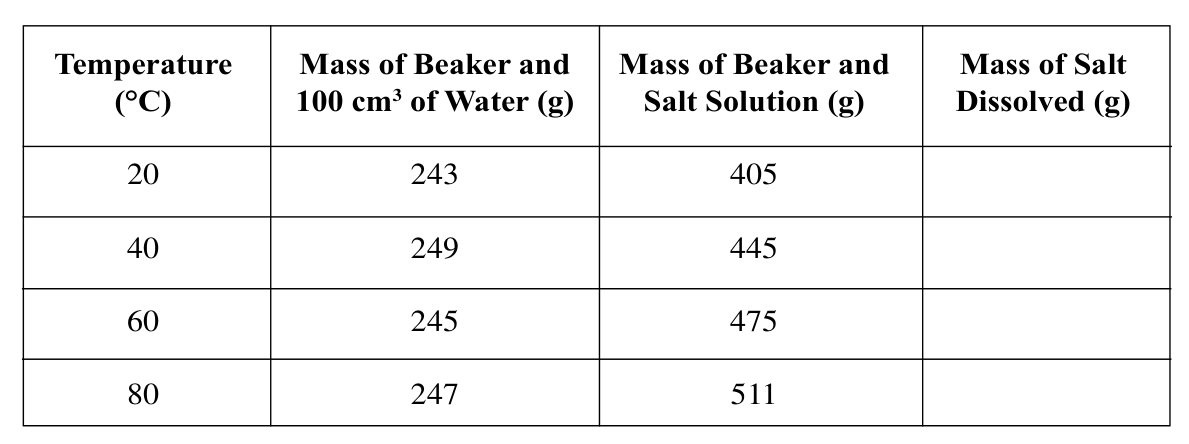
For EACH temperature in Table 1, calculate the mass of potassium iodide that was dissolved in the beaker of water, and record the value in the space provided.
[2 marks]
Free CXC Chemistry Paper 2 May/June 2013 past paper from 2013. Includes a worked answer key. Open the PDF, take a timed test, and study with AI on Caribbean AI.
Answer keys are free on Caribbean AI. View the answers to every past-paper question at no cost - no payment needed - with step-by-step worked solutions and instant AI marking available on Premium.
CSEC Chemistry Paper 2 May/June 2013 - Free CXC Past Paper with Answers
Free CXC Chemistry Paper 2 May/June 2013 past paper from 2013. Includes a worked answer key. Open the PDF, take a timed test, and study with AI on Caribbean AI.
Opening the interactive papers…
Every question from this paper as text. See the answers and worked solutions. Questions are the property of the Caribbean Examinations Council; Caribbean AI is not affiliated with CXC.
Peter was asked by his teacher to design an experiment to investigate how the solubility of a salt, potassium iodide (KI), varied with temperature. The procedure that Peter used is outlined below.
Procedure
TABLE 1: MASS OF POTASSIUM IODIDE SOLUTION AT VARYING TEMPERATURES
(Table 1 is referenced here, which contains columns for Temperature (°C), Mass of Beaker and of Water (g), Mass of Beaker and Salt Solution (g), and Mass of Salt Dissolved (g). This table will be rendered as an image.)
For EACH temperature in Table 1, calculate the mass of potassium iodide that was dissolved in the beaker of water, and record the value in the space provided.
[2 marks]
On Figure 1, plot mass of salt dissolved (solubility) against temperature, and draw a straight line through the points.
(Figure 1 is a graph grid with axes labelled "Mass of salt dissolved (g) OR Solubility (g per )" and "Temperature (°C)". This figure will be rendered as an image.)

[3 marks]
From the graph, determine the solubility (in grams per ) of potassium iodide at .
[1 mark]
of distilled water is saturated with potassium iodide at . Calculate the mass of potassium iodide that will be precipitated out from solution, if this solution is then cooled down to .
[2 marks]
Calculate the concentration () of a saturated solution of potassium iodide at . (RAM: K = 39, I = 127).
[3 marks]
"Potassium iodide is soluble in water but not very soluble in ethanol."
Explain why the statement above is true.
[4 marks]
You are provided with a mixture of solid sodium sulfate and sodium chloride.
Plan and design an experiment to obtain either solid sodium sulfate or solid sodium chloride from the mixture. Your answer should include the following:
A suggested list of apparatus and chemicals which you will use in obtaining the pure solid sample of EITHER of the two salts.
[1 mark]
An outline of the steps for the procedure to be used.
[3 marks]
List the MAIN observations that will be expected at EACH stage of the experiment.
[2 marks]
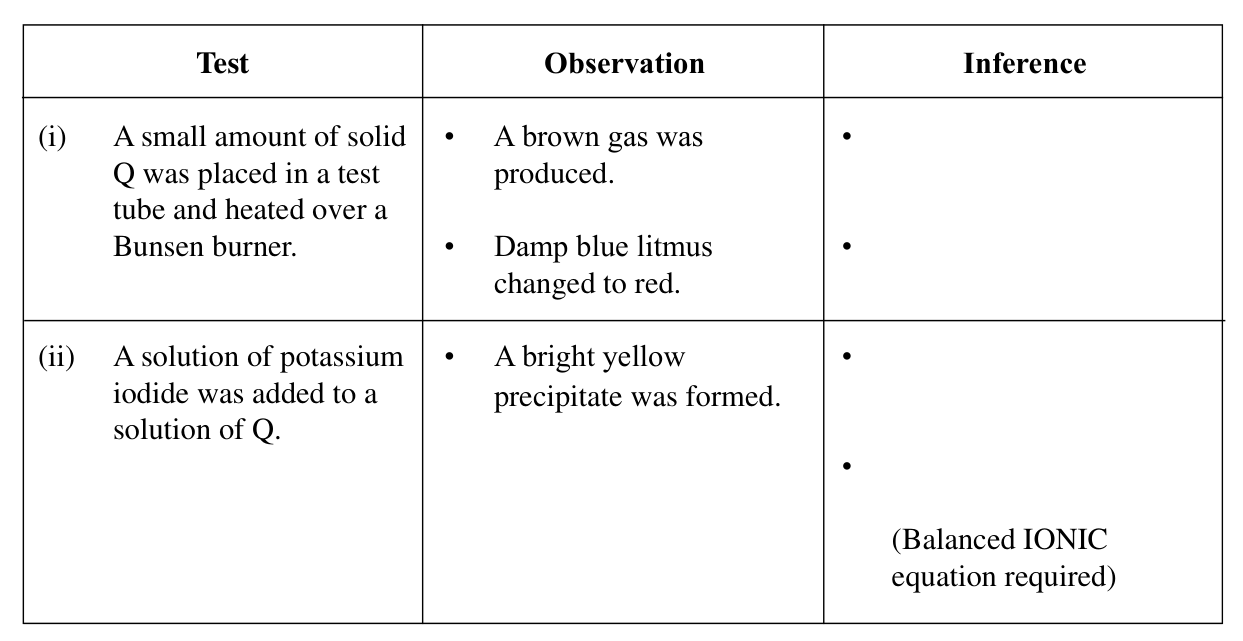
Table 2 shows the tests performed on a substance labelled Q and the observations of the tests.
Complete the table by inserting the appropriate inferences.
TABLE 2: TEST FOR IONS PRESENT IN Q
(Table 2 is referenced here, which contains columns for Test, Observation, and Inference. This table will be rendered as an image.)
[4 marks]
Figure 2 shows a section of a periodic table with two unknown elements represented as X and Y. Use the figure to answer the questions that follow.
N.B. You are not required to identify X and Y.
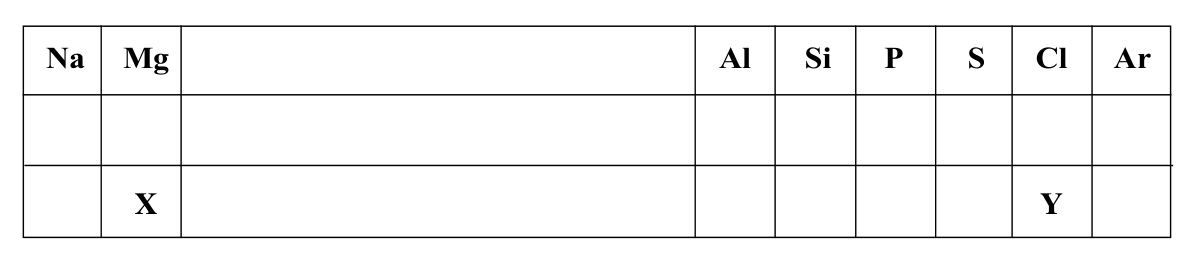
Compare Mg and X in terms of the ease of ionization, and Cl and Y in terms of the strength of oxidizing power. Provide a suitable explanation for your answer in EACH case.
Comparison of Mg and X according to ease of ionization
Explanation
[3 marks]
Comparison of Cl and Y according to strength of oxidizing power
Explanation
[3 marks]
State ONE physical property that is similar for both X and Y, and ONE physical property which is different.
Similar physical property
[1 mark]
Different physical property
[1 mark]
Element Y will bond with phosphorous to form a compound.
State the type of bonding that occurs between phosphorous and Element Y.
[1 mark]
Referring to only the electrons in the outer shells of the elements, sketch a diagram to show the bonding between phosphorous and Y.
[3 marks]
Write the chemical formula for the compound formed from phosphorous and Y. Suggest TWO properties of this compound.
[3 marks]
Cracking is a very important process in the petroleum industry. Explain what is meant by the term 'cracking'.
[2 marks]
Glucose is a small molecule that contains several OH groups, and can be polymerized to form starch.
Draw a structural representation of glucose.
[1 mark]
Use THREE units of glucose (monomer from Part (b) (i)) to show how the monomers are linked together in a partial structure of starch.
[2 marks]
State the type of polymerization reaction that glucose undergoes to form starch, and the name of the family of polymers to which starch belongs.
[2 marks]
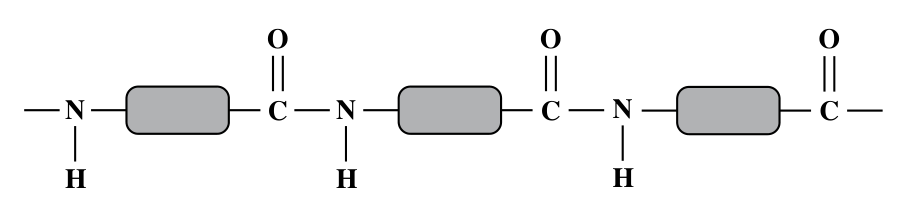
Proteins are naturally occurring polymers. The partial structure of a protein molecule is shown in Figure 3.
[7 marks]
Describe how the structure of the protein is affected by acid hydrolysis.
[2 marks]
Draw the structure of the monomer unit that results from the acid hydrolysis of the structure shown in Figure 3.
[2 marks]
The structures of four monomers, P, Q, R and S, are shown below:
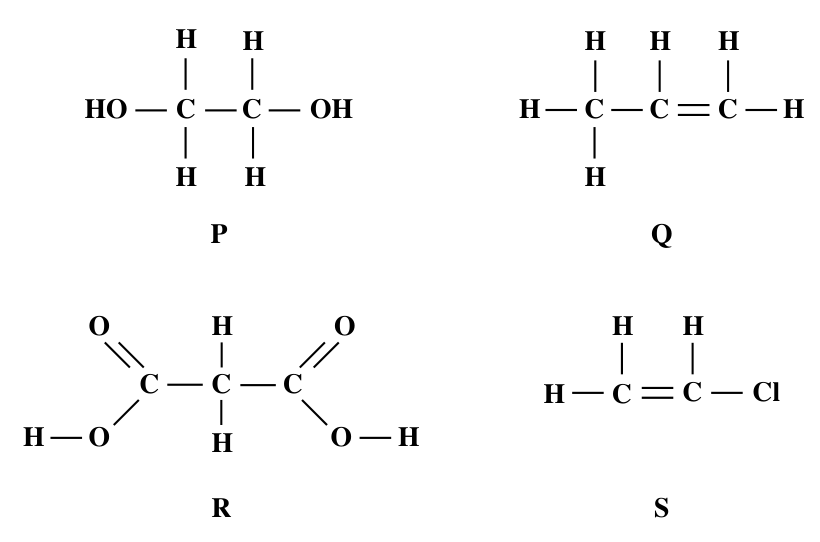
[4 marks]
Identify a) TWO monomers that will undergo condensation polymerization b) ONE monomer that will undergo addition polymerization.
[2 marks]
State the name of the family of polymers that will be formed when monomers P and R react together.
[1 mark]
SECTION B Answer ALL questions in this section. Write your responses in the spaces provided in this booklet.
State FOUR factors that can influence the rate of reaction.
[4 marks]
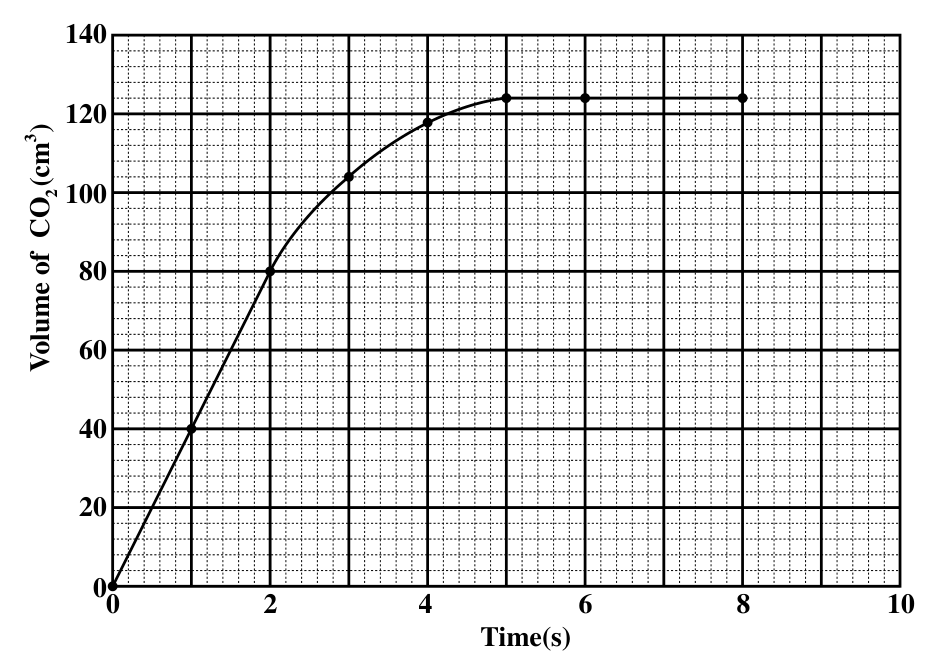
An experiment was carried out by a group of students in which an unknown mass of calcium carbonate chips was added to an excess of hydrochloric acid. At specific times, the volume of evolved was measured using a gas syringe. The results were plotted and produced the graph shown in Figure 4.
Equation for the reaction:
[5 marks]
Use the graph in Figure 4 to determine the total volume of produced.
[1 mark]
Calculate the mass of used in the experiment.
[RAM: Ca = 40, C = 12, O = 16]
[2 marks]
One of the students suggested that powdered calcium carbonate should have been used instead of chips. State, with reason, how the time for completion of the experiment would have been affected.
[2 marks]
Manganese is above hydrogen in the electrochemical series. One important alloy of manganese is duralumin. Duralumin contains $95%$ aluminium, $4%$ copper and traces of magnesium and manganese.
Explain why metals are often combined to make alloys.
[2 marks]
Other than electrolysis, describe a suitable laboratory procedure that could be used to obtain a sample of dry copper from a sample of the alloy.
Write your answer to Question 4 here.
[4 marks]
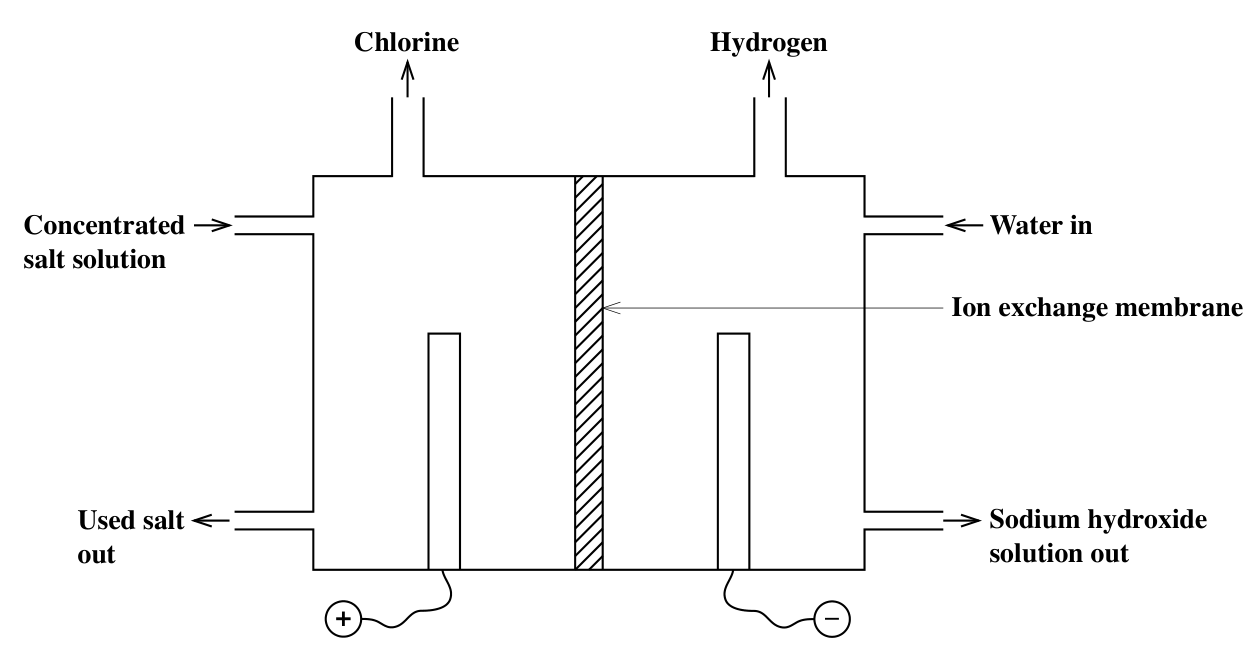
Figure 5 is a diagram of a cell used in the industrial preparation of chlorine by electrolysis.
[15 marks]
Outline the industrial preparation of chlorine using a cell such as the one shown in Figure 5. Include in your answer
the name of the electrolyte and ions present
[2 marks]
an explanation for which ions are preferentially discharged at the electrodes
[2 marks]
ionic equations showing the reactions at EACH electrode
[4 marks]
the role of the ion exchange membrane in the diagram.
[1 mark]
An experiment was carried out to purify copper by electrolyzing copper(II) sulfate solution using the impure copper as the anode and a pure copper cathode.
State what is expected to happen to the anode during the experiment.
[1 mark]
Calculate the mass of pure copper that would be produced during the experiment if a current of flowed for . (Molar mass of )
[5 marks]
There is an international effort to reduce the effect of pollution in the environment. Two main effects of pollution are ozone depletion and global warming.
For EACH of the main effects of pollution (ozone depletion, global warming)
name the MAIN pollutant responsible
[2 marks]
state TWO harmful effects.
[4 marks]
Caribbean hoteliers are required to play their part in preserving the environment by 'going green'.
Suggest TWO ways in which hoteliers may 'go green' in addressing EACH of the following issues within their hotels.
Water use
[2 marks]
Garbage disposal
[2 marks]
Energy use
[2 marks]
International agencies are strongly recommending the setting up of common international standards for pollution control which countries must follow.
State your opinion (position) on this statement and provide TWO points to justify your position.
[3 marks]