Free CXC Chemistry Paper 2 May/June 2007 past paper from 2007. Includes a worked answer key. Open the PDF, take a timed test, and study with AI on Caribbean AI.
Answer keys are free on Caribbean AI. View the answers to every past-paper question at no cost - no payment needed - with step-by-step worked solutions and instant AI marking available on Premium.
CSEC Chemistry Paper 2 May/June 2007 - Free CXC Past Paper with Answers
Free CXC Chemistry Paper 2 May/June 2007 past paper from 2007. Includes a worked answer key. Open the PDF, take a timed test, and study with AI on Caribbean AI.
Opening the interactive papers…
Every question from this paper as text. See the answers and worked solutions. Questions are the property of the Caribbean Examinations Council; Caribbean AI is not affiliated with CXC.
< ![CDATA[Do NOT spend more than 30 minutes on Question 1.
[30 marks]
A student is asked to make a solution of sodium hydroxide by dissolving an unknown mass of the pellets in 250 cm³ of water. 25.0 cm³ of the solution is then titrated against a standard solution of hydrochloric acid (0.050 mol dm⁻³) . Figure 1 below shows the initial and final volumes of the burette reading for the volume of acid added.
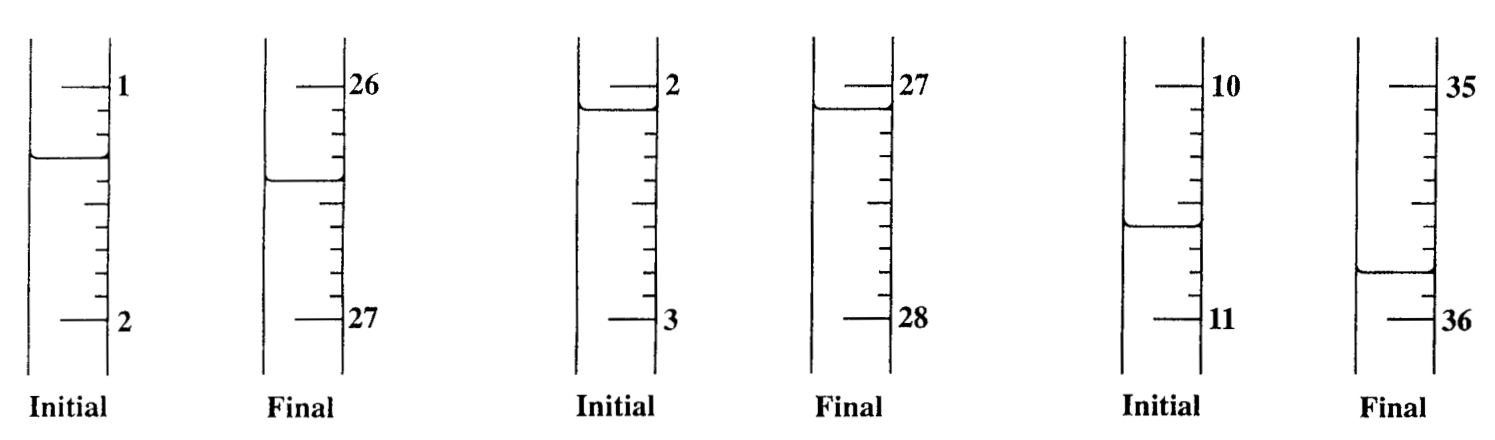
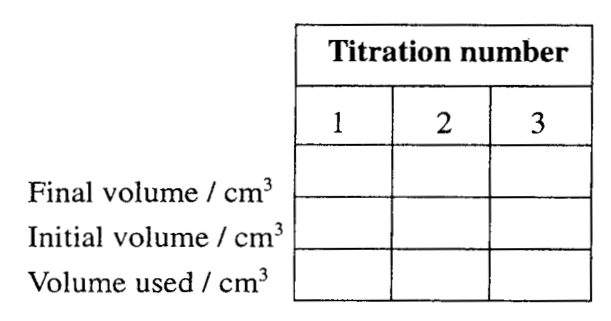
< ![CDATA[Use the information given in Figure 1 above to complete Table 1 below.
TABLE 1: RESULTS OF EXPERIMENT
[4 marks]
Write a chemical equation for the reaction that occurs during the titration.
[1 mark]
From the data in Table 1 calculate EACH of the following: The number of moles of hydrochloric acid used in the titration
[1 mark]
The number of moles of sodium hydroxide in 25.0 cm³ of the solution
[1 mark]
The number of moles of sodium hydroxide in 250 cm³ of solution
[1 mark]
Mass of sodium hydroxide dissolved in 250 cm³ of water (Relative atomic mass: Na = 23, O = 16, H = 1)
[2 marks]
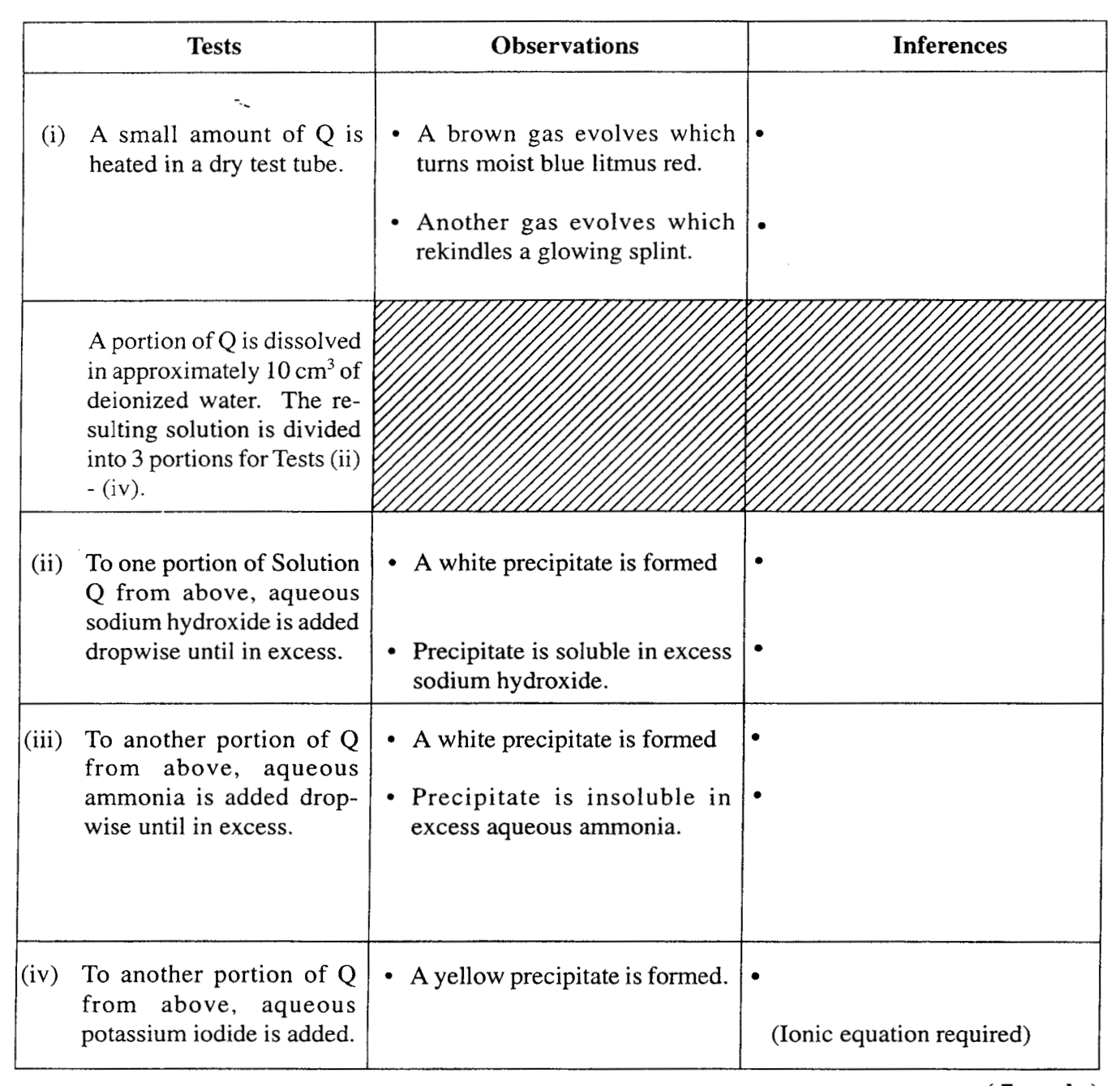
< ![CDATA[A student carries out the following tests on a solid, Q, and makes the observations recorded in Table 2 below. Complete Table 2 to show all possible inferences and write ionic equations where required.
TABLE 2: RESULTS OF TESTS ON SOLID Q
[8 marks]
Suggest the possible identity of Q.
[1 mark]
You are provided with a bottle of sea water which also contains some sand. Plan and design an experiment to recover the solid 'sea salt' from the mixture. Your answer should include the following:
A suggested list of apparatus which you would use in recovering the solid sea salt from the sandy sea water
[4 marks]
An outline of the steps for the procedure you could use
[4 marks]
List the main observations that would be expected at each stage of the experiment.
[2 marks]
A student suggests that solid sea salt contains chloride ions. How would you go about testing for chloride ions in the solid sea salt?
[2 marks]
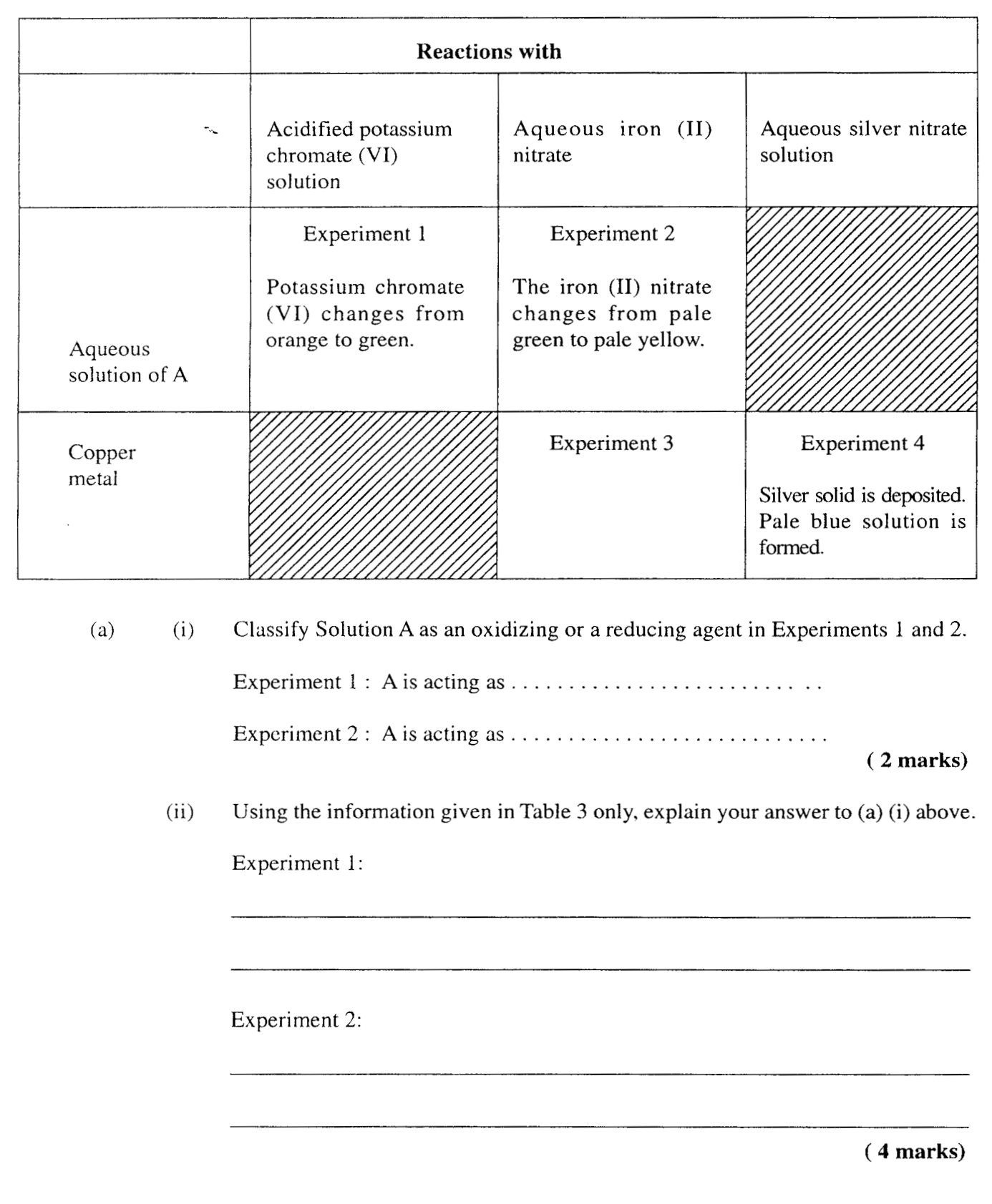
Table 3 presents some information on the reactions of Compound A and copper metal with various reagents. Use the information in Table 3 to answer the questions that follow.
TABLE 3: SOME REACTIONS OF COMPOUND A AND COPPER
Classify Solution A as an oxidizing or a reducing agent in Experiments 1 and 2. Experiment 1 : A is acting as . . . . . . . . . . . . . . . . . . . . . . . . . . . . . . . . . . Experiment 2 : A is acting as . . . . . . . . . . . . . . . . . . . . . . . . . . . . . . . . . .
[2 marks]
Using the information given in Table 3 only, explain your answer to (a) (i) above. Experiment 1: Experiment 2:
[4 marks]
< ![CDATA[
Write a balanced ionic equation to represent the reaction that occurs in Experiment 4.
[2 marks]
Account for the pale blue solution that is observed in Experiment 4.
[1 mark]
With reference to the electrochemical series, predict what you may be expected to observe in Experiment 3. Give a reason for your answer.
[3 marks]
When exposed to air for some time, copper ornaments become tarnished by green copper carbonate.
Suggest the name of a common household chemical that can be used to clean such tarnished copper ornaments.
[1 mark]
Write a suitable ionic equation to show the reaction in (d) (i) above.
[2 marks]
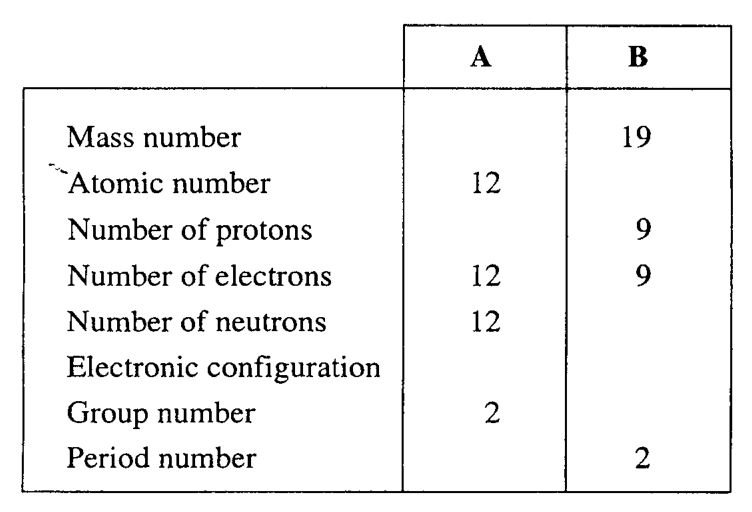
< ![CDATA[The information provided in Table 4 below refers to atoms of two elements, A and B.
[15 marks]
Complete Table 4 by writing the required information in the relevant spaces.
TABLE 4: ATOMIC PROPERTIES OF ELEMENTS A AND B
[4 marks]
What type of bonding would take place between A and B?
[1 mark]
Give a reason for your answer in (b) (i) above.
[2 marks]
< ![CDATA[Use dot cross diagrams to illustrate the bonding between A and B.
[2 marks]
Describe the bonding expected in A.
[2 marks]
Describe the bonding in graphite.
[2 marks]
Graphite is used as a lubricant. How does this use relate to its structure and bonding?
[2 marks]
X and Y are two hydrocarbons. When X is completely burnt in air, 0.50 moles of X produce 60 dm of CO and 3 moles of water at r.t.p.
Deduce the molecular formula of X. (1 mole of gas at r.t.p. has a volume of 24 dm.)
[4 marks]
Based on your answer in 4 (a) on page 9, deduce the homologous series to which X belongs.
[1 mark]
Write the name of Compound X.
[1 mark]
Draw the fully displayed structure of X.
[1 mark]
Y has the molecular formula, CH.
[4 marks]
To what homologous series does Y belong?
[1 mark]
Write the name of Compound Y.
[1 mark]
Draw the fully displayed structure of Y.
[2 marks]
What chemical test may be used to distinguish between Compounds X and Y? Reagent: Observation:
[2 marks]
What reagent and reaction conditions are necessary to convert Y to X? Reagent: Conditions:
[2 marks]
Define EACH of the following terms:
[4 marks]
Amphoteric oxide
[2 marks]
Acid anhydride
[2 marks]
Describe appropriate chemical tests, the results of which could be used to determine whether zinc oxide is amphoteric or whether it is an acid anhydride. Chemical tests:
[5 marks]
To determine if zinc oxide is amphoteric
[3 marks]
To determine if zinc oxide is an acid anhydride
[2 marks]
Sulphur (IV) oxide, a gaseous pollutant, dissolves in water droplets in the atmosphere and thus causes acid rain.
[2 marks]
Write the formula for sulphur (IV) oxide.
[1 mark]
Write an equation for the reaction between sulphur (IV) oxide and water.
[1 mark]
It has been suggested that the amount of polluting gases emitted into the atmosphere, such as the oxides of sulphur and nitrogen which are acidic, could be reduced by first passing exhaust air from factories through beds of powdered reagents.
Based on this information:
[4 marks]
Give the name of ONE reagent that could be used for this purpose. Support your answer by writing a chemical equation, using ONE of the named pollutants mentioned above.
[2 marks]
Suggest why the reagent you have named in (d) (i) above should be used in the powdered form.
[2 marks]