Free CXC Chemistry Paper 2 January 2026 past paper from 2026. Includes a worked answer key. Open the PDF, take a timed test, and study with AI on Caribbean AI.
Answer keys are free on Caribbean AI. View the answers to every past-paper question at no cost - no payment needed - with step-by-step worked solutions and instant AI marking available on Premium.
CSEC Chemistry Paper 2 January 2026 - Free CXC Past Paper with Answers
Free CXC Chemistry Paper 2 January 2026 past paper from 2026. Includes a worked answer key. Open the PDF, take a timed test, and study with AI on Caribbean AI.
Opening the interactive papers…
Every question from this paper as text. See the answers and worked solutions. Questions are the property of the Caribbean Examinations Council; Caribbean AI is not affiliated with CXC.
A student carried out the following tests on three solutions, A, B, and C, and made the inferences and observations which are recorded in Table 2. Complete Table 2 by filling in ALL the possible observations and inferences.
| Test | Observations | Inferences |
|---|---|---|
| (i) To a sample of Solution A, potassium iodide solution was added. | ions are present. | |
| (ii) To another sample of Solution A, dilute nitric acid was added. Any gas liberated was tested with lime water. | absent. |
| (iii) To a sample of Solution B, two drops of aqueous sodium hydroxide were added. | ions present. |
| More drops of aqueous sodium hydroxide were added until in excess. |
| (iv) To another sample of Solution B, a drop of silver nitrate solution was added followed by aqueous ammonia. | White precipitate formed. |
| (v) To a sample of Solution C, dilute sodium hydroxide was added dropwise. | No metal cation is present. |
| (vi) The resulting solution from (v) was then warmed and any gas liberated was tested with damp red litmus paper. | gas liberated, therefore ions present. |
[25 marks]
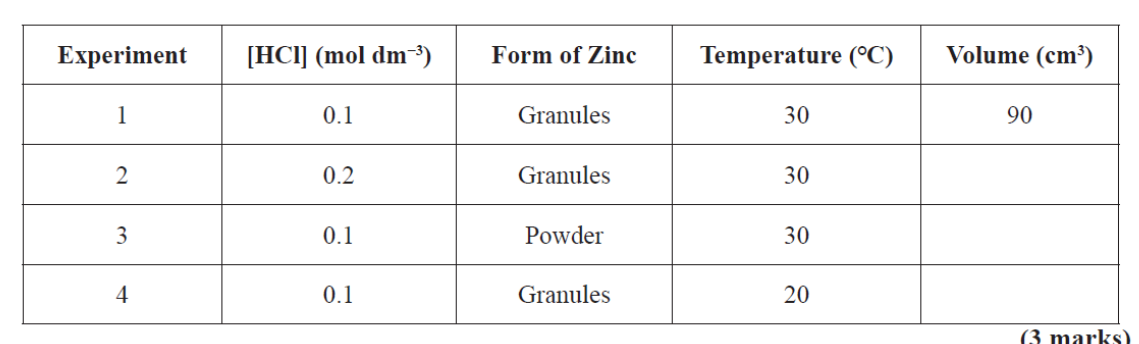
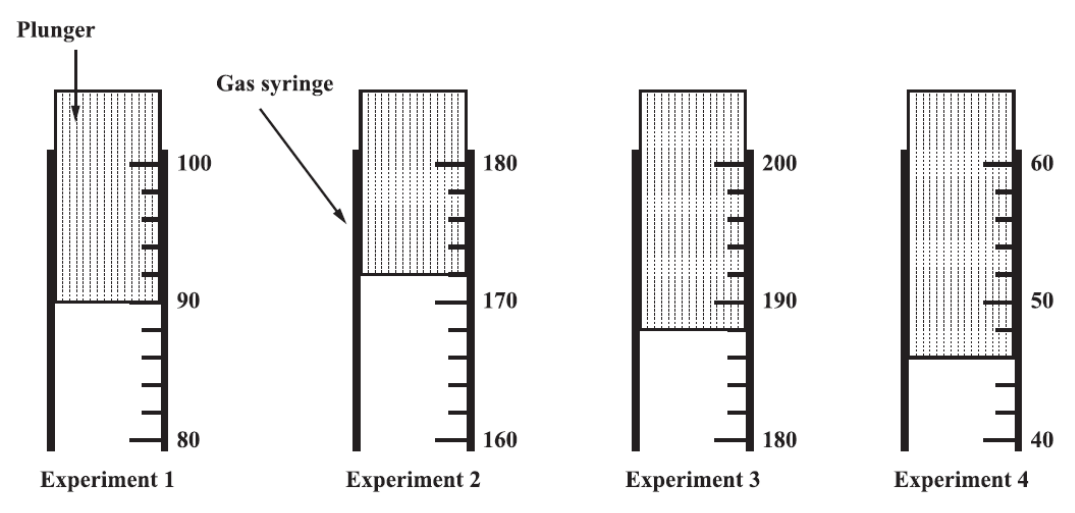
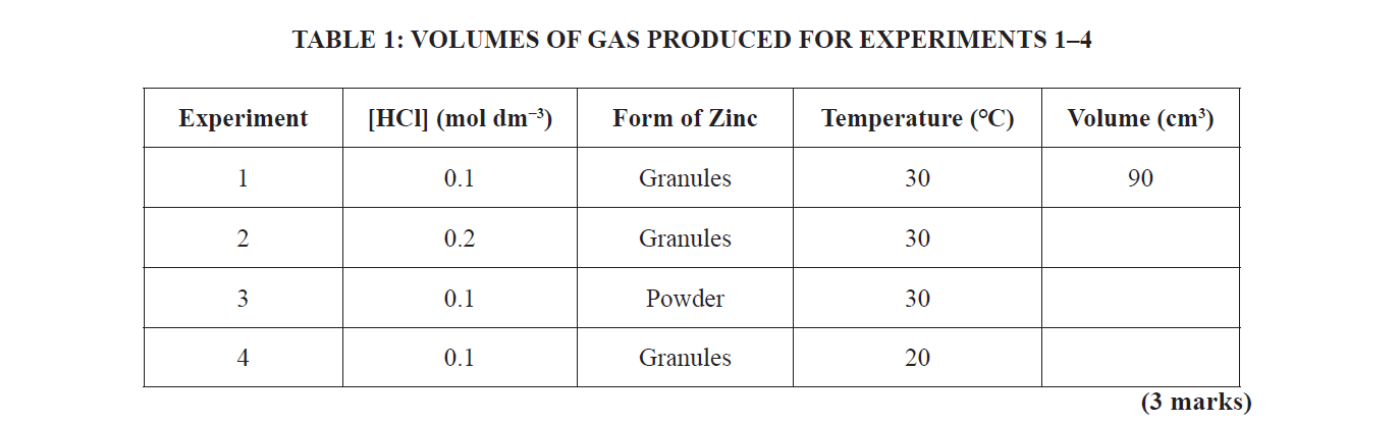
Complete Table 1 below by inserting the volume of gas produced for EACH experiment as shown in Figure 1. Experiment 1 has been done for you.
| Experiment | [HCl] (mol ) | Form of Zinc | Temperature (C) | Volume () |
|---|---|---|---|---|
| 1 | 0.1 | Granules | 30 | 90 |
| 2 | 0.2 | Granules | 30 | |
| 3 | 0.1 | Powder | 30 | |
| 4 | 0.1 | Granules | 20 |
[3 marks]
Write a balanced chemical equation, including state symbols, for the reaction between zinc metal and dilute hydrochloric acid.
[3 marks]
Calculate the maximum volume of hydrogen gas, at room temperature and pressure (RTP), that would be produced when 1.0 gram of zinc metal reacts with excess dilute hydrochloric acid.
(Given that 1 mole of a gas occupies 24 at RTP; RAM Zn = 65.)
[3 marks]
Compare the volume of gas produced in Experiments 2, 3 and 4 to the volume of gas produced in Experiment 1, and give an explanation in EACH case.
[6 marks]
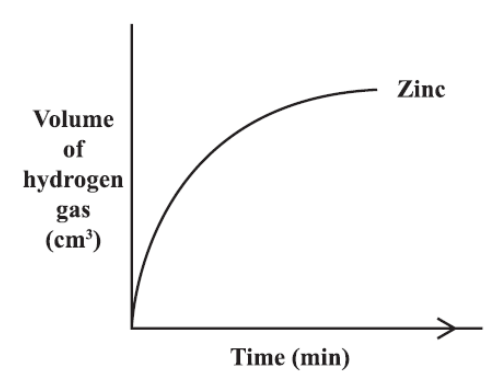
Figure 2 is a graph which shows how the volume of hydrogen gas varied with time for Experiment 1.
Experiment 1 was repeated under the same conditions but using magnesium granules instead of zinc granules. State which granules, zinc or magnesium, would be more reactive.
[1 mark]
On the graph provided in Figure 2, sketch the curve if magnesium granules were used in Experiment 1.
[1 mark]
A student carried out the following tests on three solutions, A, B, and C, and made the inferences and observations which are recorded in Table 2. Complete Table 2 by filling in ALL the possible observations and inferences.
To a sample of Solution A, potassium iodide solution was added.
Inferences: ions are present.
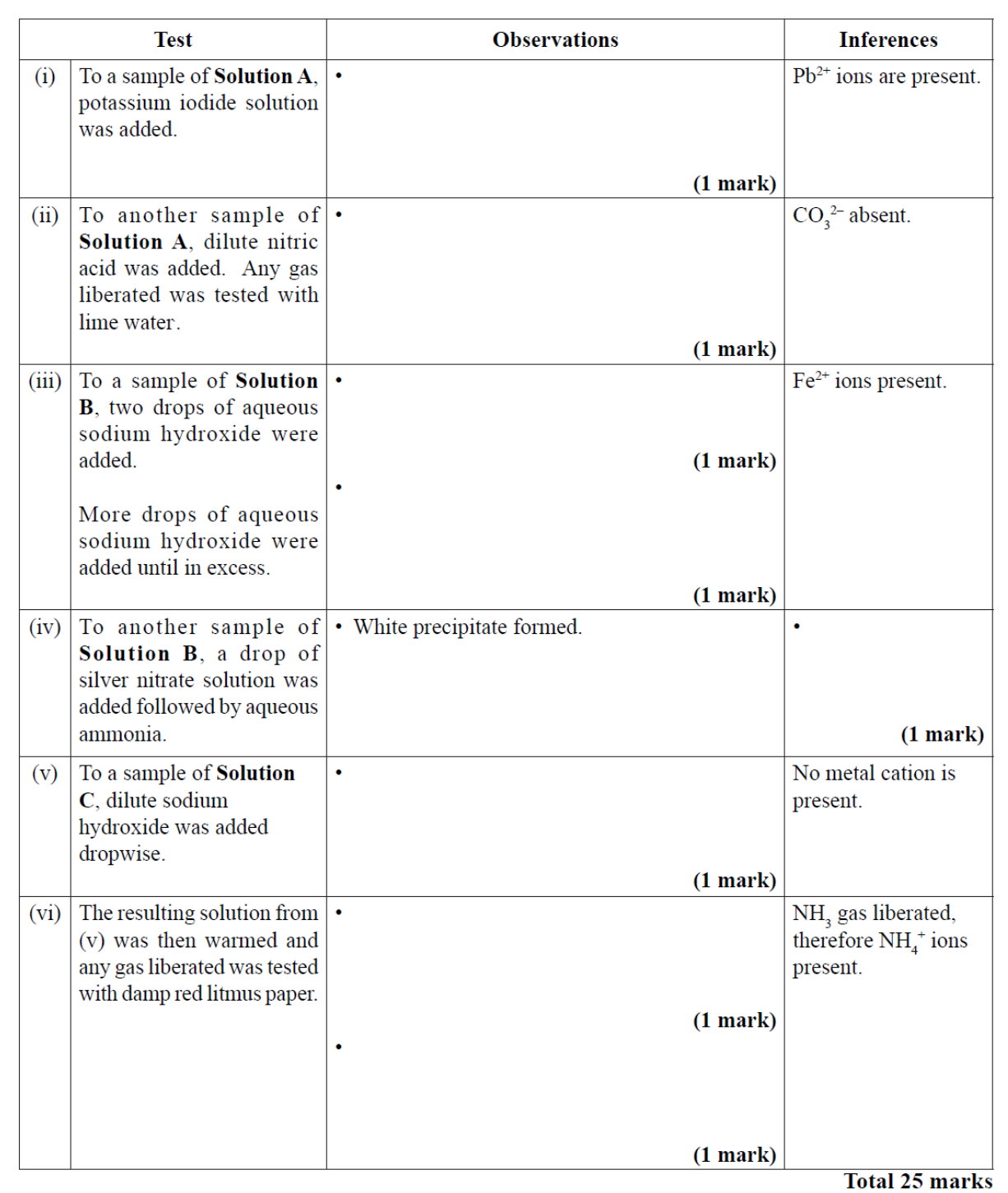
[1 mark]
To another sample of Solution A, dilute nitric acid was added. Any gas liberated was tested with lime water.
Inferences: absent.
[1 mark]
To a sample of Solution B, two drops of aqueous sodium hydroxide were added.
More drops of aqueous sodium hydroxide were added until in excess.
Inferences: ions present.
[1 mark]
To another sample of Solution B, a drop of silver nitrate solution was added followed by aqueous ammonia.
Observations: White precipitate formed.
[1 mark]
To a sample of Solution C, dilute sodium hydroxide was added dropwise.
Inferences: No metal cation is present.
[1 mark]
The resulting solution from (v) was then warmed and any gas liberated was tested with damp red litmus paper.
Inferences: gas liberated, therefore ions present.
[1 mark]
Different halogens (elements in Group VII) can combine to form compounds. One such compound is chlorine fluoride, ClF.
[15 marks]
The atomic number of chlorine, Cl, is 17.
Define the term 'atomic number'.
[1 mark]
Draw a diagram to show the arrangement of electrons in the chlorine atom.
[2 marks]
Using valence shells only, draw a dot and cross diagram to show the bonding which occurs in chlorine fluoride, ClF.
[2 marks]
State TWO reasons why chlorine fluoride, ClF, is expected to have a low melting point.
[2 marks]
Analysis of a sample of chlorine fluoride, ClF, shows that it consists of molecules of the same molecular formula; however, these molecules have different molar masses. Outline a possible reason for this observation.
[2 marks]
The balanced equation for the reaction which occurs when chlorine, , reacts with aqueous potassium iodide, KI, is given below.
Determine the change in the oxidation number of the iodide ions.
[2 marks]
State whether chlorine is acting as an oxidizing or a reducing agent. Give a reason for your answer.
[2 marks]
Write the net ionic equation, including state symbols, for the reaction between chlorine and aqueous potassium iodide.
[2 marks]
Polythene is manufactured in Trinidad and is used extensively throughout the Caribbean.
[15 marks]
Define the term 'polymer'.
[2 marks]
State the type of polymerization that is used in the manufacture of polythene.
[1 mark]
State ONE use of polythene.
[1 mark]
Name ONE polymer other than polythene.
[1 mark]
The fully displayed structures for two hydrocarbons, Compound A and Compound B, are shown below.
      H H
      | |
H — C — C — H
      | |
      H H
Compound A
      H H
      | |
H — C = C — C — H
            |
            H
Compound B
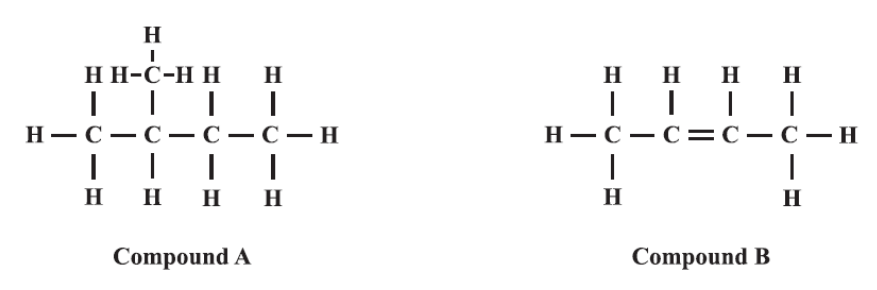
Identify the homologous series to which Compounds A and B belong.
[2 marks]
State the name of EACH compound.
[2 marks]
Define the term 'structural isomerism'.
[2 marks]
For EACH of the compounds shown in Figure 3, draw the FULLY DISPLAYED structure of ONE structural isomer.
[4 marks]
SECTION B Answer ALL questions.
[15 marks]
The main ingredient in Epsom* salts is magnesium sulfate. List TWO uses of Epsom* salts.
[2 marks]
In order to effectively use Epsom* salts, the product is usually made into a solution. Explain why water molecules are able to dissolve Epsom* salts.
[3 marks]
Calcium carbonate is the main active ingredient in Tums*, an antacid used to relieve heartburn, acid indigestion and upset stomach. Outline the steps in the preparation of dry calcium carbonate in the laboratory, based on ONE method. In your answer, include a balanced equation for the reaction.
[6 marks]
When magnesium ions are present in natural water, the water is referred to as 'permanent hard water'.
Identify TWO compounds of magnesium, other than magnesium sulfate, that lead to the formation of permanent hard water.
[2 marks]
Write a chemical equation, with state symbols, for the formation of magnesium sulfate in water.
[2 marks]
Methane is an example of a hydrocarbon. It is the first member of the alkane homologous series.
[15 marks]
State TWO natural sources of hydrocarbons.
[2 marks]
Methane is used as fuel when it is burnt in air. Write a balanced chemical equation, with state symbols, for the combustion of methane.
[3 marks]
List THREE general characteristics of a homologous series.
[3 marks]
Write the molecular formulae of the second and third members of the alkane homologous series.
[2 marks]
1-butene (), like all alkenes, is described as an unsaturated compound which undergoes hydrogenation reactions to become saturated.
State the type of reaction, addition or substitution, which occurs during the hydrogenation of 1-butene.
[1 mark]
Write the balanced chemical equation, including state symbols, for the hydrogenation of 1-butene.
[2 marks]
Draw the FULLY DISPLAYED structural formula for the hydrogenation product of 1-butene.
[2 marks]
The two main effects of pollution are ozone depletion and global warming. There is an international effort to reduce the effects of pollution on the environment.
[15 marks]
Name the MAIN pollutant responsible for ozone depletion.
[1 mark]
State TWO harmful effects of ozone depletion.
[2 marks]
Name the MAIN pollutant responsible for global warming.
[1 mark]
State TWO harmful effects of global warming.
[2 marks]
Caribbean hoteliers are required to play their part in preserving the environment by 'going green'. For EACH of the following issues, suggest THREE ways in which hoteliers may 'go green' within their hotels.
Water use
[3 marks]
Garbage disposal
[3 marks]
Energy use
[3 marks]