Free CXC Chemistry Paper 2 May/June 2024 past paper from 2024. Includes a worked answer key. Open the PDF, take a timed test, and study with AI on Caribbean AI.
Answer keys are free on Caribbean AI. View the answers to every past-paper question at no cost - no payment needed - with step-by-step worked solutions and instant AI marking available on Premium.
CSEC Chemistry Paper 2 May/June 2024 - Free CXC Past Paper with Answers
Free CXC Chemistry Paper 2 May/June 2024 past paper from 2024. Includes a worked answer key. Open the PDF, take a timed test, and study with AI on Caribbean AI.
Opening the interactive papers…
Every question from this paper as text. See the answers and worked solutions. Questions are the property of the Caribbean Examinations Council; Caribbean AI is not affiliated with CXC.
Define the term 'rate of reaction'.
[1 mark]
Write a balanced chemical equation for the reaction between sodium thiosulfate and dilute hydrochloric acid.
[2 marks]
Describe a test and state the observation that can be used to confirm the presence of the sulfur dioxide gas produced from the reaction.
Test
Observation
[2 marks]
Determine the mass of sulfur dioxide produced when of the gas was collected at STP.
[RAM. S = 32, O = 16; 1 mole of a gas occupies at STP.]
[3 marks]
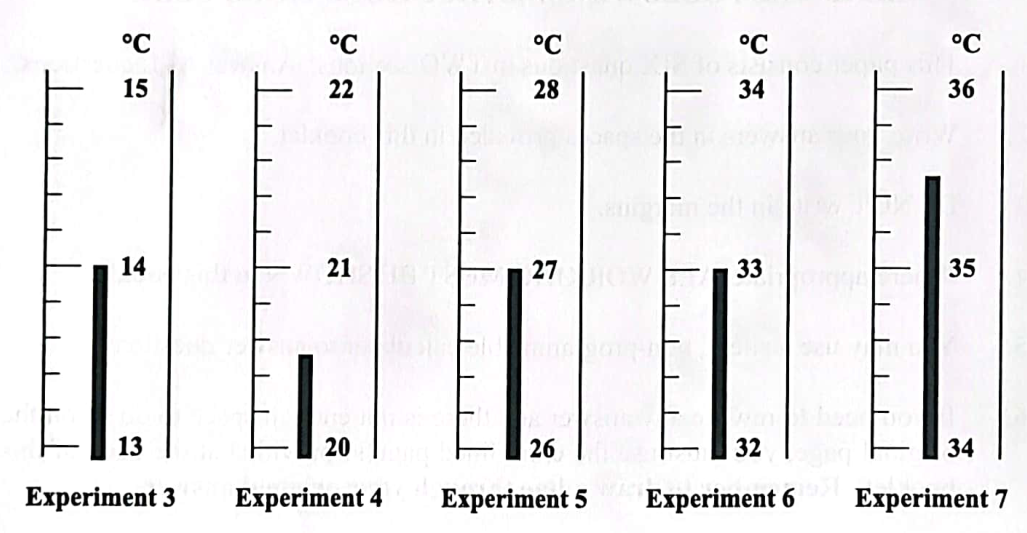
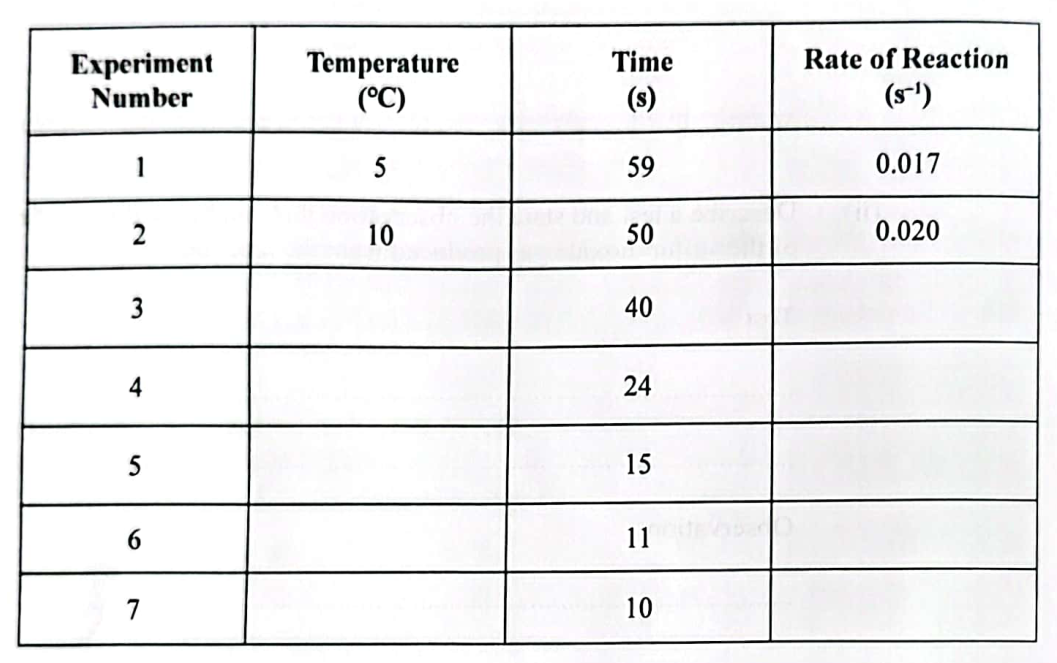
In Table 1, record the temperature readings for each of the experiments shown in Figure 1 on page 4.
| Experiment Number | Temperature (C) | Time (s) | Rate of Reaction () |
|---|---|---|---|
| 1 | 5 | 59 | 0.017 |
| 2 | 10 | 50 | 0.020 |
| 3 | 40 | ||
| 4 | 24 | ||
| 5 | 15 | ||
| 6 | 11 | ||
| 7 | 10 |
[5 marks]
Calculate, to three decimal places, the rate of reaction for EACH experiment, given that the rate is . Record your results in Column 4 of Table 1.
[5 marks]
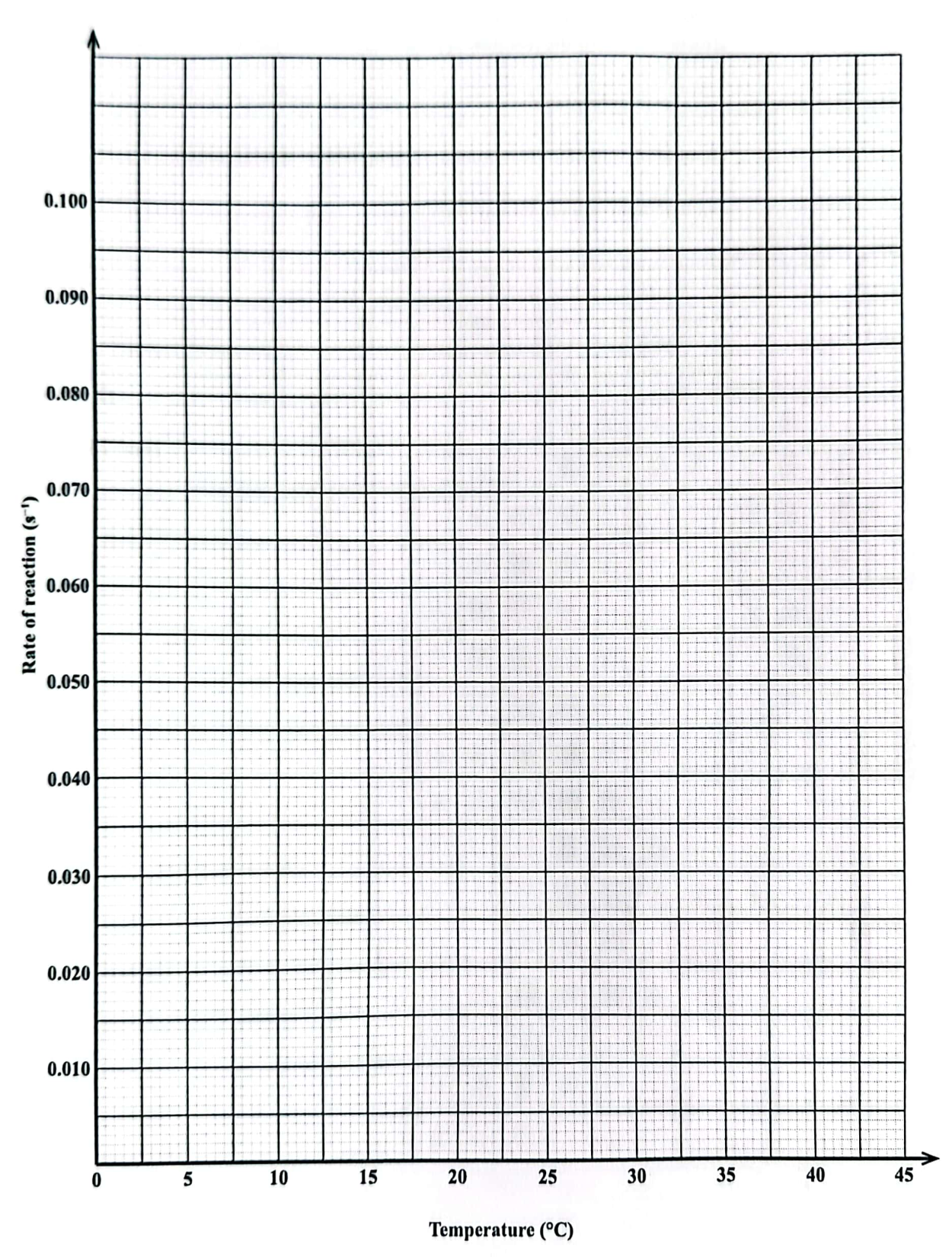
Using the axes provided in Figure 2 on page 7, plot a graph of rate of reaction versus temperature for Experiments 1–7. Draw a smooth curve through the points.
[5 marks]
Using the graph you plotted on page 7, explain how the change in temperature affects the rate of the reaction between sodium thiosulfate and hydrochloric acid.
[2 marks]
The most stable form of the element oxygen has a mass number of 16 and an atomic number of 8. It can also exist as a radioactive isotope.
[15 marks]
Define the following terms.
[4 marks]
Atomic number
[1 mark]
Mass number
[1 mark]
Isotopes
[2 marks]
Use a dot and cross diagram to show the bonding present in oxygen gas.
[3 marks]
There are many uses of radioactive isotopes in everyday life. List ANY THREE uses of radioactive isotopes.
[3 marks]
Carbon burns completely in excess oxygen to produce carbon dioxide. Write a balanced chemical equation, including state symbols, to show this reaction.
[2 marks]
Carbon burns in limited oxygen supply to produce carbon monoxide. Write a balanced chemical equation, including state symbols, to show this reaction.
[3 marks]
Compounds A and B are straight-chain hydrocarbons whose molecular formulas are and respectively.
[15 marks]
Compounds A and B are straight-chain hydrocarbons whose molecular formulas are and respectively.
State ONE natural source of hydrocarbons.
[1 mark]
State TWO uses of Compound B.
[2 marks]
Draw the FULLY displayed structure of Compound A.
[4 marks]
Draw the FULLY displayed structure of Compound A.
[2 marks]
Draw the FULLY displayed structure of Compound B.
[2 marks]
List ANY FOUR general characteristics of a homologous series.
[4 marks]
Deduce the homologous series to which Compounds A and B belong.
[1 mark]
Compound B () burns completely in oxygen to produce carbon dioxide () and water (). Write a balanced chemical equation, including state symbols, for this reaction.
Magnesium and lead are metals often found in living things and in the environment.
Explain metallic bonding in metals.
[2 marks]
Give the reason why metals conduct electricity in solid form.
[1 mark]
State ANY TWO harmful effects of lead and its compounds on living things and their environment.
[2 marks]
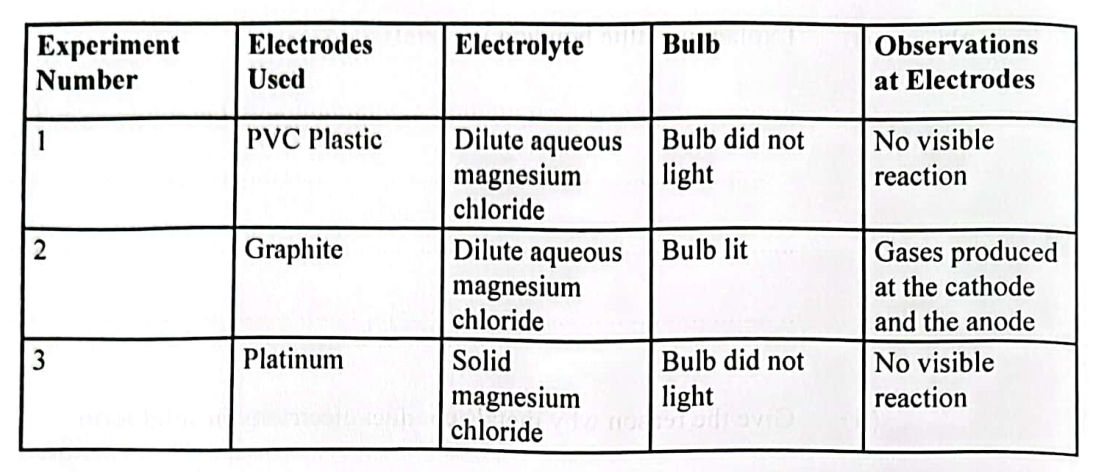
A chemistry student conducted a series of experiments using an electrolytic cell to test the conductivity of magnesium chloride. The materials used to set up the apparatus and the student's observations were recorded in Table 2 below.
| Experiment Number | Electrodes Used | Electrolyte | Bulb | Observations at Electrodes |
|---|---|---|---|---|
| 1 | PVC Plastic | Dilute aqueous magnesium chloride | Bulb did not light | No visible reaction |
| 2 | Graphite | Dilute aqueous magnesium chloride | Bulb lit | Gases produced at the cathode and the anode |
| 3 | Platinum | Solid magnesium chloride | Bulb did not light | No visible reaction |
Explain why the bulb did not light in Experiments 1 and 3.
Experiment 1
Experiment 3
[4 marks]
Explain why the bulb lit in Experiment 2.
[3 marks]
State the process that took place in Experiment 2.
[1 mark]
Magnesium readily reacts with oxygen in the air. Write a balanced chemical equation for this reaction.
[2 marks]
Proteins and starch are examples of natural polymers which are formed through the process of condensation polymerization.
[3 marks]
Define the term 'polymer'.
[2 marks]
Define the term 'condensation polymerization'.
[1 mark]
The manufacture of ethanol makes use of the fermentation process.
[12 marks]
Define the term 'fermentation'.
[3 marks]
Write a balanced chemical equation, including state symbols, to show the process of fermentation.
[3 marks]
Draw the FULLY displayed structure of ethanol.
[2 marks]
During a demonstration of the wine-making process in the school's food laboratory, a technician separated a pure sample of ethanol. However, the flask was not labelled and water was accidentally poured into the sample.
Using a line diagram, draw and label the apparatus that could be set up in the chemistry laboratory to obtain the pure ethanol from the contaminated sample.
[4 marks]
Alka Seltzer® and Epsom® salt are common remedies used in the Caribbean. Alka Seltzer® is an antacid used to treat upset stomach and Epsom® salt is used to treat sprains and muscle pain. The active ingredient in Alka Seltzer® is sodium bicarbonate () and in Epsom® salt, magnesium sulfate.
Water is called the universal solvent because it dissolves many substances. Epsom® salt and Alka Seltzer® work by dissolving in water.
Explain why water is a good solvent.
[2 marks]
State TWO properties of water other than it is a good solvent.
[2 marks]
State ANY TWO other compounds that dissolve in water.
[2 marks]
Continuous use of Epsom® salt in water may cause hardness of water. This does not happen with Alka Seltzer®.
State the type of water hardness caused by dissolving Epsom® salt in water.
[1 mark]
Explain why Epsom® salt causes hardness of water.
[2 marks]
Explain why boiling the water will not remove the hardness caused by Epsom® salt.
[2 marks]
Identify TWO salts that cause hardness of water and can be removed by boiling.
[2 marks]
When used as an antacid, Alka Seltzer® neutralizes the hydrochloric acid ($HCl$) in the stomach. Write a balanced chemical equation, including state symbols, to illustrate this process.
[2 marks]
[3 marks]
[3 marks]