Free CXC Chemistry Paper 2 May/June 2018 past paper from 2018. Includes a worked answer key. Open the PDF, take a timed test, and study with AI on Caribbean AI.
Answer keys are free on Caribbean AI. View the answers to every past-paper question at no cost - no payment needed - with step-by-step worked solutions and instant AI marking available on Premium.
CSEC Chemistry Paper 2 May/June 2018 - Free CXC Past Paper with Answers
Free CXC Chemistry Paper 2 May/June 2018 past paper from 2018. Includes a worked answer key. Open the PDF, take a timed test, and study with AI on Caribbean AI.
Opening the interactive papers…
Every question from this paper as text. See the answers and worked solutions. Questions are the property of the Caribbean Examinations Council; Caribbean AI is not affiliated with CXC.
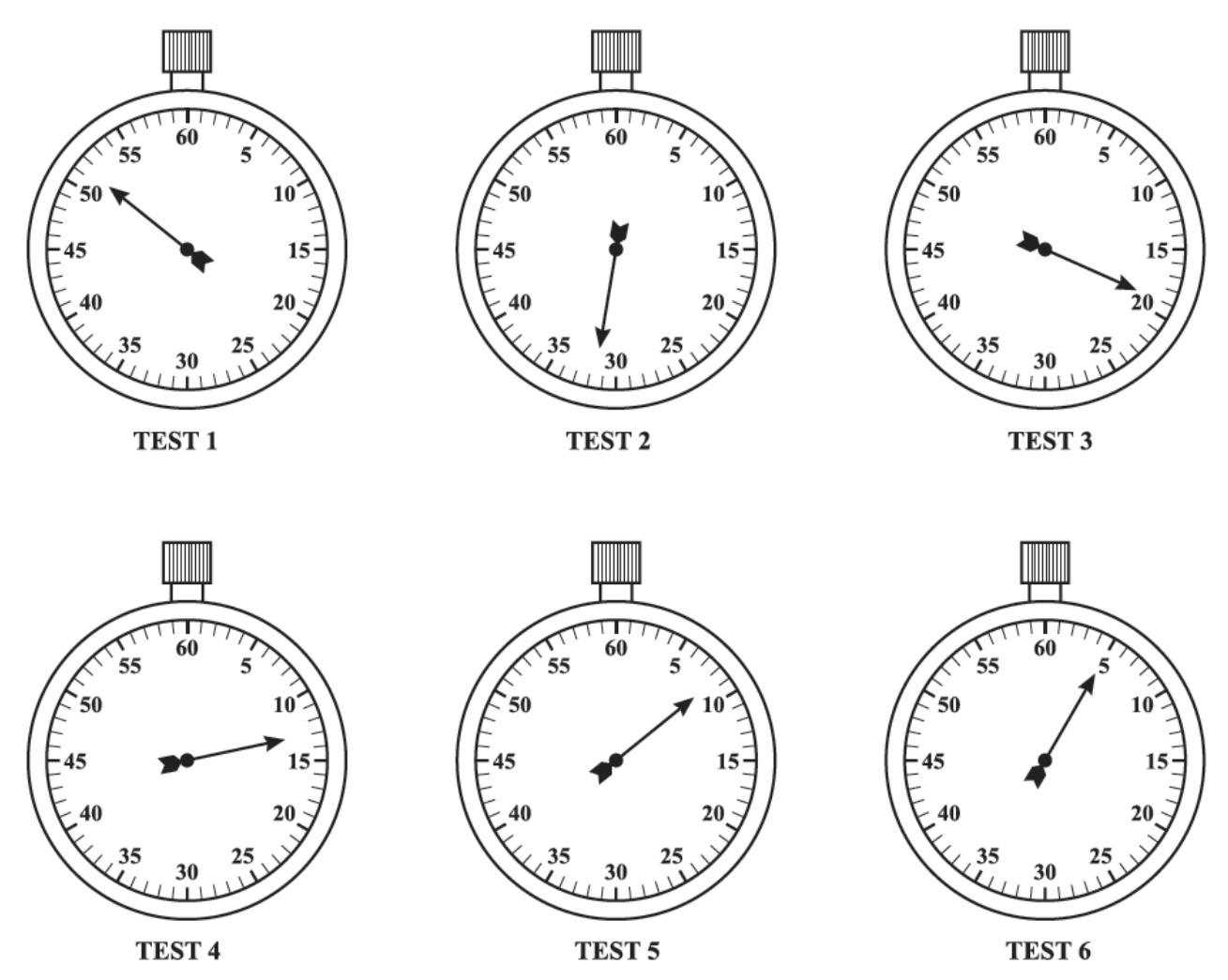
Sally performed an experiment which consisted of a series of six tests to investigate the effect of temperature on the rate of reaction. The same mass of calcium carbonate, , chips was allowed to react with an excess of dilute hydrochloric acid at different temperatures. Carbon dioxide gas was produced from the reaction and the time taken to collect of this gas for EACH test is shown in Figure 1.
The six tests were carried out at different temperatures using the following reagents:
[25 marks]
Define 'rate of reaction'.
[1 mark]
Write a balanced chemical equation for the reaction between calcium carbonate and hydrochloric acid.
[2 marks]
Calculate the volume of carbon dioxide that would be produced at RTP from of chips.
[RMM: ; of a gas occupies at RTP.]
[3 marks]
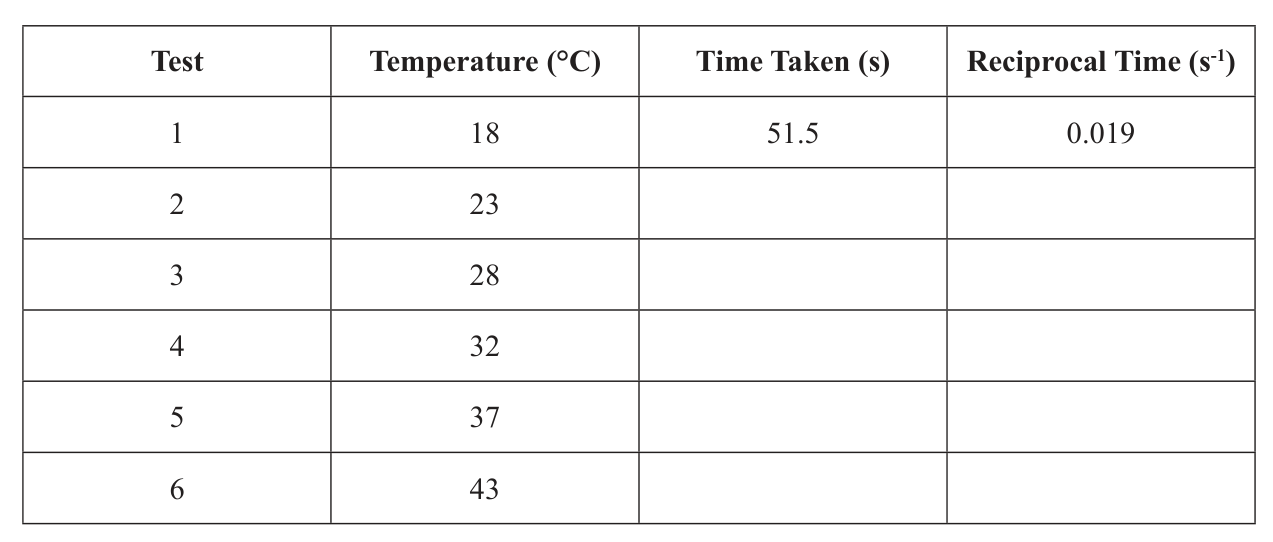
From the stopwatches displayed in Figure 1 on page 2, record the times taken for the carbon dioxide gas to be collected in the appropriate spaces in Table 1. The time taken for Test 1 has already been recorded.
| Test | Temperature () | Time Taken (s) | Reciprocal Time () |
|---|---|---|---|
| 1 | 18 | 51.5 | 0.019 |
| 2 | 23 | ||
| 3 | 28 | ||
| 4 | 32 | ||
| 5 | 37 | ||
| 6 | 43 |
[3 marks]
Calculate the reciprocal times () and record them to 3 decimal places in the appropriate spaces in Table 1. The reciprocal time for Test 1 has already been calculated.
[4 marks]
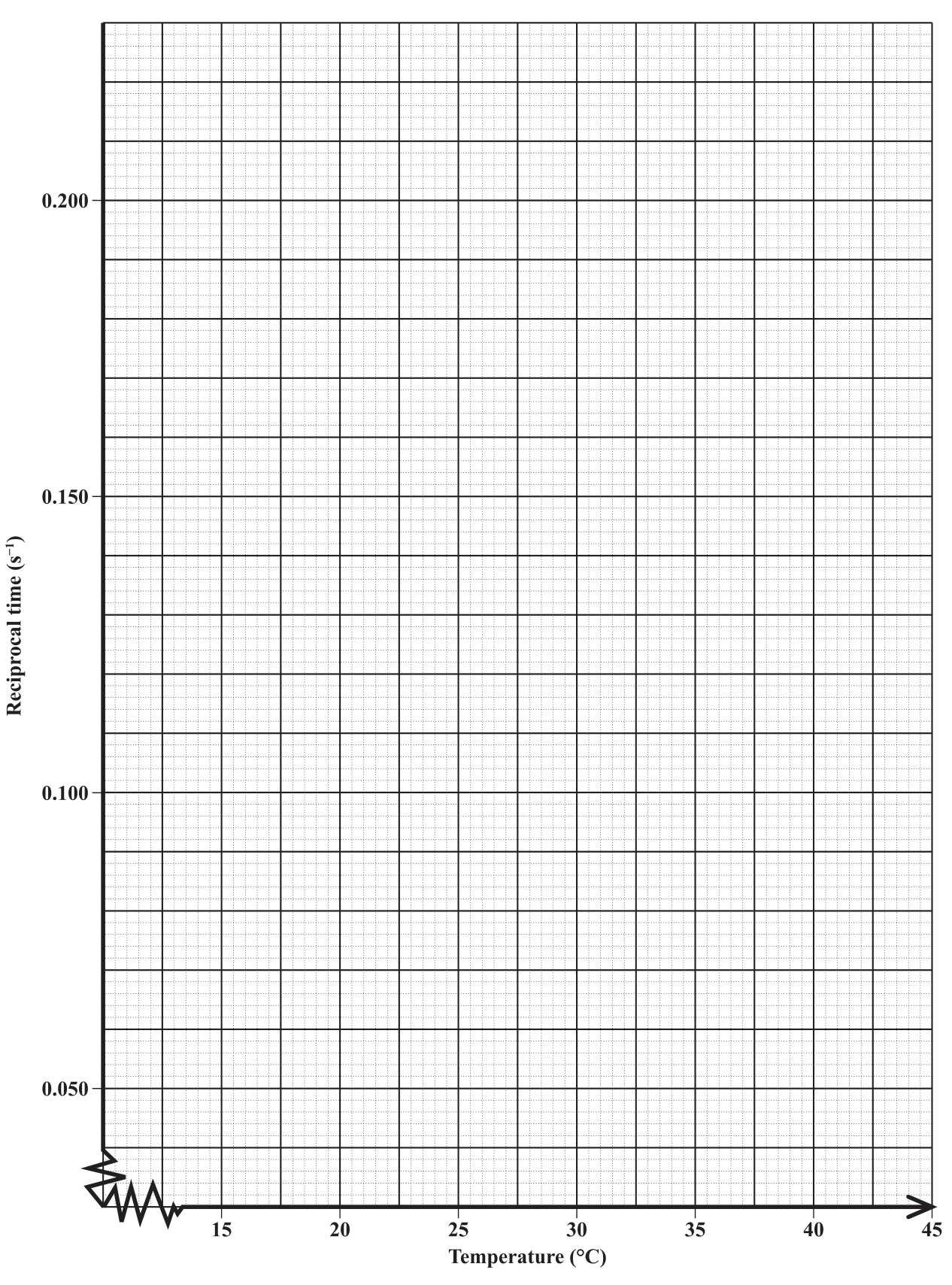
Using the axes provided in Figure 2 on page 7, plot a graph of reciprocal time versus temperature for Tests 1–6. Draw the best curve through the points.
[5 marks]
Based on the graph drawn in (c) (iii) on page 7, deduce the effect that temperature has on the rate of reaction.
[1 mark]
State TWO reasons that account for the observed effect, given in (d) (i), of temperature on the rate of reaction.
[2 marks]
Use the graph drawn on page 7 to determine the value of the reciprocal time that would have been obtained if the experiment was carried out at .
[2 marks]
Describe a confirmatory test for carbon dioxide.
[2 marks]
The element chlorine, , with electron configuration 2.8.7 has TWO main isotopes, namely chlorine-35, , and chlorine-37, .
The element chlorine, , with electron configuration 2.8.7 has TWO main isotopes, namely chlorine-35, , and chlorine-37, .
Define 'isotopes'.
[2 marks]
Hence, show by calculation that chlorine-35 and chlorine-37 are isotopes.
[2 marks]
Some elements have isotopes that are unstable and radioactive. These are known as radioisotopes. State TWO uses of radioisotopes.
[2 marks]
A student, while investigating the reactions of chlorine, bubbles chlorine gas into an aqueous solution of potassium iodide and deduces that the potassium iodide was oxidized because a colour change occurred.
Write a balanced chemical IONIC equation for the reaction that is responsible for the colour change.
[2 marks]
Describe the colour change that the student observed.
[2 marks]
Sulfur is an element that is bright yellow in colour, and burns in air to give an acidic gas with a choking smell.
Write a balanced chemical equation, with state symbols, for the burning of sulfur in air.
[2 marks]
State ONE use of sulfur.
[1 mark]
Sulfur is in the same group as oxygen and so undergoes similar reactions. Write a balanced chemical equation, with state symbols, for the reaction of magnesium with sulfur.
[2 marks]
Compounds X and Y are simple hydrocarbons. Compound X has the general formula with and Compound Y has the general formula with .
State the homologous series to which EACH compound belongs.
Compound X Compound Y
[2 marks]
State one use EACH of Compound X and Compound Y.
Compound X Compound Y
[2 marks]
Draw the FULLY DISPLAYED formulae to show the structure of Compound X and Compound Y.
[4 marks]
Compound Y reacts with water to form an alcohol.
Draw the structure of the alcohol formed from Compound Y.
[2 marks]
State the reagents and reaction conditions for the conversion of Compound Y to the alcohol.
Reagents Reaction conditions
[2 marks]
Ethanol reacts with ethanoic acid to produce a sweet-smelling oily liquid, an ester. State the name of the ester formed.
[1 mark]
Write the full equation for the reaction between ethanol and ethanoic acid.
[2 marks]
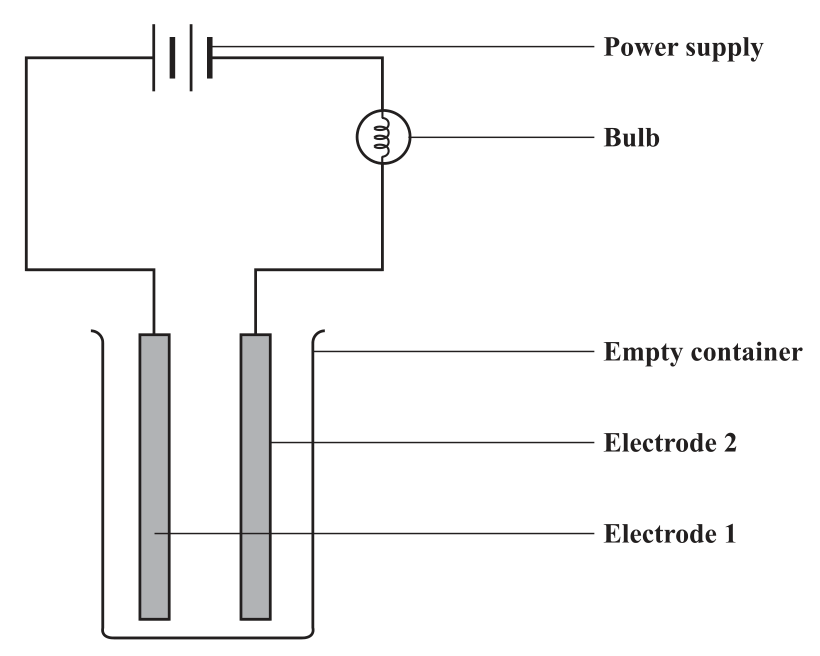
The circuit in Figure 3 can be used to test if a substance conducts electricity.
Define 'electrolysis'.
[2 marks]
Describe the effect that EACH of the following substances will have on the bulb, when the substance is placed in the empty container in Figure 3. State a reason for your answer for EACH substance.
Solid sodium chloride
Effect Reason
[2 marks]
1 mol hydrochloric acid
Effect Reason
[2 marks]
Ethanol
Effect Reason
[2 marks]
A bar of lead touching the electrodes
Effect Reason
[2 marks]
A sample of molten lead bromide, , is electrolysed for three minutes with a current of 6 amperes. Calculate the mass of lead that is deposited at the cathode, given that two moles of electrons are required to liberate one mole of lead as shown in the following equation:
Ethanol, the main ingredient in many alcoholic drinks, is obtained by a process known as fermentation. Describe the process of fermentation. In your description, identify the raw materials and products, and write a relevant chemical equation.
[5 marks]
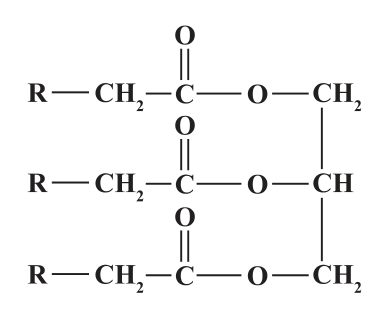
In the production of soaps, the saponification process uses naturally occurring fats and oils as raw materials. The following diagram represents a fat molecule that can be used.
      O
      ||
R — CH₂ — C — O — CH₂
            O
            ||
R — CH₂ — C — O — CH
            O
            ||
R — CH₂ — C — O — CH₂
Briefly describe the soap-making process, stating the necessary reagents and conditions. Based on the structure of the fat molecule shown above, draw the structure of the soap that would be formed during the saponification process.
[4 marks]
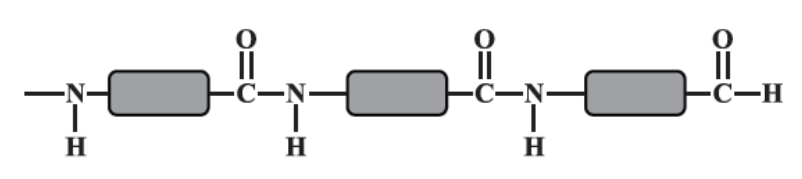
There are several different types of polymers, for example, polyalkenes, polyesters, polysaccharides and polyamides. (i) Based on the following diagrams showing the partial structure of a polymer, deduce the type of polymer shown, and the type of polymerization reaction that took place in EACH case.
[6 marks]
Based on the following diagrams showing the partial structure of a polymer, deduce the type of polymer shown, and the type of polymerization reaction that took place in EACH case.
Partial structure of Polymer BB Partial structure of Polymer CC

[4 marks]
Draw the structure of the monomer used to form Polymer CC.
[2 marks]
Many important biological processes in plants and animals depend on the specific roles of certain metal ions. (i) Farmer Jones reaped a crop of tomatoes and reported that the yield was far below what was expected. Analysis of the soil revealed that there was a deficiency of magnesium. Discuss the importance of magnesium in plant health, and explain how a magnesium deficiency can result in the low yield of tomatoes.
[7 marks]
Farmer Jones reaped a crop of tomatoes and reported that the yield was far below what was expected. Analysis of the soil revealed that there was a deficiency of magnesium. Discuss the importance of magnesium in plant health, and explain how a magnesium deficiency can result in the low yield of tomatoes.
[5 marks]
State ONE other metal ion which is important to plant health and state the result of its deficiency.
[2 marks]
Many years ago, car exhaust fumes were known to contain compounds of metals and non-metals, which could negatively impact both humans and the environment. Identify ONE metal and ONE non-metal whose compounds were present in car exhaust fumes. Discuss the effect of these compounds on human health and the environment.
[5 marks]
Define 'green chemistry' and discuss the measures that have been taken to produce a 'greener' automotive fuel.
[3 marks]
[5 marks]