Free CXC Biology Paper 2 May/June 2008 past paper from 2008. Includes a worked answer key. Open the PDF, take a timed test, and study with AI on Caribbean AI.
Answer keys are free on Caribbean AI. View the answers to every past-paper question at no cost - no payment needed - with step-by-step worked solutions and instant AI marking available on Premium.
CSEC Biology Paper 2 May/June 2008 - Free CXC Past Paper with Answers
Free CXC Biology Paper 2 May/June 2008 past paper from 2008. Includes a worked answer key. Open the PDF, take a timed test, and study with AI on Caribbean AI.
Opening the interactive papers…
Every question from this paper as text. See the answers and worked solutions. Questions are the property of the Caribbean Examinations Council; Caribbean AI is not affiliated with CXC.
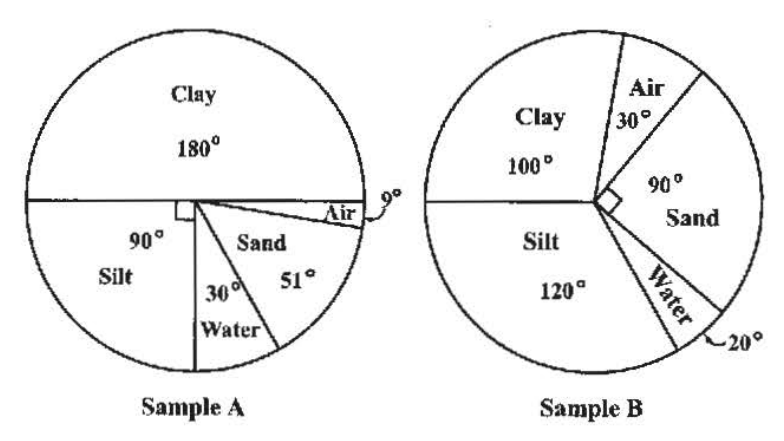
The pie charts in Figure 1 show the results of an investigation by a student on equal volumes of two samples of soil.
Calculate the percentage of air in Sample A. Show your working.
[2 marks]
How do you account for the difference in the proportion of air in Samples A and B?
[2 marks]
The student carried out a further investigation on the soil in which of water was poured on each of the soil samples, A and B. The water which drained from each soil sample was collected in measuring cylinders. Figure 2 shows diagrams of the two cylinders in which the water that drained through each soil sample was collected.
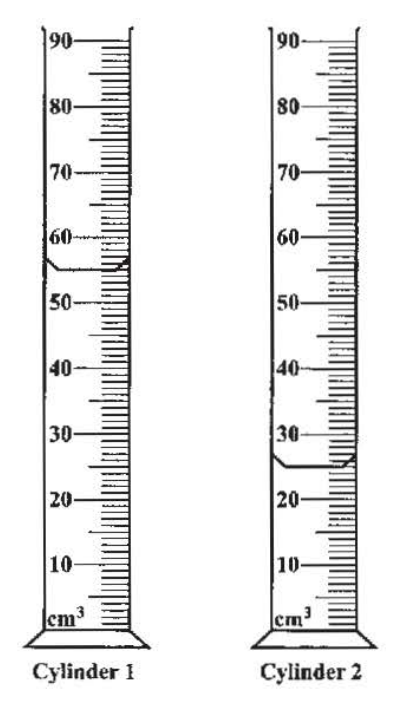
What is the volume of water in EACH cylinder as shown in Figure 2?
Cylinder 1: Cylinder 2:
[2 marks]
Which measuring cylinder represents drainage from Sample B? Give a reason for your answer.
[2 marks]
Calculate the volume of water retained by EACH sample of soil.
[2 marks]
Identify ONE source of error in the investigation of soil drainage.
[1 mark]
Explain why it is important to investigate water retention properties of soils.
[2 marks]
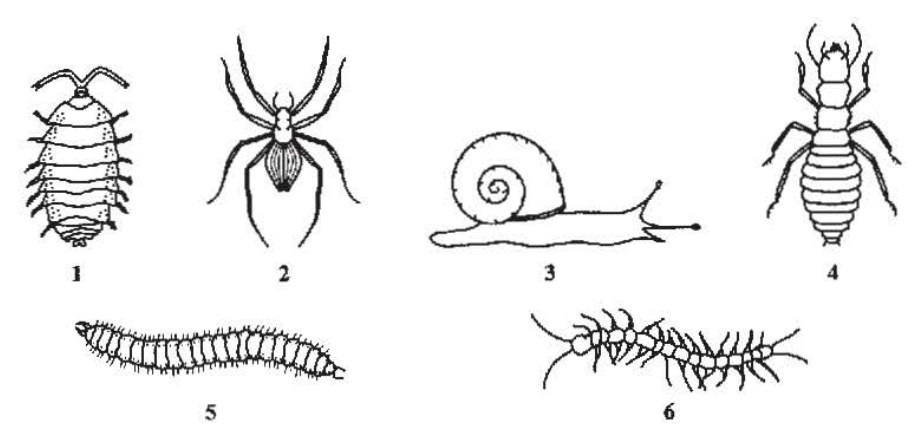
Apart from the components shown in the pie chart in Figure 1, soil also contains living organisms. Six soil organisms are shown in Figure 3.
Identify TWO features of the organisms observed in Figure 3 which could be used to classify them.
[2 marks]
Name ONE group of soil organisms that is important in the recycling of soil nutrients.
[1 mark]
Organisms 1 and 3 in Figure 3 are usually found under stones or leaf litter. Suggest TWO reasons why these organisms are found in this type of habitat.
[2 marks]
To investigate the number in the population of Organism 5 that occurs in its habitat: a) List the apparatus you would need. b) Describe the method you would use.
[4 marks]
Organism 5 feeds on leaf litter, while Organism 6 is thought to be a carnivore. a) Define the term 'carnivore'. b) Give TWO adaptations that Organism 6 should possess as a carnivore.
[3 marks]
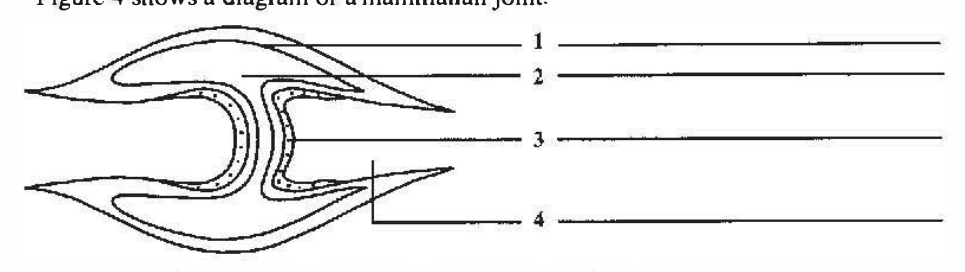
Figure 4 shows a diagram of a mammalian joint.
Figure 4. Diagram of a mammalian joint
[15 marks]
On the diagram in Figure 4, label EACH of the parts numbered 1, 2, 3 and 4.
[4 marks]
State ONE function of EACH of the parts labelled 2 and 4. Part 2: Part 4:
[2 marks]
Name a partially movable joint.
[3 marks]
How does movement at a partially movable joint differ from movement at the elbow joint?
[3 marks]
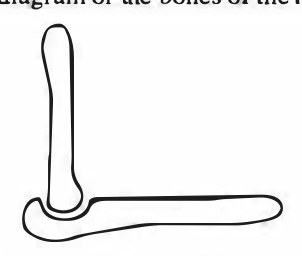
Figure 5 shows a diagram of the bones of the human fore limb.
Figure 5. Stylised diagram of a human fore limb On the stylised diagram in Figure 5, draw a representation of a pair of antagonistic muscles for flexing and extending the arm.
[2 marks]
Many older persons replace their hip bone to retain their ability to walk. Suggest TWO reasons why the hip bone can lose its locomotory function.
[4 marks]
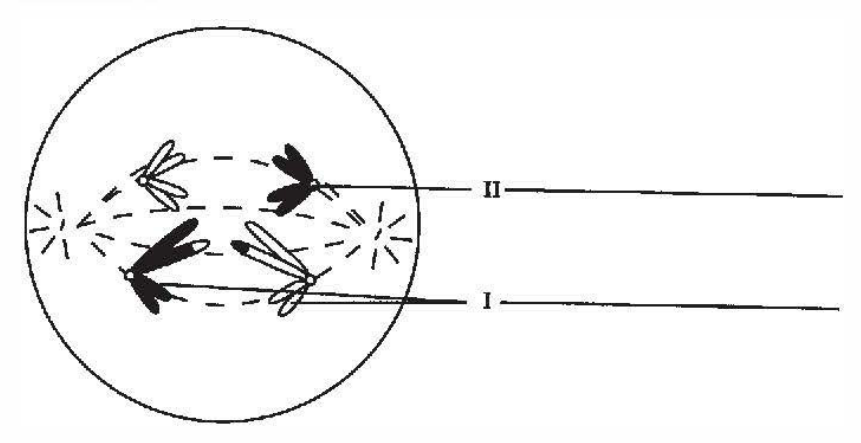
Figure 6 is a diagram of a dividing cell of an organism which has a diploid chromosome number of 4.
Figure 6. Dividing cell showing chromosomes
[15 marks]
On the diagram in Figure 6, write the name of the structures labelled I and II.
[2 marks]
What type of cell division is illustrated in Figure 6?
[1 mark]
Give TWO reasons for your response in (a) (ii) above.
[2 marks]
How many chromosomes would there be in the daughter cells produced in the cell division illustrated in Figure 6?
[1 mark]
Give TWO advantages to an organism of this type of cell division.
[2 marks]
What is 'genetic engineering'?
[2 marks]
Give ONE advantage of genetic engineering.
[1 mark]
Suggest ONE problem that could arise from genetically modifying an organism.
[2 marks]
Suggest ONE reason why it is possible to successfully transfer genes from one species to another, yet species under normal conditions do not generally interbreed.
[2 marks]
SECTION B Answer ALL questions in this section.
Write your answers in the answer booklet provided.
[15 marks]
Explain why food chains usually begin with a plant species.
[8 marks]
Using an appropriate diagram, show how a plant or animal may belong to more than one food chain.
[8 marks]
Explain why the number of organisms decreases at the successive trophic levels.
[8 marks]
Biological control usually involves the introduction of new species to an ecosystem to reduce or control the population of organisms considered to be pests.
[7 marks]
Identify ONE relationship that is important in biological control and explain how this relationship functions in biological control.
[7 marks]
Suggest TWO reasons why biological control is a preferred method of reducing pest populations compared to the use of pesticides.
[7 marks]
With the aid of a fully annotated diagram, explain how air reaches the lungs and oxygen is absorbed into the blood stream.
[9 marks]
Suggest why it is important for human blood to have a specialised type of cell for oxygen absorption.
[9 marks]
The effect of smoke emission from factories on plant leaves is sometimes compared to the effect of cigarette smoke on human lungs. Suggest TWO reasons why this comparison is appropriate.
[4 marks]
Many governments have passed legislation to reduce the amount of cigarette smoking in public. Explain why governments should consider it their responsibility to reduce smoking in public.
[2 marks]
How does the human body defend itself against disease?
[8 marks]
Identify TWO diseases from which the body CANNOT effectively defend itself.
[8 marks]
For any ONE disease you identified at (a) (ii), explain why it is difficult for the body to defend itself from that disease.
[8 marks]
Antibiotics are a group of drugs that is used to help the body fight diseases caused by certain organisms. Doctors advise their patients to take an entire course of antibiotics only when and as prescribed. However, many people do not follow the doctor's advice and some of these drugs have been found to be no longer effective.
Suggest TWO biological and TWO social implications of the improper use of antibiotics.
[4 marks]
Alcohol is sometimes considered an abused drug. Explain why this may be an appropriate description.
[3 marks]