CSEC Biology Paper 2 May/June 2010 - Free CXC Past Paper with Answers
Free CXC Biology Paper 2 May/June 2010 past paper from 2010. Includes a worked answer key. Open the PDF, take a timed test, and study with AI on Caribbean AI.
Answer keys are free on Caribbean AI. View the answers to every past-paper question at no cost - no payment needed - with step-by-step worked solutions and instant AI marking available on Premium.
- All CSEC Past Papers
- CSEC Biology Past Papers
- CSEC Biology Paper 2 May/June 2026
- CSEC Biology Paper 2 May/June 2025
- CSEC Biology Paper 2 January 2025
- CSEC Biology Paper 2 May/June 2024
- CSEC Biology Paper 2 January 2024
- CSEC Biology Paper 2 May/June 2023
- CSEC Biology Paper 2 January 2023
- CSEC Biology Paper 2 May/June 2022
- CSEC Biology Paper 2 May/June 2021
- CSEC Biology Paper 2 January 2021
- CSEC Biology Paper 2 May/June 2020
- CSEC Biology Paper 2 January 2020
- CSEC Biology Paper 2 May/June 2019
- CSEC Biology Paper 2 January 2019
- CSEC Biology Paper 2 May/June 2018
- CSEC Biology Paper 2 January 2018
- CSEC Biology Paper 2 January 2017
- CSEC Biology Paper 2 May/June 2017
- CSEC Biology Paper 2 May/June 2016
- CSEC Biology Paper 2 May/June 2015
- CSEC Biology Paper 2 January 2015
- CSEC Biology Paper 2 May/June 2014
- CSEC Biology Paper 2 May/June 2013
- CSEC Biology Paper 2 May/June 2012
- CSEC Biology Paper 2 May/June 2011
- CSEC Biology Paper 2 May/June 2009
- CSEC Biology Paper 2 January 2008
- CSEC Biology Paper 2 May/June 2008
- CSEC Biology Paper 2 January 2007
- CSEC Biology Paper 2 May/June 2007
- CSEC Biology Paper 2 May/June 2006
- CSEC Biology Paper 2 May/June 2005
CSEC Biology Paper 2 May/June 2010 - Free CXC Past Paper with Answers
Free CXC Biology Paper 2 May/June 2010 past paper from 2010. Includes a worked answer key. Open the PDF, take a timed test, and study with AI on Caribbean AI.
Opening the interactive papers…
- All CSEC Past Papers
- CSEC Biology Past Papers
- CSEC Biology Paper 2 May/June 2026
- CSEC Biology Paper 2 May/June 2025
- CSEC Biology Paper 2 January 2025
- CSEC Biology Paper 2 May/June 2024
- CSEC Biology Paper 2 January 2024
- CSEC Biology Paper 2 May/June 2023
- CSEC Biology Paper 2 January 2023
- CSEC Biology Paper 2 May/June 2022
- CSEC Biology Paper 2 May/June 2021
- CSEC Biology Paper 2 January 2021
- CSEC Biology Paper 2 May/June 2020
CSEC Biology Paper 2 May/June 2010 Questions
Every question from this paper as text. See the answers and worked solutions. Questions are the property of the Caribbean Examinations Council; Caribbean AI is not affiliated with CXC.
Question 1 (25 marks)
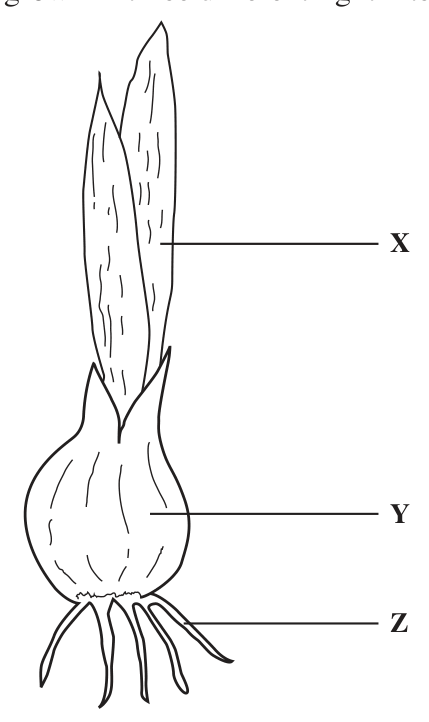
In an experiment on the plant species illustrated in Figure 1, the part identified as X was tested in several plants after they had grown in three different light intensities.
Figure 1. A plant species
[25 marks]
Sets of three plants for each light intensity were tested for the following: starch, reducing sugar, protein, oil.
[7 marks]
In the space provided below construct a table to show how the data from the experiment might be collected.
[5 marks]
Explain why a sample of three plants was used for each test.
[2 marks]
In the space provided below, draw a labelled diagram of the apparatus that can be used in an experiment to illustrate that Part Z will take in water for use by Part Y (in Figure 1 on page 2).
[4 marks]