Free CXC Biology Paper 2 January 2017 past paper from 2017. Includes a worked answer key. Open the PDF, take a timed test, and study with AI on Caribbean AI.
Answer keys are free on Caribbean AI. View the answers to every past-paper question at no cost - no payment needed - with step-by-step worked solutions and instant AI marking available on Premium.
CSEC Biology Paper 2 January 2017 - Free CXC Past Paper with Answers
Free CXC Biology Paper 2 January 2017 past paper from 2017. Includes a worked answer key. Open the PDF, take a timed test, and study with AI on Caribbean AI.
Opening the interactive papers…
Every question from this paper as text. See the answers and worked solutions. Questions are the property of the Caribbean Examinations Council; Caribbean AI is not affiliated with CXC.
Write your answers in the spaces provided in this booklet.
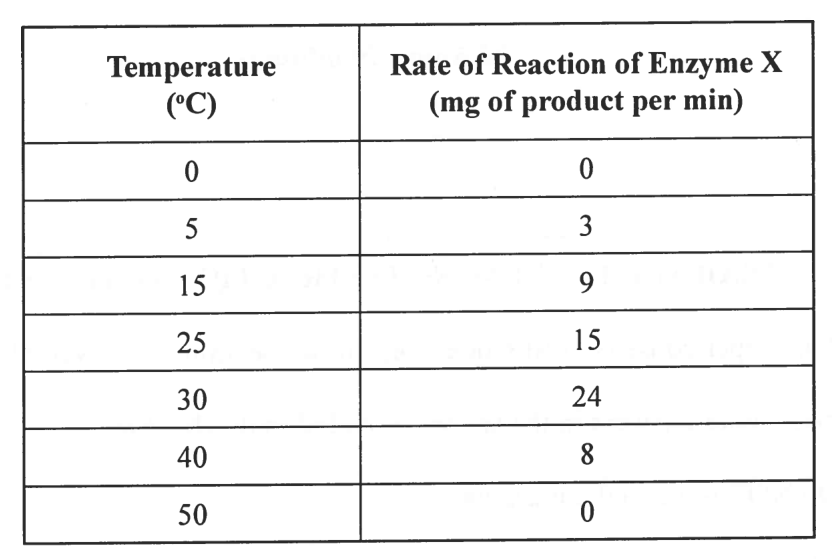
A group of students conducts an experiment to investigate the rate of reaction of Enzyme X at different temperatures. The results of the experiment are shown in Table 1.
TABLE 1: RATE OF REACTION OF ENZYME X AT DIFFERENT TEMPERATURES
| Temperature (C) | Rate of Reaction of Enzyme X (mg of product per min) |
|---|---|
| 0 | 0 |
| 5 | 3 |
| 15 | 9 |
| 25 | 15 |
| 30 | 24 |
| 40 | 8 |
| 50 |
| 0 |
Plot the data in Table 1 on the grid below.

[4 marks]
Use the graph plotted in (a) (i) to identify the optimum temperature for Enzyme X.
[1 mark]
Account for the shape of the graph:
Between C and C
[2 marks]
Above C
[1 mark]
Name TWO enzymes that break down protein.
[2 marks]
Name TWO parts of the human alimentary canal where enzymes that break down protein are found.
[2 marks]
Suggest TWO reasons why the different enzymes for breaking down proteins are located in two different parts of the alimentary canal.
[2 marks]
Leguminous plants such as peanuts are able to manufacture proteins with the help of nitrogen-fixing bacteria that live in the nodules on their roots.
Identify the type of relationship that exists between the peanut plant and the bacteria.
[1 mark]
Explain your answer in (c) (i) on page 6.
[3 marks]
Describe a suitable procedure for testing the presence of protein in peanuts.
[3 marks]
Suggest TWO reasons why plants need protein.
[2 marks]
State THREE differences between a plant cell and an animal cell.
[3 marks]
State TWO differences between a prokaryotic cell and a eukaryotic cell.
[2 marks]
State the function of EACH of the following:
[2 marks]
Cell wall
[1 mark]
Cell membrane
[1 mark]
Explain what happens to an animal cell when it is removed from the organism and placed into concentrated sucrose solution.
[2 marks]
Explain what happens to an animal cell when it is removed from the organism and placed into distilled water.
[2 marks]
Describe how the results would be different from (c) (i) and (ii) for a plant cell in concentrated sucrose solution and distilled water respectively.
Concentrated sucrose solution
Distilled water
[4 marks]
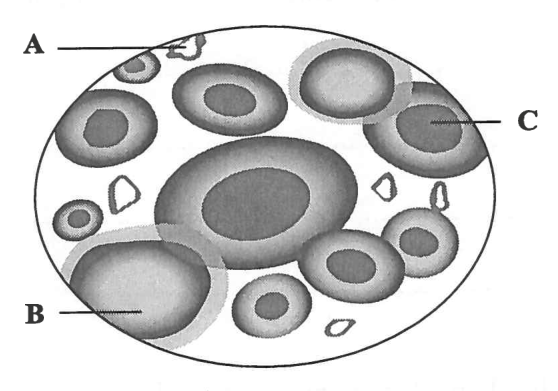
Figure 1 shows components of blood.
[15 marks]
Identify the components of blood that are labelled A, B and C in Figure 1.
A B C
[3 marks]
Name the component of the blood that is responsible for clotting.
[1 mark]
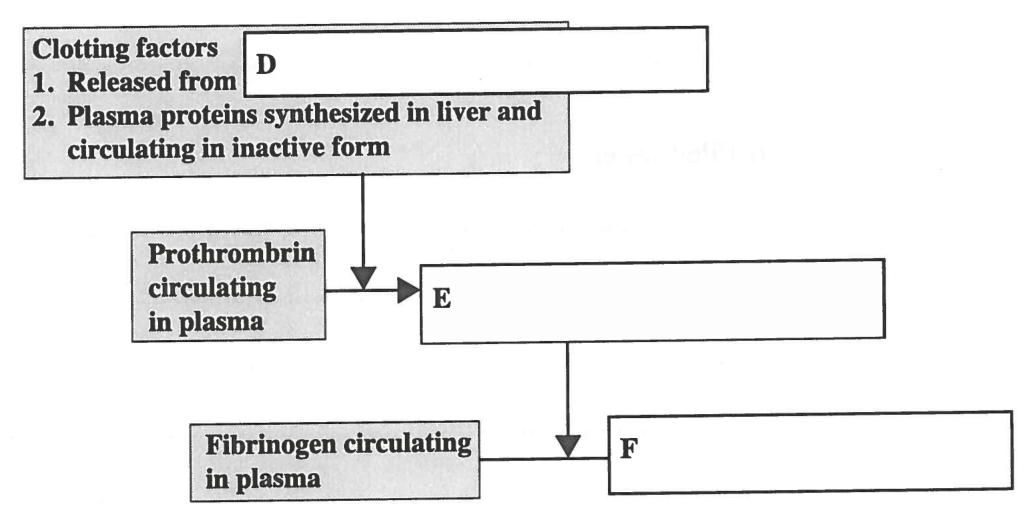
Complete the flow diagram shown in Figure 2 by filling in the missing words at positions D, E and F.
[3 marks]
Sometimes persons may inherit a condition called haemophilia in which the blood does not clot normally. The allele for blood clotting is located on the X chromosome. A female with normal blood clotting ability mates with a male with normal blood clotting ability to produce offspring.
[3 marks]
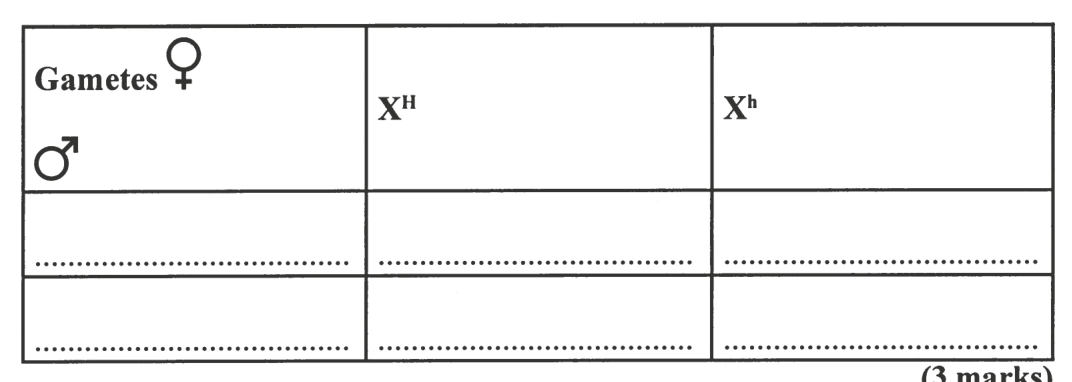
Complete the following genetics diagram to illustrate this information.
Parents' phenotypes: Male Female Parents' genotypes: Gametes:
Fertilization cross:
| Gametes | |||
|---|---|---|---|
[3 marks]
State the probability of the couple having a haemophiliac child.
[1 mark]
What is the likely sex of the haemophiliac child? Give ONE reason to support your answer.
[3 marks]
Suggest ONE reason why haemophiliacs may be more susceptible to infectious disease.
[1 mark]
Answer ALL questions.
Write your answers in the spaces provided in this booklet.
[15 marks]
Describe how oxygen in the atmosphere becomes available to human blood for delivery to the cells, and explain how this process differs from the way plant cells obtain oxygen for respiration.
[9 marks]
Suggest SIX reasons why humans who smoke heavily have less oxygen available to the cells for respiration.
[6 marks]
Blood that has been oxygenated in the lungs must first be pumped through the heart before it is sent to all the other organs of the body. Describe the pathway that blood takes as it flows into the heart from the lungs, until it is pumped out of the heart to be sent to the rest of the body.
[4 marks]
Identify TWO physiological diseases that affect the circulatory system.
[2 marks]
Chemotherapy is a treatment that destroys both the malignant (bad) cells and the good cells in the body. Explain why a person undergoing chemotherapy would have decreased natural immunity.
[4 marks]
Peter, who has not had a tetanus vaccine, gets his foot punctured by a nail. He is given a tetanus antiserum injection at the hospital. Suggest why he is given an antiserum injection instead of a vaccine.
[5 marks]
Describe how genetic engineering is used to produce human insulin using the bacterium E. coli.
[6 marks]
Discuss THREE differences between genetic engineering and artificial selection used by farmers to produce improved varieties of crop plants.
[6 marks]
Suggest THREE advantages of using genetic engineering to produce insulin.
[3 marks]