Free CXC Biology Paper 2 May/June 2012 past paper from 2012. Includes a worked answer key. Open the PDF, take a timed test, and study with AI on Caribbean AI.
Answer keys are free on Caribbean AI. View the answers to every past-paper question at no cost - no payment needed - with step-by-step worked solutions and instant AI marking available on Premium.
CSEC Biology Paper 2 May/June 2012 - Free CXC Past Paper with Answers
Free CXC Biology Paper 2 May/June 2012 past paper from 2012. Includes a worked answer key. Open the PDF, take a timed test, and study with AI on Caribbean AI.
Opening the interactive papers…
Every question from this paper as text. See the answers and worked solutions. Questions are the property of the Caribbean Examinations Council; Caribbean AI is not affiliated with CXC.
Construct a table to represent the data shown on the graph in Figure 1, using FOUR temperature values from the graph.
[4 marks]
Describe the trend in enzyme activity as shown by the graph in Figure 1.
[3 marks]
Explain what happens to the enzyme at temperatures above .
[2 marks]
Design an experiment to determine the rate at which starch is broken down under different pH conditions.
[5 marks]
Name TWO parts of the human digestive system where amylase may be found.
[2 marks]
Explain why the digestion of starch stops when food reaches the stomach.
[2 marks]
Name an enzyme which works best in the stomach.
[1 mark]
Amylase is also found in plants. Suggest THREE plant structures in which amylase may be found.
[3 marks]
How is the starch produced in leaves converted to a substance which can be transported to other parts of the plant?
[2 marks]
Give ONE benefit of the storage of starch in plants.
[1 mark]
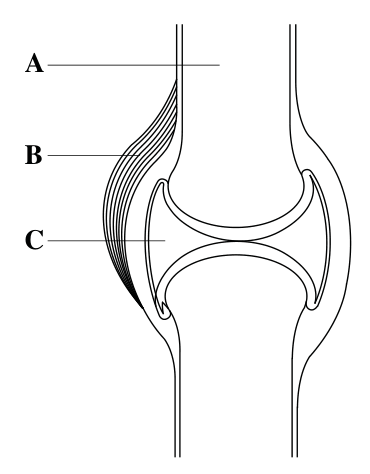
Figure 2 is a diagram of a hinge joint found at the elbow in a human body.
State the name of the structures labelled A, B and C in Figure 2, and give ONE function of EACH structure.
Name of A: Function:
Name of B: Function:
Name of C: Function:
[6 marks]
Use a line and the letter D to show the cartilage in the joint in Figure 2.
[1 mark]
Arthritis, a degenerative disease, may cause the wearing away of the cartilage of joints. Explain how this will affect joints.
[2 marks]
Explain how the muscles of the upper arm bring about the raising and lowering of the lower arm.
[4 marks]
Suggest why the treatment of some blood diseases may involve a bone marrow transplant.
[2 marks]
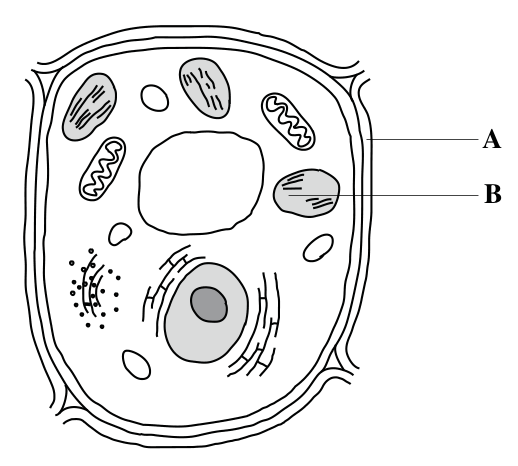
The diagram shown in Figure 3 represents a typical plant cell.
Identify the parts labelled A and B and state the function of EACH part.
A: Function of A: B: Function of B:
[4 marks]
The cell in Figure 3 was left in a concentrated salt solution for one hour. In the space below, draw an annotated diagram to show the appearance of this plant cell after one hour.
[6 marks]
If all the cells in a plant appear like the one drawn in (b) on page 7, the plant’s ability to photosynthesize will be reduced. Explain why photosynthesis will be reduced.
[2 marks]
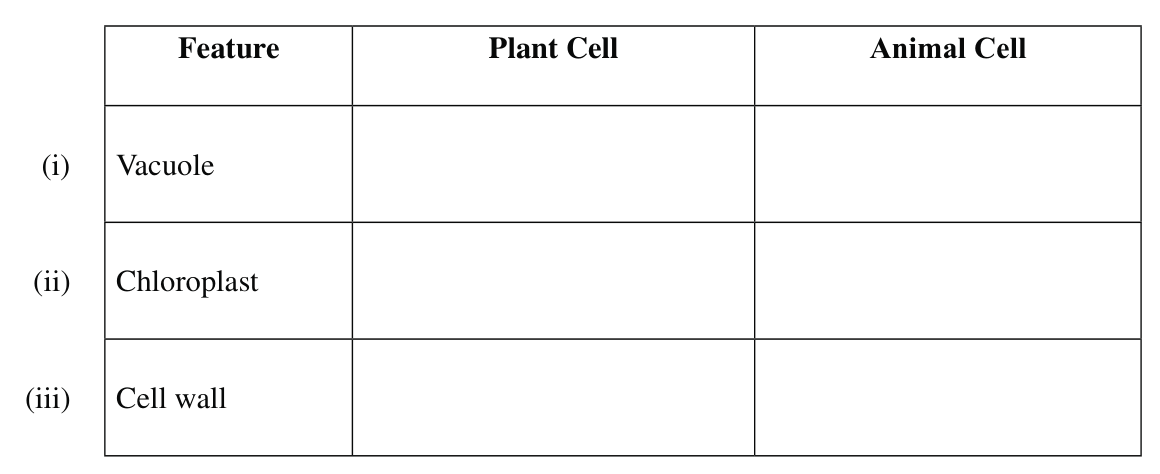
Complete the table below to show THREE differences between plant and animal cells.
| Feature | Plant Cell | Animal Cell |
|---|---|---|
| (i) Vacuole | ||
| (ii) Chloroplast | ||
| (iii) Cell wall |
[3 marks]
Write your answers in the spaces provided at the end of each question.
Distinguish between the following pairs of terms:
[6 marks]
Allele and gene
[2 marks]
Phenotype and genotype
[2 marks]
Dominant and recessive
[2 marks]
Black fur colour is controlled by a dominant allele, B, and brown fur colour by its recessive allele, b. This characteristic is NOT sex-linked. Give the genotypes of the parents and offspring of a cross between a black male and a brown female that produces black offspring and brown offspring. Show all the steps in the working of this problem.
[5 marks]
Haemophilia is caused by an X-linked recessive gene. Two parents with the normal phenotype have a haemophiliac child. Use a genetic diagram to show how this is possible. ( = normal; = gene for haemophilia)
[4 marks]
Insect vectors are involved in the spread of some pathogenic diseases.
[15 marks]
Describe the life cycle of a named insect vector.
[4 marks]
Distinguish between the transmission of a named pathogenic disease and a named physiological (lifestyle) disease.
[4 marks]
Explain how the treatment and control measures for a named pathogenic disease will differ from those of a named physiological disease.
[4 marks]
Evaluate the socio-economic impact of AIDS on the Caribbean population.
[3 marks]
With the aid of a labelled diagram, describe the structure of the human male reproductive system. Indicate on the diagram the structure that produces gametes, and the structures that transport the gametes to allow reproduction to take place.
[6 marks]
Name ONE method of contraception that works by preventing (i) fertilization (ii) ovulation.
Explain EACH of the methods named above functions to prevent pregnancy.
[4 marks]
fertilization
[2 marks]
ovulation.
[2 marks]
Compare the means by which the gametes are brought together in flowering plants with the means by which the gametes are brought together in humans.
[5 marks]