Free CXC Biology Paper 2 May/June 2022 past paper from 2022. Includes a worked answer key. Open the PDF, take a timed test, and study with AI on Caribbean AI.
Answer keys are free on Caribbean AI. View the answers to every past-paper question at no cost - no payment needed - with step-by-step worked solutions and instant AI marking available on Premium.
CSEC Biology Paper 2 May/June 2022 - Free CXC Past Paper with Answers
Free CXC Biology Paper 2 May/June 2022 past paper from 2022. Includes a worked answer key. Open the PDF, take a timed test, and study with AI on Caribbean AI.
Opening the interactive papers…
Every question from this paper as text. See the answers and worked solutions. Questions are the property of the Caribbean Examinations Council; Caribbean AI is not affiliated with CXC.
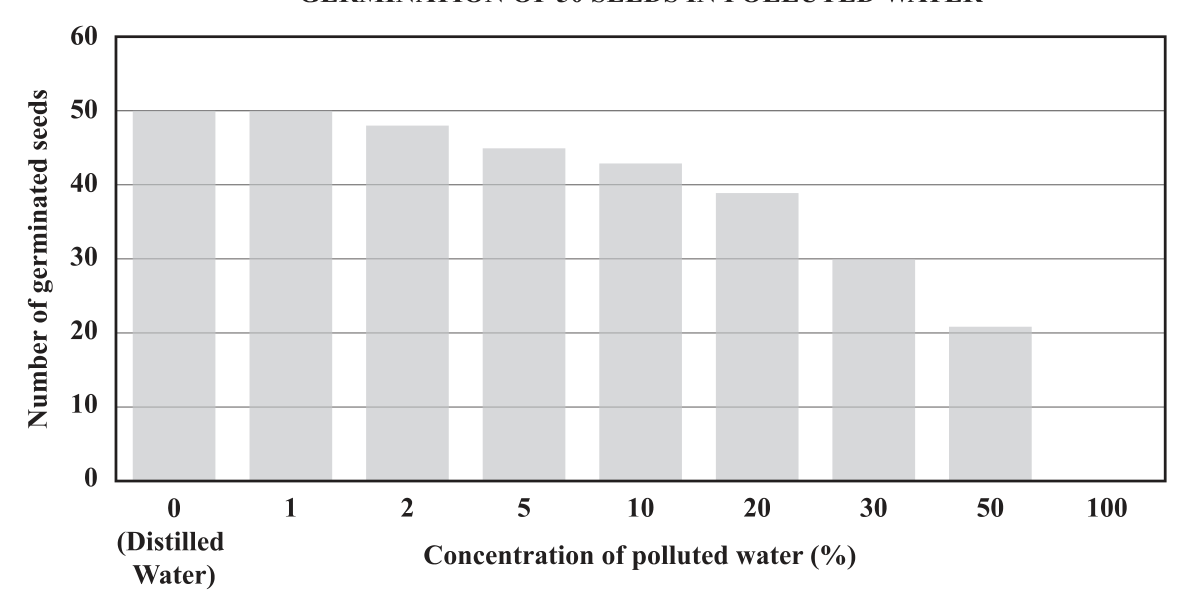
Germination involves the breakdown of food stores in a seed. Figure 1 shows the results of an experiment, where 50 germinating seeds were exposed to varying concentrations of pollutants in water.
List FOUR factors, other than pollution, that can affect the germination of seeds.
[4 marks]
State the aim of the experiment.
[1 mark]
Using Figure 1, explain how the concentration of polluted water affects germination at EACH of the following concentrations:
[4 marks]
1%
[2 marks]
50%
[2 marks]
The research team provided the results of the experiment to a farmer. State TWO ways in which the farmer can use the data to improve his farming practices.
[2 marks]
On Figure 1, clearly place an X on the bar that represents the results of the control.
[2 marks]
Give ONE reason for your answer in (e) (i).
[1 mark]
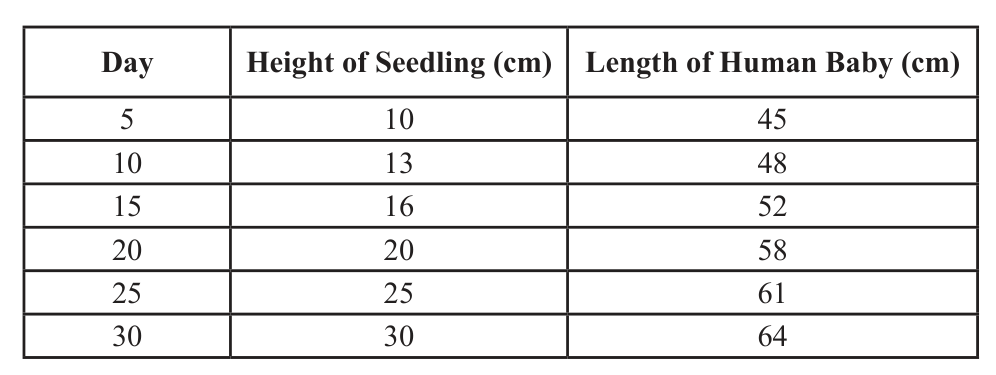
Meena investigated the growth of some seedlings and made comparisons with growth patterns in a human baby over a 30-day period. The data are provided in Table 1.
| Day | Height of Seedling (cm) | Length of Human Baby (cm) |
|---|---|---|
| 5 | 10 | 45 |
| 10 | 13 | 48 |
| 15 | 16 | 52 |
| 20 | 20 | 58 |
| 25 | 25 | 61 |
| 30 | 30 | 64 |
On the grid provided on page 7, plot the data obtained for both the seedling and the baby, using the same scales and axes. Provide a suitable title for the graph.
[6 marks]
Suggest TWO ways in which the growth of the baby differs from the growth of the seedlings.
[3 marks]
Suggest TWO ways in which the growth of the baby differs from the growth of the seedlings.
[2 marks]
Suggest ONE similarity between the growth of the baby and the growth of the seedlings.
[1 mark]
Describe how the seedlings' height is measured using a ruler.
[1 mark]
Suggest ONE example that shows that an increase in cells is NOT always due to growth.
[1 mark]
Suggest ONE factor that should be considered before making a conclusion from the data in Table 1.
[1 mark]
Define EACH of the following terms:
[3 marks]
Saprophytic nutrition
[1 mark]
Heterotrophic nutrition
[1 mark]
Autotrophic nutrition
[1 mark]
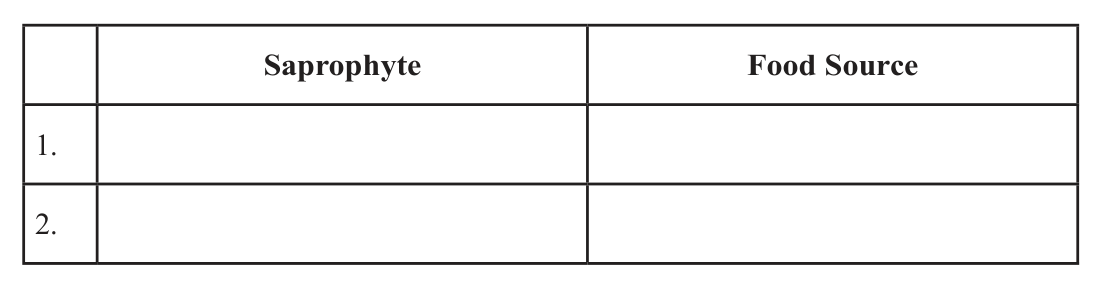
Complete Table 2 identifying TWO saprophytes and their food sources.
[4 marks]
Explain TWO processes by which the raw materials required for making nutrients reach the leaves of a plant.
[4 marks]
Young seedlings use all the nutrients stored in their cotyledons to start their growth. Explain the process by which the seedlings make more nutrients to continue their growth.
[4 marks]
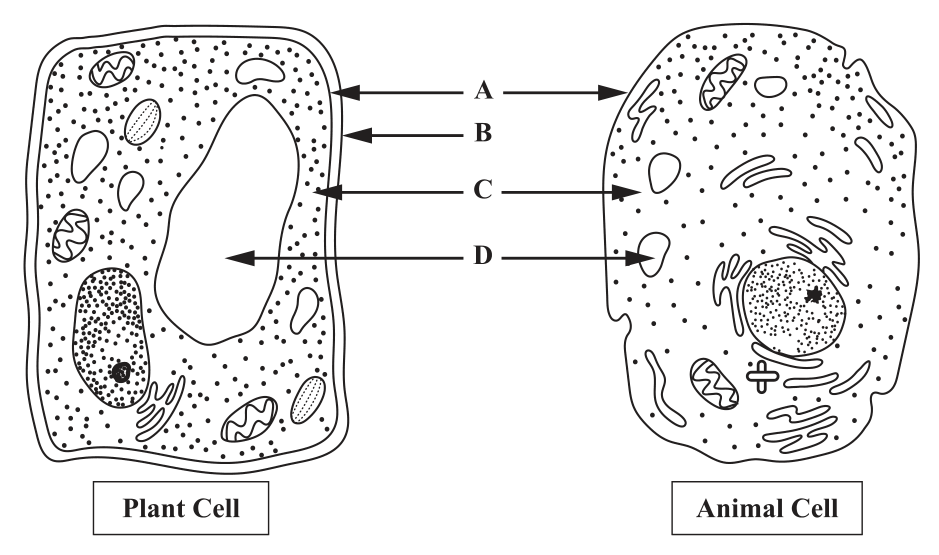
Figure 2 below shows a typical plant cell and a typical animal cell.
[7 marks]
Identify the structures labelled A, B, C and D.
[4 marks]
State the function of any THREE of the structures identified in (a) (i).
[3 marks]
A student collected two specimens, A and B, from a seashore during her Biology field trip. She used a microscope to determine which structures were present in the specimens and found that Specimen A contained more mitochondria than Specimen B.
Suggest TWO reasons why Specimen A had more mitochondria than Specimen B.
[4 marks]
Using TWO named examples, explain why cell specialization is important for cells to function effectively.
[4 marks]
SECTION B
Answer ALL questions.
[15 marks]
Define EACH of the following terms:
[2 marks]
Climate change
[1 mark]
Population
[1 mark]
State FOUR methods that may be used to conserve the environment.
[4 marks]
The earth's climate has warmed considerably over the past few decades. Using THREE examples, explain how global warming may lead to an increase in infectious diseases within the Caribbean region.
[6 marks]
Climate change can severely impact Small Island Developing States (SIDS) within the Caribbean. Suggest THREE possible actions that can be taken to reduce the effects of climate change.
[3 marks]
Ellis received a blood test from his doctor. His test results showed that his white blood cell and platelet levels were normal while his red blood cell levels were not normal.
[15 marks]
Ellis received a blood test from his doctor. His test results showed that his white blood cell and platelet levels were normal while his red blood cell levels were not normal.
[6 marks]
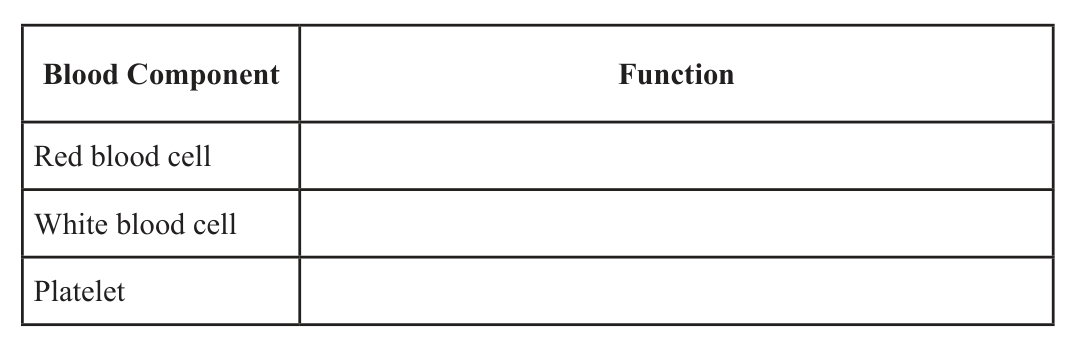
Complete Table 3 below to show ONE function of EACH of the blood components.
TABLE 3: BLOOD COMPONENTS AND FUNCTIONS
| Blood Component | Function |
|---|---|
| Red blood cell | |
| White blood cell | |
| Platelet |
[3 marks]
Name THREE other substances which are found in the blood.
[3 marks]
Ellis received additional tests which revealed that he has sickle-cell anaemia. Suggest ONE way in which Ellis' red blood cells may differ from a person who does NOT have sickle-cell anaemia.
[2 marks]
Ellis becomes concerned that his child may also develop sickle-cell anaemia. His doctor tested his wife's blood and told Ellis that it is unlikely that he will have a child with sickle-cell anaemia. With the use of a genetic diagram, explain why it is NOT possible for Ellis to have a child with sickle-cell anaemia.
In your answer, let S denote the allele for the sickle-cell trait and A the allele for the normal trait.
Phenotype (father): _________________________ Phenotype (mother): _________________________ Genotype (father): _________________________ Genotype (mother): _________________________
Genetic cross:
Explanation:
[7 marks]
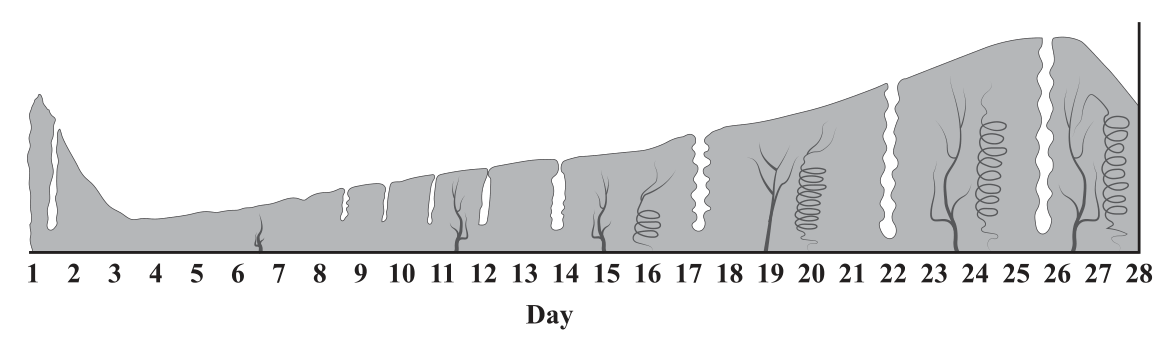
Anna has a 28-day menstrual cycle. Figure 3 shows the changes which occur in Anna’s uterine lining during her menstrual cycle.
[15 marks]
Anna has a 28-day menstrual cycle. Figure 3 shows the changes which occur in Anna’s uterine lining during her menstrual cycle.
[4 marks]
Name the TWO sex hormones which are associated with the menstrual cycle.
[2 marks]
On Figure 3, sketch a line for EACH hormone to show how the levels of the sex hormones named in (a) (i) change over the 28-day cycle. Label EACH line.
[2 marks]
Anna recently became pregnant. Explain the effect that pregnancy will have on the TWO sex hormones named in (a) (i).
[4 marks]
After the delivery of a healthy baby boy, Anna decides that she does not want to have any other children at this time. She, however, wishes to have another child in the future.
[4 marks]
Recommend ONE suitable birth control method which Anna could use to prevent pregnancy.
[1 mark]
State TWO advantages and ONE disadvantage of the birth control method recommended in (c) (i).
[3 marks]
Not all birth control methods can prevent both pregnancy and infections from sexually transmitted diseases.
[3 marks]
State TWO sexually transmitted diseases.
[2 marks]
Identify a birth control method which would be effective at preventing pregnancy AND infections from sexually transmitted infections.
[1 mark]