Free CXC Biology Paper 2 May/June 2009 past paper from 2009. Includes a worked answer key. Open the PDF, take a timed test, and study with AI on Caribbean AI.
Answer keys are free on Caribbean AI. View the answers to every past-paper question at no cost - no payment needed - with step-by-step worked solutions and instant AI marking available on Premium.
CSEC Biology Paper 2 May/June 2009 - Free CXC Past Paper with Answers
Free CXC Biology Paper 2 May/June 2009 past paper from 2009. Includes a worked answer key. Open the PDF, take a timed test, and study with AI on Caribbean AI.
Opening the interactive papers…
Every question from this paper as text. See the answers and worked solutions. Questions are the property of the Caribbean Examinations Council; Caribbean AI is not affiliated with CXC.
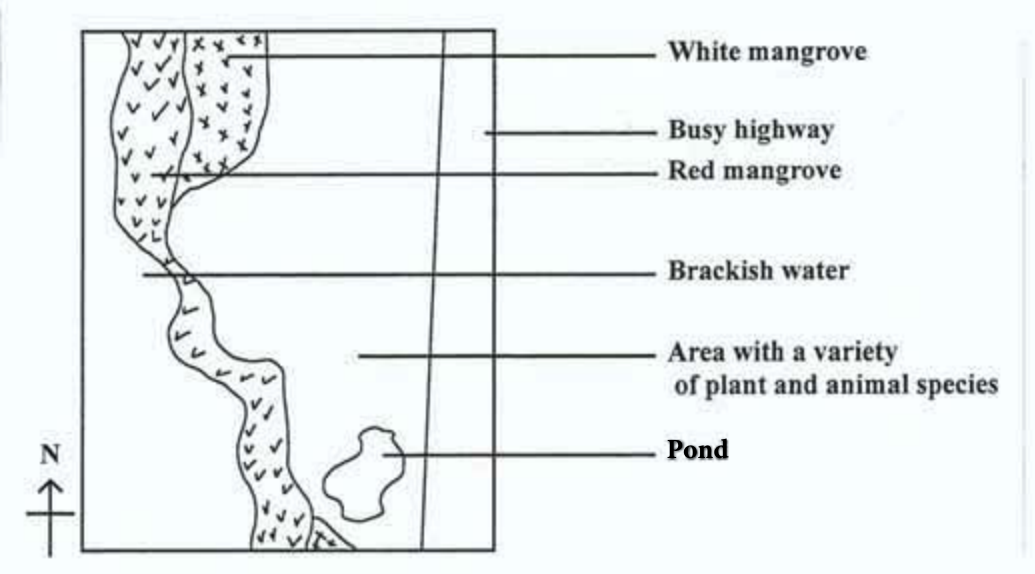
A biology class goes on a field trip to study a small coastal ecosystem along a busy highway. A student's sketch of the area investigated is shown in Figure 1 below.
[25 marks]
The distribution of the different plant and animal species changes from the water's edge to the highway. Name TWO additional pieces of apparatus the students will need to investigate the changing distribution of plant and animal species.
[2 marks]
Describe how EACH piece of apparatus you named in (a) (i) can be used to study the distribution of plant species in this area.
[2 marks]
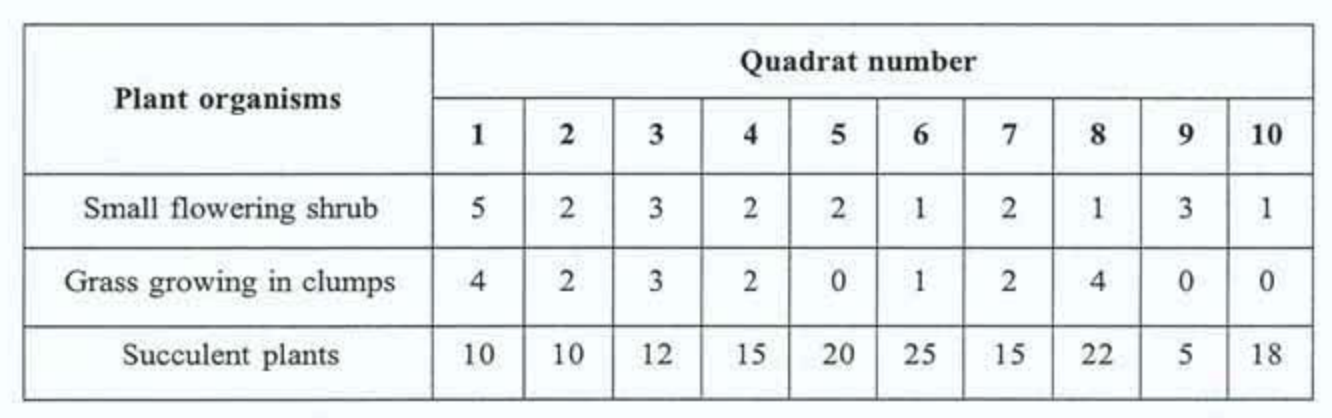
One group of students uses a quadrat to determine the distribution of three plant species in the area behind the mangroves. The results are shown in Table 1.
State ONE precaution that should be taken when using the quadrat to determine the distribution of the plant species.
[1 mark]
Calculate the species density of the small flowering shrub in the area. (Show your working.)
[2 marks]
Suggest a reason for such a large number of succulent plants in the area.
[2 marks]
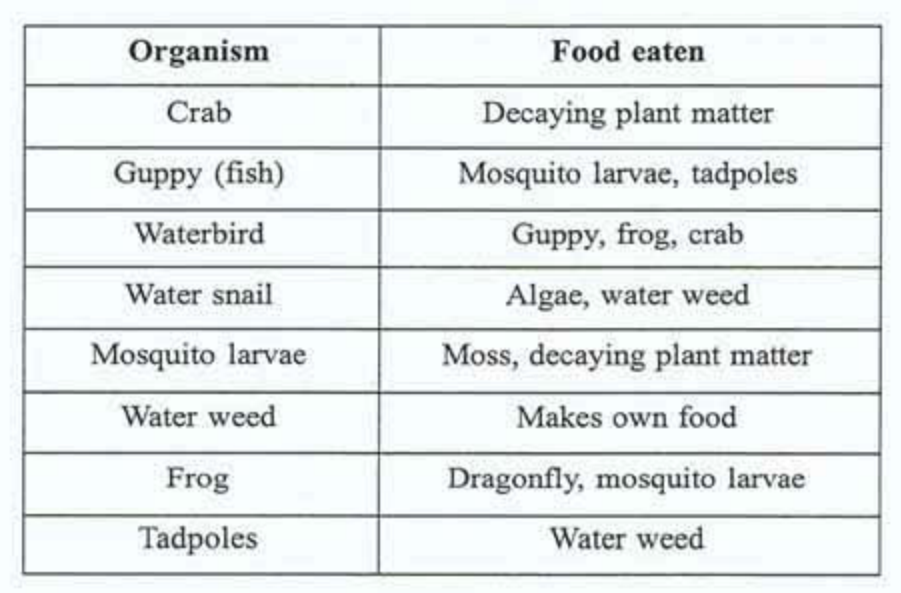
Another group of students observes the feeding relationship among the organisms found in and around the pond. The data recorded is shown in Table 2.
| Organism | Food eaten |
|---|---|
| Crab | Decaying plant matter |
| Guppy (fish) | Mosquito larvae, tadpoles |
| Waterbird | Guppy, frog, crab |
| Water snail | Algae, water weed |
| Mosquito larvae | Moss, decaying plant matter |
| Water weed | Makes own food |
| Frog | Dragonfly, mosquito larvae |
| Tadpoles | Water weed |
Another group of students observes the feeding relationship among the organisms found in and around the pond. The data recorded is shown in Table 2.
Using the information in Table 2 construct a food web with TEN organisms.
[3 marks]
Explain why there are usually no more than four trophic levels in a food web.
[2 marks]
State TWO physical factors that could affect the population of the organisms that live in the pond.
[2 marks]
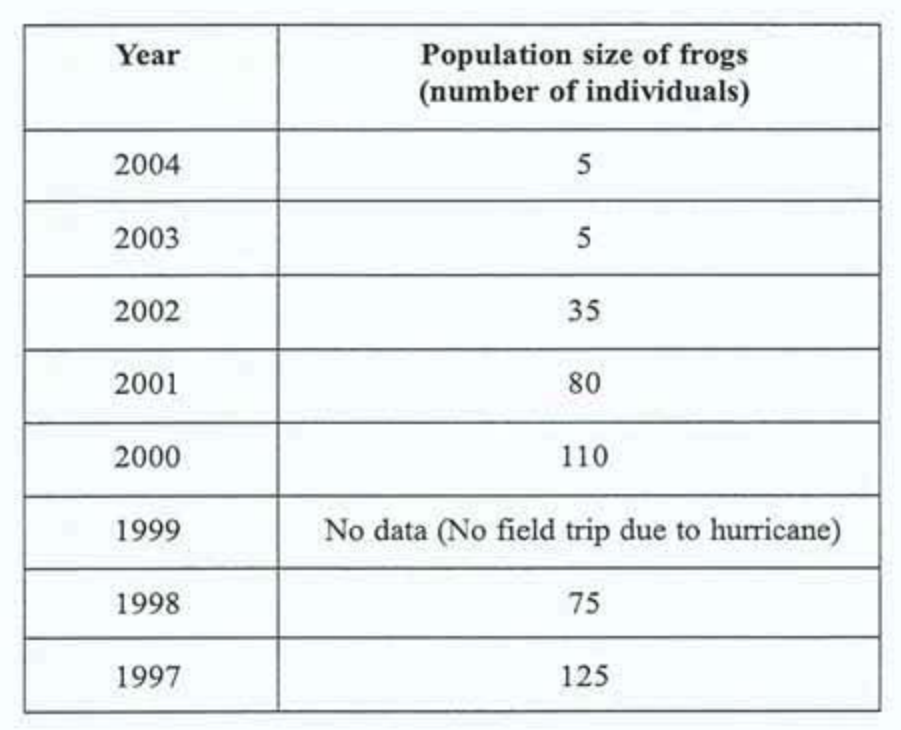
Different groups of students collected data on the frog population from 1997 to 2004. Table 3 shows this data.
| Year | Population size of frogs (number of individuals) |
|---|---|
| 2004 | 5 |
| 2003 | 5 |
| 2002 | 35 |
| 2001 | 80 |
| 2000 | 110 |
| 1999 | No data (No field trip due to hurricane) |
| 1998 | 75 |
| 1997 | 125 |
Different groups of students collected data on the frog population from 1997 to 2004. Table 3 shows this data.
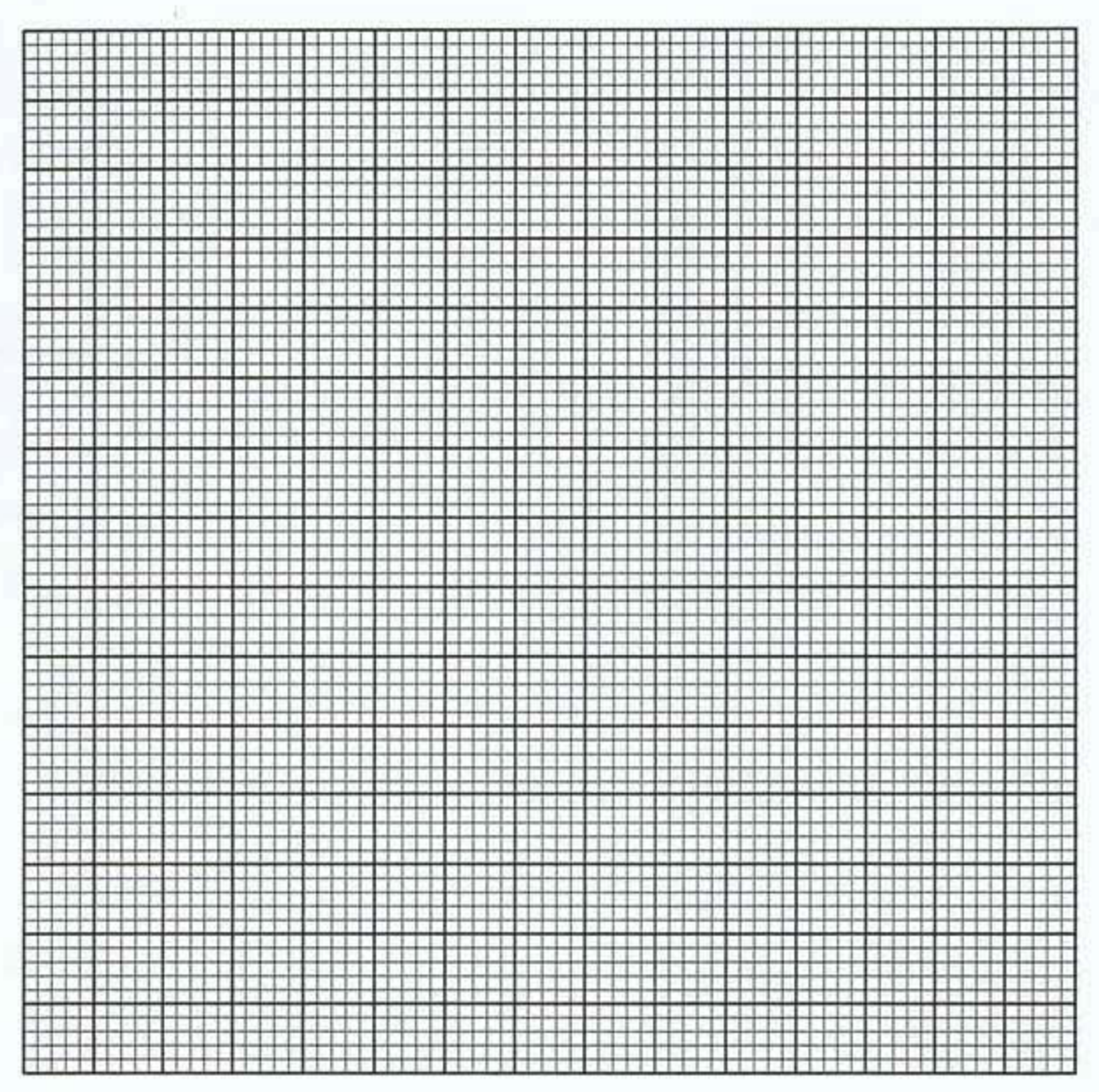
Plot a graph to represent the data shown in Table 3, using the grid provided on page 7.
[4 marks]
Account for the trend in the frog population before and after the hurricane.
[3 marks]
Suggest ONE reason why it is useful to study the distribution of frogs.
[2 marks]
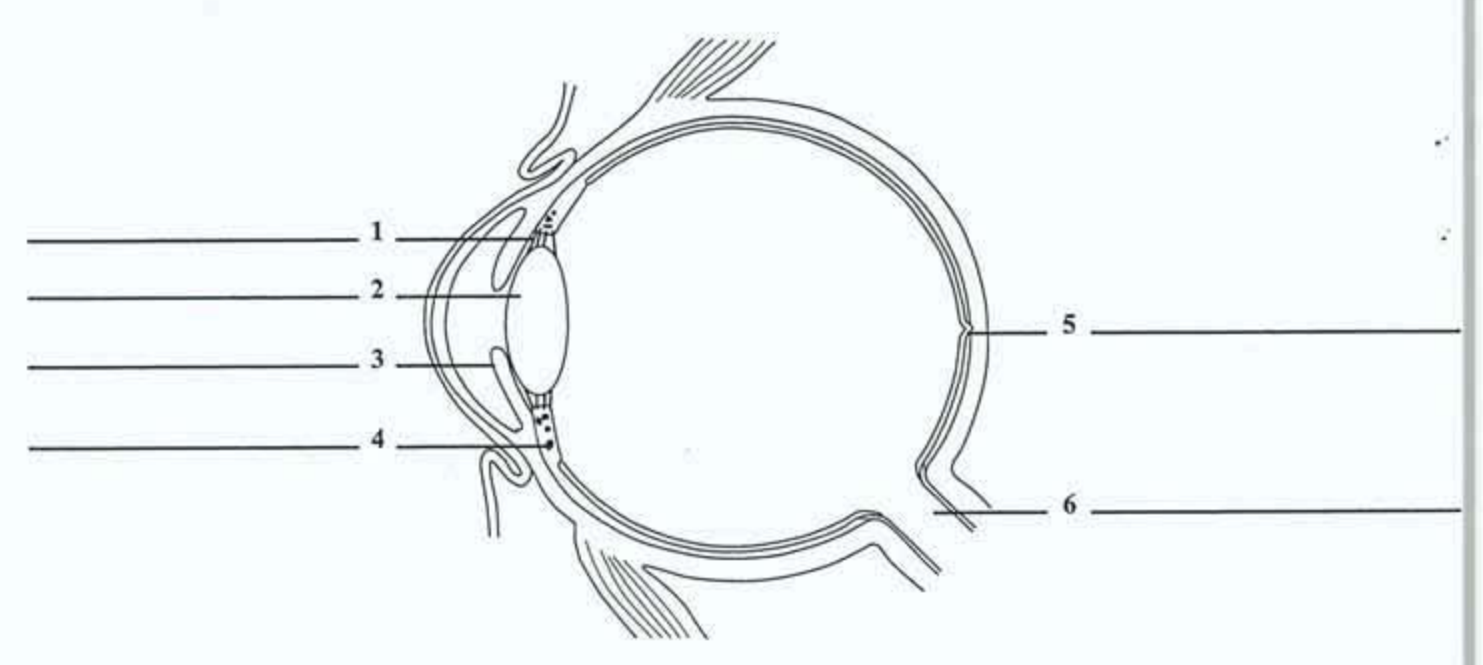
Figure 2 shows the structure of the human eye.
Label the parts numbered 1 to 6 on the diagram in Figure 2.
[6 marks]
The rods and cones are specialised cells of the retina which are stimulated by light. What biological term describes such cells?
[1 mark]
Severe lack of Vitamin A can result in the cornea of the eye becoming dry and thickened. Explain how this condition would affect a person's ability to see.
[2 marks]
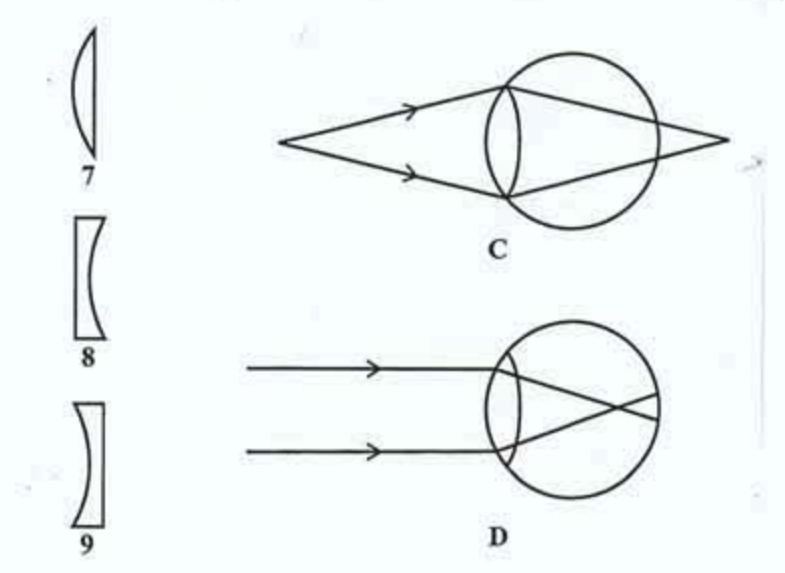
Diagrams C and D in Figure 3 show two common eye defects, while Diagrams 7, 8 and 9 show three types of lenses that can be used to correct eye defects.
Identify the eye defects and the lenses in Figure 3 that can be used to correct the defects.
Diagram C Eye defect:
Corrective lens:
Diagram D Eye defect:
Corrective lens:
Diagrams C and D in Figure 3 show two common eye defects, while Diagrams 7, 8 and 9 show three types of lenses that can be used to correct eye defects.
Identify the eye defects and the lenses in Figure 3 that can be used to correct the defects.
Diagram C Eye defect: Corrective lens:
Diagram D Eye defect: Corrective lens:
[4 marks]
Sometimes contact lenses are used to correct eye defects. Suggest TWO precautions one should take when using contact lenses.
[2 marks]
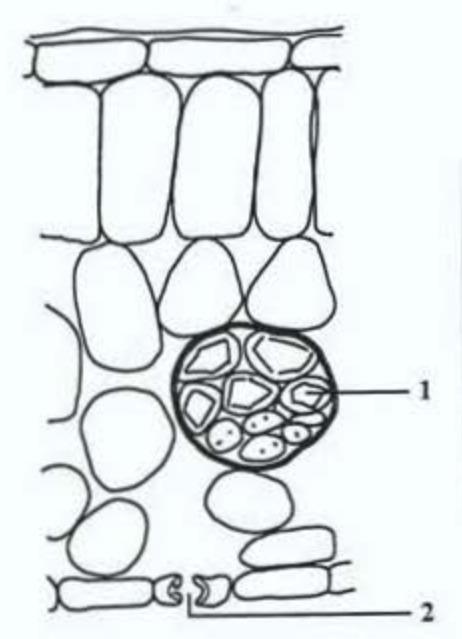
Figure 4 shows the internal structure of a dicotyledonous leaf.
[15 marks]
Name ONE function for which the leaf in Figure 4 is suited and suggest how it is BEST suited for that function.
[2 marks]
Using THREE arrows only, show on Figure 4 the path of water diffusing from the leaf.
[3 marks]
Identify the structures labelled 1 and 2.
Structure 1: Structure 2:
[2 marks]
Name ONE consequence to a herbaceous plant if there is temporary unavailability of water to replace the water lost from the leaves.
[1 mark]
Explain how water from the soil gets to the leaf in a plant.
[3 marks]
Explain how any ONE structural feature of plant cells helps in transport in plants.
[2 marks]
Explain why all the water taken up by the roots of a plant is NOT lost by evaporation from the leaves.
[2 marks]
SECTION B
Answer ALL questions in this section.
Write your answer in the spaces provided at the end of EACH question in this booklet.
With the aid of a fully annotated diagram of the kidney (uriniferous) tubule, explain how urine is produced and gets to the bladder.
[8 marks]
Suggest why urine production is important in humans.
[3 marks]
Members of a Boy Scouts troop were advised by their leader to take water with them on their hike into the mountains. One boy decided to drink a large quantity of water before leaving on the hike. Explain how his body functions to deal with the excess water.
[3 marks]
One lesson taught to the Boy Scouts troop on their hike was that the plants along the trail were adapted to conserve water. Suggest TWO reasons why the plants observed growing along the trail had mechanisms to reduce water loss.
[4 marks]
Using a diagram, illustrate how any THREE named processes are involved in the recycling of carbon in nature.
[6 marks]
Sometimes human activity abnormally affects natural cycles.
[9 marks]
Sometimes human activity abnormally affects natural cycles. Suggest TWO ways in which human activity contributes to an abnormal rise in levels of atmospheric carbon dioxide.
Suggest ONE likely consequence of abnormally high carbon dioxide levels on ecosystems.
[3 marks]
Suggest TWO ways in which carbon dioxide levels can be controlled.
[3 marks]
Draw a diagram to show the relative positions of the ovaries, uterus, oviduct and cervix of the human female reproductive system.
[3 marks]
Annotate the diagram to identify the functions of the labelled parts.
[3 marks]
Two hormones associated with the reproductive cycle of the female are oestrogen and progesterone. What are TWO likely consequences of limited production of these hormones?
[3 marks]
Women of reproductive age are generally advised not to smoke cigarettes. Identify TWO ways in which smoking is likely to harm the developing foetus.
[3 marks]
Education on reproductive health in some schools now includes condom education.
[3 marks]
State ONE disadvantage of using condoms.
[1 mark]
Suggest TWO reasons why choosing a birth control method can be a more difficult issue for the female partner in a marriage than the male.
[2 marks]