
Free CXC Biology Paper 2 May/June 2016 past paper from 2016. Includes a worked answer key. Open the PDF, take a timed test, and study with AI on Caribbean AI.
Answer keys are free on Caribbean AI. View the answers to every past-paper question at no cost - no payment needed - with step-by-step worked solutions and instant AI marking available on Premium.
CSEC Biology Paper 2 May/June 2016 - Free CXC Past Paper with Answers
Free CXC Biology Paper 2 May/June 2016 past paper from 2016. Includes a worked answer key. Open the PDF, take a timed test, and study with AI on Caribbean AI.
Opening the interactive papers…
Every question from this paper as text. See the answers and worked solutions. Questions are the property of the Caribbean Examinations Council; Caribbean AI is not affiliated with CXC.
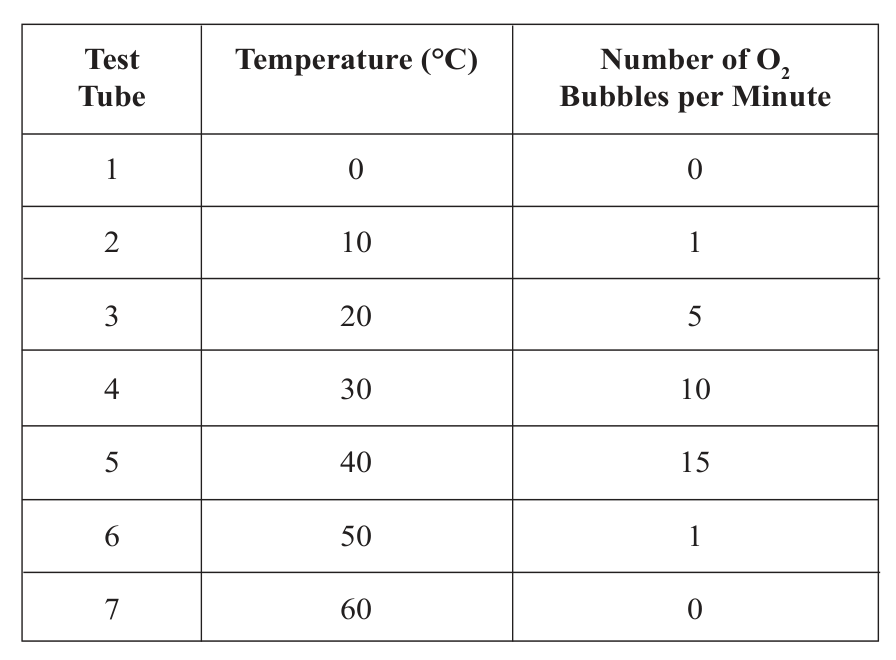
Students investigate the effect of temperature on the rate of reaction of the enzyme, catalase. They use crushed potato as the source of the enzyme and place 5 mg into each of 7 test tubes. They add 5 cm of 1% hydrogen peroxide to each test tube and place them into water-baths kept at the following temperatures: 0 °C, 10 °C, 20 °C, 30 °C, 40 °C, 50 °C and 60 °C. They count the number of bubbles released per minute from each test tube and record the data in Table 1.
TABLE 1: EFFECT OF TEMPERATURE ON CATALASE ACTIVITY
| Test Tube | Temperature (°C) | Number of O Bubbles per Minute |
|---|
| 1 | 0 | 0 |
| 2 | 10 | 1 |
| 3 | 20 | 5 |
| 4 | 30 | 10 |
| 5 | 40 | 15 |
| 6 | 50 | 1 |
| 7 | 60 | 0 |
[25 marks]
Plot a graph on the grid provided on page 5 to show the relationship between the number of oxygen bubbles released and temperature.
[4 marks]
From your graph, determine the optimum temperature for the enzyme.
[1 mark]
Explain the shape of the graph at EACH of the following temperature ranges:
[6 marks]
Write a conclusion that the students could draw from their results.
[1 mark]
Suggest ONE reason why living organisms need to maintain a constant internal temperature.
[1 mark]
Describe TWO precautions that the students should take when doing this experiment.
[2 marks]
How could this experiment be modified to investigate the effect of pH on enzyme activity?
[2 marks]
Name TWO enzymes that function in protein digestion and describe the role of EACH.
[2 marks]
Before food can be chemically digested by enzymes, it must first be mechanically broken down in the alimentary canal.
[8 marks]
Name TWO parts of the alimentary canal that are responsible for the mechanical digestion of food.
[2 marks]
Give TWO reasons why mechanical digestion of food is important.
[2 marks]
Explain the significance of chemical digestion of food.
[2 marks]
In the box provided below, draw a food web consisting of the following organisms:
[3 marks]
What is the role of the organism at the start of the food web?
[1 mark]
Name the organism which performs EACH of the following functions in the food web drawn in (a) (i) on page 10. a) Both as a prey and a predator b) Primary consumer c) Secondary consumer d) Tertiary consumer (top carnivore)
From your food web in (a) (i), draw a food chain consisting of THREE organisms.
[1 mark]
What is the role of the organism to which the arrow points in a food chain?
[1 mark]
Explain why energy flows in one direction in the food chain.
[2 marks]
List THREE features of an environment which support living organisms.
[3 marks]
Define EACH of the following terms:
[3 marks]
Stimulus
[1 mark]
Receptor
[1 mark]
Effector
[1 mark]
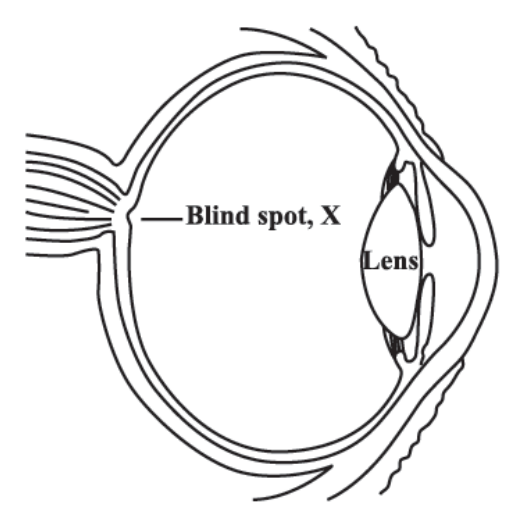
Figure 1 is a diagram of a section through the human eye.
(i) Label EACH of the following parts of the eye on Figure 1:
(ii) Why is X called the 'blind spot'?
[4 marks]
Label EACH of the following parts of the eye on Figure 1:
[4 marks]
Why is X called the 'blind spot'?
[1 mark]
A boy looks up from reading his book to see a helicopter flying in the distance. Account for the changes that would occur in the lens of both of his eyes to enable him to see the helicopter.
[3 marks]
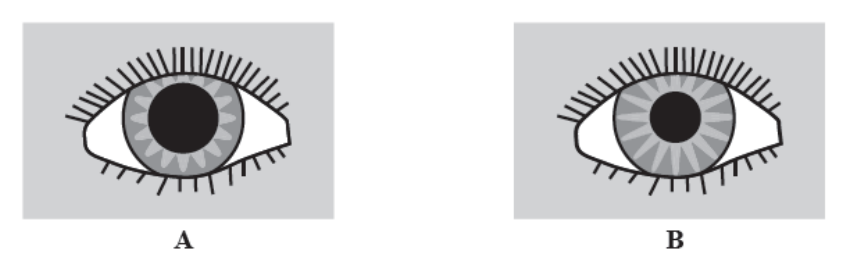
Figure 2 shows two eyes labelled A and B, under two different light conditions.
Which of the eyes in Figure 2, A or B, shows the appearance of an eye exposed to dim light? Explain your answer.
[3 marks]
Why is it important for the eye to respond when exposed to very bright light?
[1 mark]
SECTION B
Answer ALL questions in this section.
Write your answers in the spaces provided in this booklet.
[15 marks]
In the box below, draw a labelled diagram of the female reproductive system, and using an arrow, trace the path that a spermatozoon would have to take to fertilize an ovum.

[6 marks]
A young couple wants to choose between two contraceptive methods — barrier or surgical. Discuss why the male may prefer the barrier method rather than the surgical method of contraception. Your answer should include TWO advantages of the barrier method and THREE disadvantages of the surgical method.
[5 marks]
A biologist discovers that the flowers of a species of plants have no male reproductive parts. Suggest ONE method by which these plants produce offspring, and THREE advantages of this method.
Method
Advantages
[4 marks]
With the aid of a chemical equation, explain what is meant by the term 'photosynthesis', and discuss how a dicotyledonous leaf is adapted to capture maximum sunlight and carbon dioxide for the process.
Photosynthesis
Equation
Adaptations
[11 marks]
Outline how decomposers assist in the cycling of carbon dioxide to make it available to green plants.
[4 marks]
State TWO causes of anaemia and describe TWO signs/symptoms of the disease.
Causes
Signs/symptoms
[4 marks]
Sickle-cell anaemia is caused by the presence of a recessive allele. Persons who are heterozygous and carry the sickle-cell allele are more resistant to a type of severe malaria than persons who are homozygous for the normal haemoglobin allele.
(i) State what is meant by EACH of the following terms:
[2 marks]
Homozygous
[1 mark]
Heterozygous
[1 mark]
With the aid of a genetic diagram, show how a man and a woman who do NOT have sickle-cell anaemia can have a child who has the disease.

[6 marks]
Explain why the sickle-cell allele is more common in the population, in countries where the severe form of malaria is present.
[3 marks]