Free CXC Biology Paper 2 May/June 2023 past paper from 2023. Includes a worked answer key. Open the PDF, take a timed test, and study with AI on Caribbean AI.
Answer keys are free on Caribbean AI. View the answers to every past-paper question at no cost - no payment needed - with step-by-step worked solutions and instant AI marking available on Premium.
CSEC Biology Paper 2 May/June 2023 - Free CXC Past Paper with Answers
Free CXC Biology Paper 2 May/June 2023 past paper from 2023. Includes a worked answer key. Open the PDF, take a timed test, and study with AI on Caribbean AI.
Opening the interactive papers…
Every question from this paper as text. See the answers and worked solutions. Questions are the property of the Caribbean Examinations Council; Caribbean AI is not affiliated with CXC.
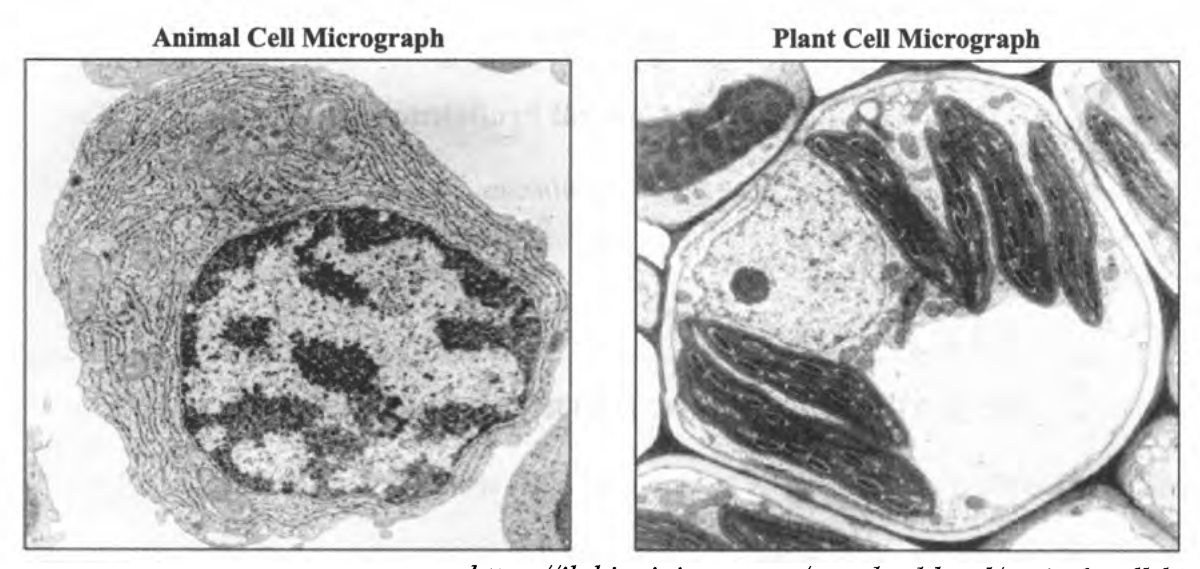
What type of microscope was used to produce the images shown in Figure 1?
[1 mark]
Draw a large, clearly labelled diagram of ONE plant cell from the micrograph shown in Figure 1.

[9 marks]
List TWO similarities between the plant cell and the animal cell.
[2 marks]
The most prominent structure on the animal cell electron micrograph carries genetic information in the form of DNA. State the name of the structure.
[1 mark]
The diagram in Figure 2 shows the general structure of a bacterial cell.
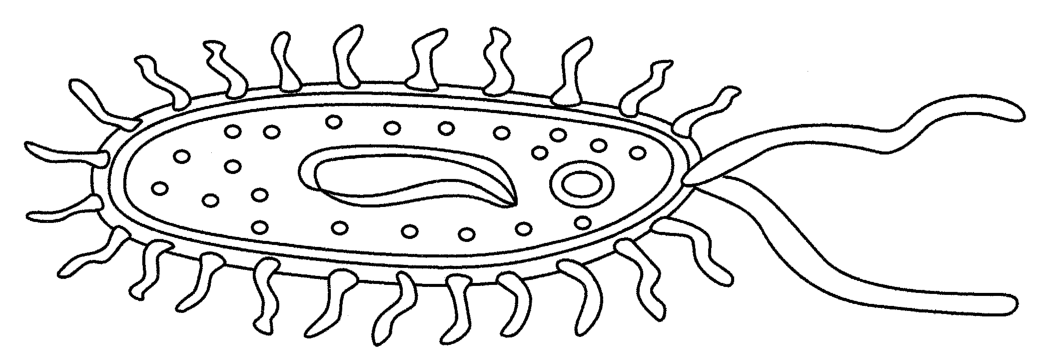
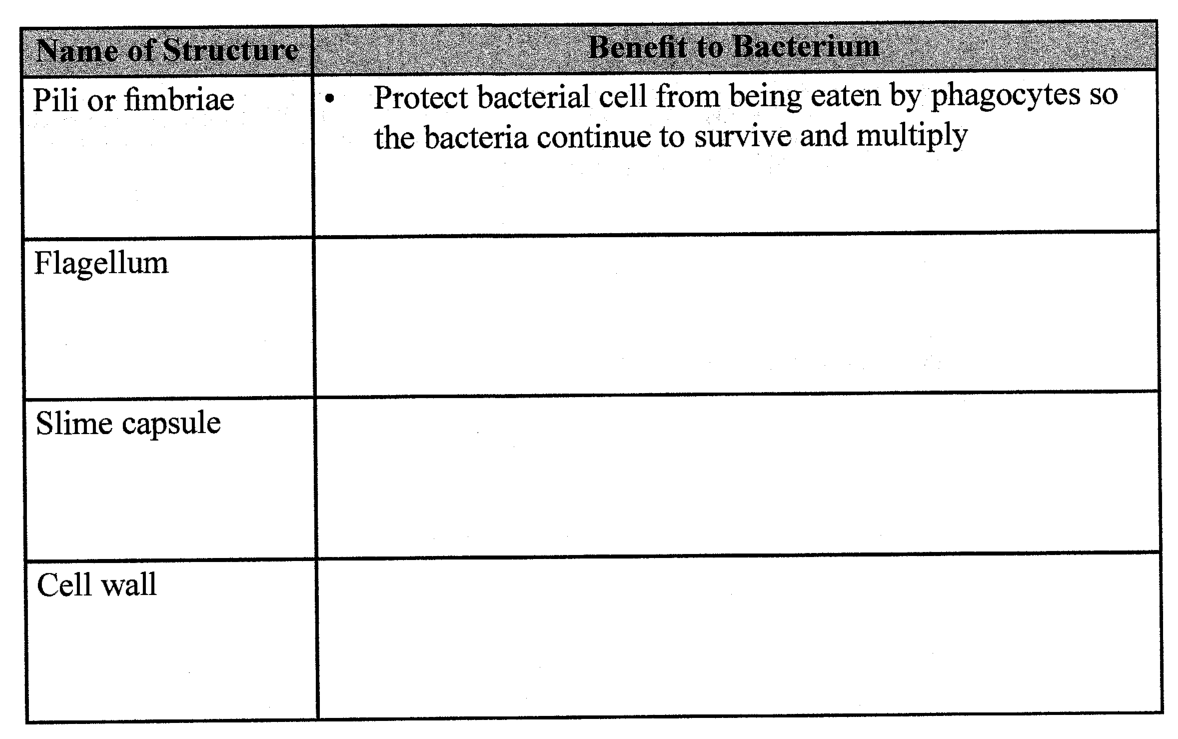
(i) Identify ONE similarity between the bacterial cell and a plant cell. (ii) The structures of the bacterial cell are especially suited for its role in infecting other organisms. Table 1 lists four of these structures.
Complete Table 1 by explaining how EACH structure helps the bacterium to infect organisms. An example has been provided for you.
| Name of Structure | Benefit to Bacterium |
|---|---|
| Pili or fimbriae | Protect bacterial cell from being eaten by phagocytes so the bacteria continue to survive and multiply |
| Flagellum | |
| Slime capsule | |
| Cell wall |
[6 marks]
Identify ONE similarity between the bacterial cell and a plant cell.
[1 mark]
The structures of the bacterial cell are especially suited for its role in infecting other organisms. Table 1 lists four of these structures.
Complete Table 1 by explaining how EACH structure helps the bacterium to infect organisms. An example has been provided for you.
| Name of Structure | Benefit to Bacterium |
|---|---|
| Pili or fimbriae | Protect bacterial cell from being eaten by phagocytes so the bacteria continue to survive and multiply |
| Flagellum | |
| Slime capsule | |
| Cell wall |
[6 marks]
Human beings are multicellular and are made up of a large variety of cells.
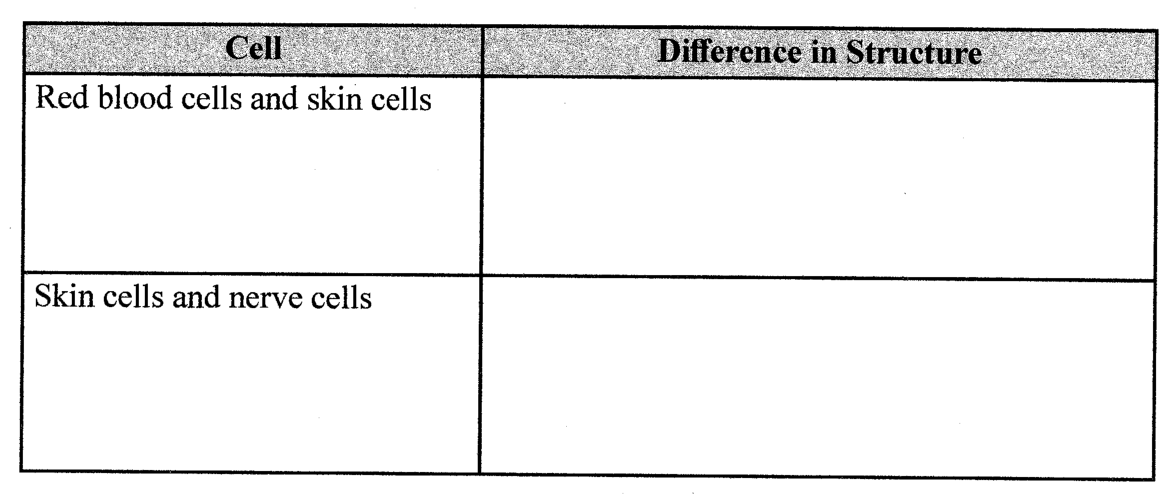
(i) Complete Table 2 by distinguishing between the following cells:
| Cell | Difference in Structure |
|---|---|
| Red blood cells and skin cells | |
| Skin cells and nerve cells |
(ii) Name ONE feature that would enable a scientist to distinguish a spherical bacterial cell from an animal cell when viewed under a microscope.
[5 marks]
Complete Table 2 by distinguishing between the following cells:
| Cell | Difference in Structure |
|---|---|
| Red blood cells and skin cells | |
| Skin cells and nerve cells |
[4 marks]
Name ONE feature that would enable a scientist to distinguish a spherical bacterial cell from an animal cell when viewed under a microscope.
[1 mark]
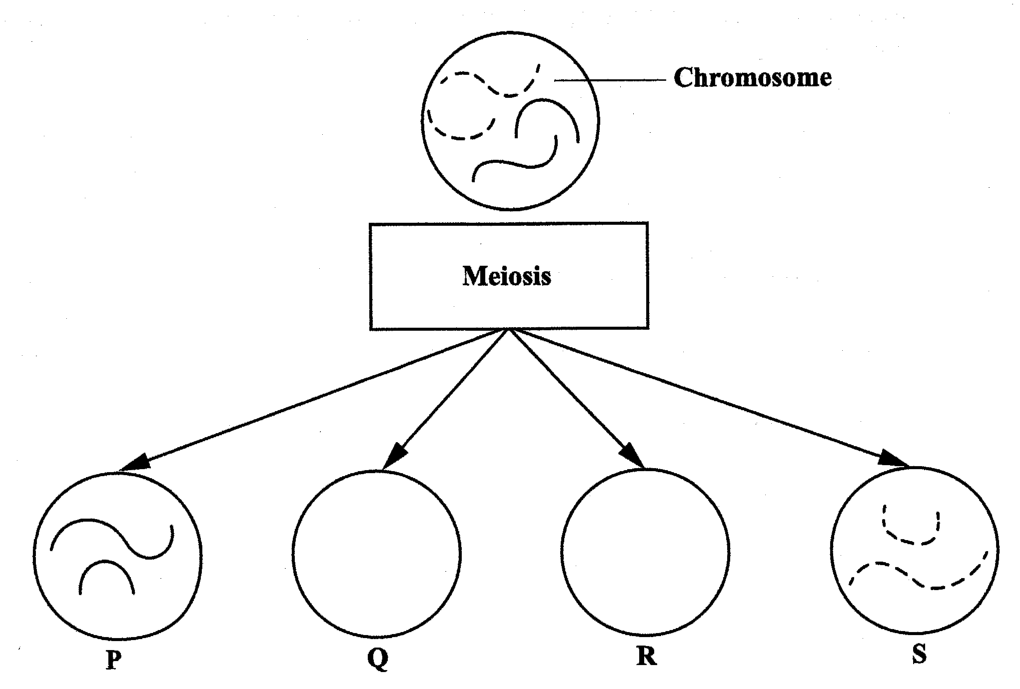
Figure 3 is an incomplete diagram of meiosis in an animal cell. Four genetically different daughter cells, P, Q, R and S, are produced.
Figure 3. Partial diagram of the process of meiosis in an animal cell
[15 marks]
Complete Figure 3 by drawing the contents of the daughter cells Q and R on the diagram.
[4 marks]
State whether the daughter cells produced by meiosis are haploid or diploid.
[1 mark]
Name ONE part of the body in which meiosis occurs.
[1 mark]
Name the structure within the nucleus which contains the genetic material.
[1 mark]
Khara and Keturah are the daughters of Mr and Mrs Balram, yet their observable characteristics are very different. Use your knowledge of genetics to explain why the observable characteristics in the sisters are different. Include TWO possible reasons in your response.
[4 marks]
State TWO reasons why meiosis is important to living organisms.
[2 marks]
Meiosis also occurs in flowering plants. Name the TWO gametes produced.
[2 marks]
List THREE kingdoms, other than the animal kingdom, into which organisms can be classified.
[3 marks]
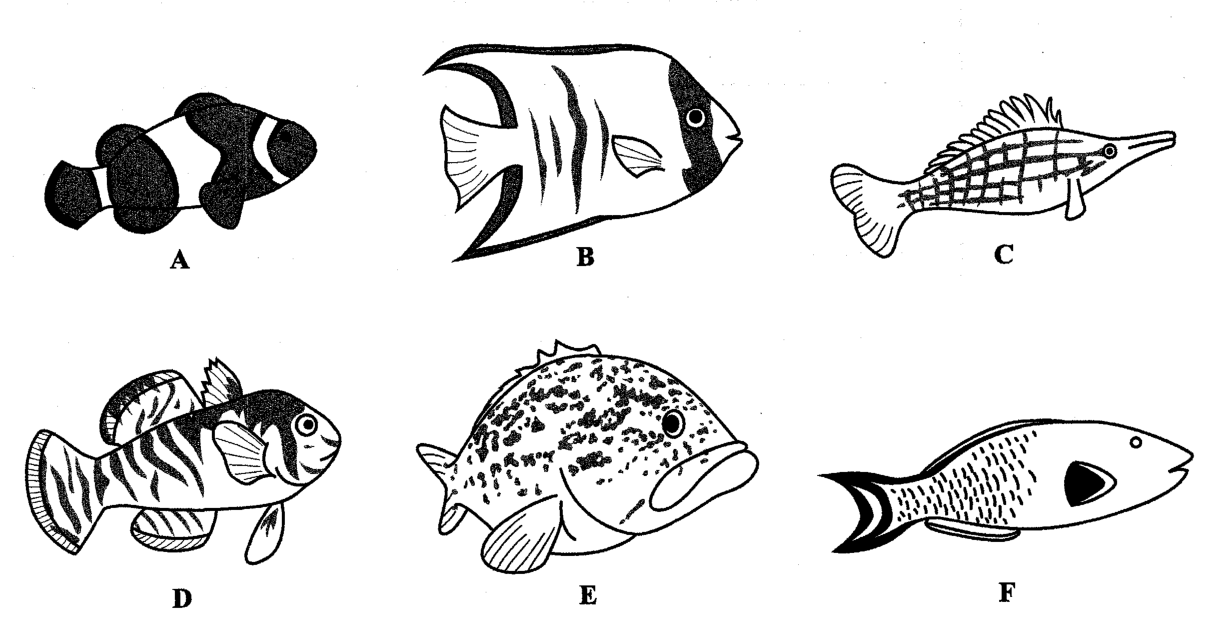
Fish are organisms that belong to the animal kingdom. Figure 4 shows six species of fish (A–F) that live on coral reefs in the Caribbean.
Figure 4. Six species of fish (A–F) that live on coral reefs in the Caribbean
[3 marks]
List THREE visible characteristics that may be used to classify the fish in Figure 4.
[3 marks]
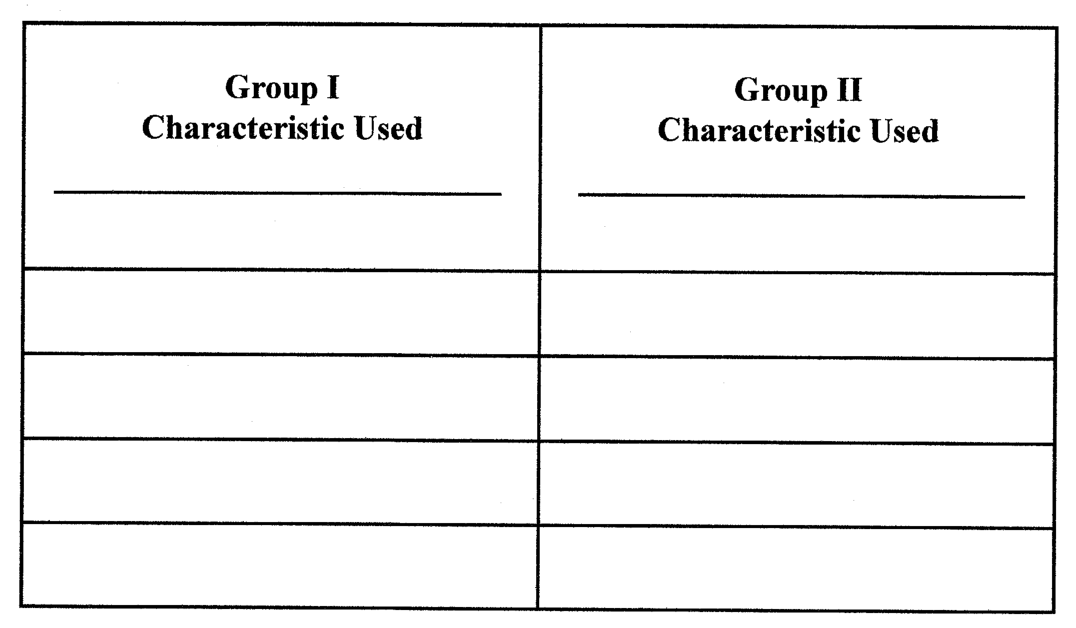
Using any ONE of the characteristics listed in (b)(i), arrange the fish species (A–F) into two groups, I and II, in Table 3 below.
[4 marks]
Define the term 'conservation' as used in biology.
[1 mark]
Fish populations which live on coral reefs in the Caribbean are under a threat of extinction due to predation and pollution.
Explain TWO methods of conservation that may be used to minimize these threats.
[4 marks]
SECTION B
Answer ALL questions.
Organisms can be either multicellular or unicellular. State ONE example of a unicellular organism.
[1 mark]
List THREE materials that can be transported in multicellular organisms.
[3 marks]
Explain why multicellular organisms require transport systems while unicellular organisms do not. Include TWO reasons in your response.
[4 marks]
Define the terms 'translocation' and 'transpiration'.
[2 marks]
Explain TWO ways in which the structure of the xylem is suited for its role in transpiration.
[4 marks]
Suggest how the structure of the phloem allows it to deliver nutrients to the sieve elements.
[1 mark]
Define the following terms:
Diffusion
Breathing
Respiration
[3 marks]
Name the THREE muscles in the ribcage which are responsible for breathing in humans.
[3 marks]
Explain how the process of gaseous exchange occurs in the lungs.
[5 marks]
Explain how human beings use anaerobic respiration during exercise.
[4 marks]
Define the terms 'egestion' and 'excretion'.
[2 marks]
In humans, several organs are responsible for excretion. List TWO organs of excretion and, for EACH organ, state ONE substance which is excreted from it. Excretory organ Substance excreted Excretory organ Substance excreted
[4 marks]
Joy is ill and is vomiting a lot during the day. She becomes very dehydrated as a result of her condition because she has lost a large volume of fluid. Explain the role of the kidneys in correcting Joy's fluid imbalance.
[4 marks]
Suggest ONE way in which Joy can correct the fluid loss she experienced as a result of vomiting.
[1 mark]
Explain TWO ways in which plants conserve water.
[4 marks]