CSEC Biology Paper 2 May/June 2011 - Free CXC Past Paper with Answers
Free CXC Biology Paper 2 May/June 2011 past paper from 2011. Includes a worked answer key. Open the PDF, take a timed test, and study with AI on Caribbean AI.
Answer keys are free on Caribbean AI. View the answers to every past-paper question at no cost - no payment needed - with step-by-step worked solutions and instant AI marking available on Premium.
- All CSEC Past Papers
- CSEC Biology Past Papers
- CSEC Biology Paper 2 May/June 2026
- CSEC Biology Paper 2 May/June 2025
- CSEC Biology Paper 2 January 2025
- CSEC Biology Paper 2 May/June 2024
- CSEC Biology Paper 2 January 2024
- CSEC Biology Paper 2 May/June 2023
- CSEC Biology Paper 2 January 2023
- CSEC Biology Paper 2 May/June 2022
- CSEC Biology Paper 2 May/June 2021
- CSEC Biology Paper 2 January 2021
- CSEC Biology Paper 2 May/June 2020
- CSEC Biology Paper 2 January 2020
- CSEC Biology Paper 2 May/June 2019
- CSEC Biology Paper 2 January 2019
- CSEC Biology Paper 2 May/June 2018
- CSEC Biology Paper 2 January 2018
- CSEC Biology Paper 2 January 2017
- CSEC Biology Paper 2 May/June 2017
- CSEC Biology Paper 2 May/June 2016
- CSEC Biology Paper 2 May/June 2015
- CSEC Biology Paper 2 January 2015
- CSEC Biology Paper 2 May/June 2014
- CSEC Biology Paper 2 May/June 2013
- CSEC Biology Paper 2 May/June 2012
- CSEC Biology Paper 2 May/June 2010
- CSEC Biology Paper 2 May/June 2009
- CSEC Biology Paper 2 January 2008
- CSEC Biology Paper 2 May/June 2008
- CSEC Biology Paper 2 January 2007
- CSEC Biology Paper 2 May/June 2007
- CSEC Biology Paper 2 May/June 2006
- CSEC Biology Paper 2 May/June 2005
CSEC Biology Paper 2 May/June 2011 - Free CXC Past Paper with Answers
Free CXC Biology Paper 2 May/June 2011 past paper from 2011. Includes a worked answer key. Open the PDF, take a timed test, and study with AI on Caribbean AI.
Opening the interactive papers…
- All CSEC Past Papers
- CSEC Biology Past Papers
- CSEC Biology Paper 2 May/June 2026
- CSEC Biology Paper 2 May/June 2025
- CSEC Biology Paper 2 January 2025
- CSEC Biology Paper 2 May/June 2024
- CSEC Biology Paper 2 January 2024
- CSEC Biology Paper 2 May/June 2023
- CSEC Biology Paper 2 January 2023
- CSEC Biology Paper 2 May/June 2022
- CSEC Biology Paper 2 May/June 2021
- CSEC Biology Paper 2 January 2021
- CSEC Biology Paper 2 May/June 2020
CSEC Biology Paper 2 May/June 2011 Questions
Every question from this paper as text. See the answers and worked solutions. Questions are the property of the Caribbean Examinations Council; Caribbean AI is not affiliated with CXC.
Question 1 (25 marks)
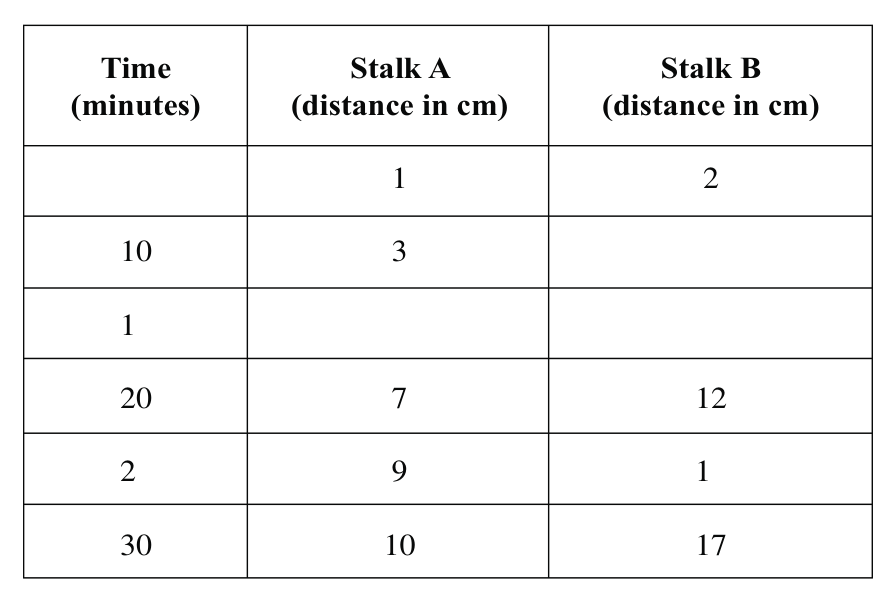
A student investigating transpiration carried out the following procedure. He obtained two celery stalks and cut the bottom end of each while they were submerged in water. The cut ends of both stalks were then quickly placed into two flasks of dye, Flask A and Flask B. Flask A was placed in a laboratory bench in normal room conditions, while Flask B was put in the same room but warm air from a blow-dryer was directed onto it. The time was noted and the celery stalks were allowed to stand for 30 minutes. The student measured and recorded the distance the dye had travelled up each stalk at five-minute intervals during the 30-minute period. The results are shown in Table 1.
TABLE 1: DISTANCE DYE TRAVELLED UP THE CELERY STALKS
| Time (minutes) | Stalk A (distance in cm) | Stalk B (distance in cm) |
|---|---|---|
| 1 | 1 | 2 |
| 10 | 3 | |
| 1 | ||
| 20 | 7 | 12 |
| 2 | 9 | 1 |
| 30 | 10 | 17 |