Free CXC Biology Paper 2 May/June 2018 past paper from 2018. Includes a worked answer key. Open the PDF, take a timed test, and study with AI on Caribbean AI.
Answer keys are free on Caribbean AI. View the answers to every past-paper question at no cost - no payment needed - with step-by-step worked solutions and instant AI marking available on Premium.
CSEC Biology Paper 2 May/June 2018 - Free CXC Past Paper with Answers
Free CXC Biology Paper 2 May/June 2018 past paper from 2018. Includes a worked answer key. Open the PDF, take a timed test, and study with AI on Caribbean AI.
Opening the interactive papers…
Every question from this paper as text. See the answers and worked solutions. Questions are the property of the Caribbean Examinations Council; Caribbean AI is not affiliated with CXC.
Scientists, interested in studying the survival of organisms living at high temperatures, identify some microorganisms living in a desert habitat where the average daily temperatures exceed . They extract an enzyme, protease, that facilitates the digestion of proteins from these organisms, and investigate the effect of temperature on the action of this enzyme.
State TWO precautions that they should take in carrying out this experiment.
[2 marks]
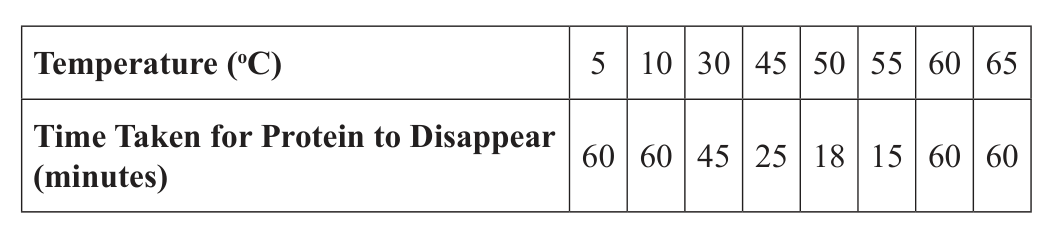
The results of their experiment are presented in Table 1. On the grid provided in Figure 1 on page 3, draw a graph to represent the results presented in Table 1.
TABLE 1: RESULTS OF EXPERIMENT INVESTIGATING THE EFFECT OF TEMPERATURE ON ENZYME ACTIVITY
| Temperature () | 5 | 10 | 30 | 45 | 50 | 55 | 60 | 65 |
|---|---|---|---|---|---|---|---|---|
| Time Taken for Protein to Disappear (minutes) | 60 | 60 | 45 | 25 | 18 | 15 | 60 | 60 |
[4 marks]
From the graph in Figure 1, identify the optimum temperature for the protease activity.
[1 mark]
Suggest ONE reason for the shape of the graph at less than , TWO reasons for the shape of the graph between and , and ONE reason for the shape of the graph at more than .
Less than
More than
[4 marks]
Describe a suitable procedure that the scientists could use to investigate the effect of pH on the activity of the protease enzyme.
[3 marks]
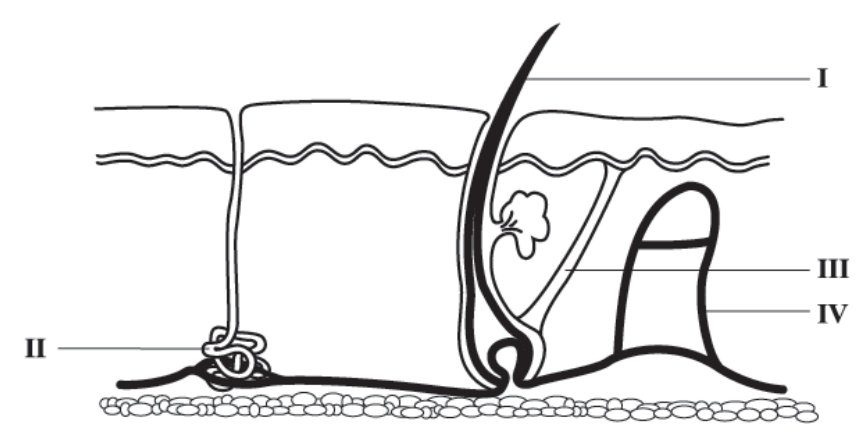
The human skin shown in Figure 2 is an organ which helps humans to regulate their body temperature.
Name the parts labelled I, II, III and IV in Figure 2.
I
II
III
IV
[4 marks]
Describe how the structures named in (b) (i) help humans to regulate their body temperature.
[4 marks]
Explain how changes in the epidermal cells of leaves help plants to conserve water during high temperatures.
[3 marks]
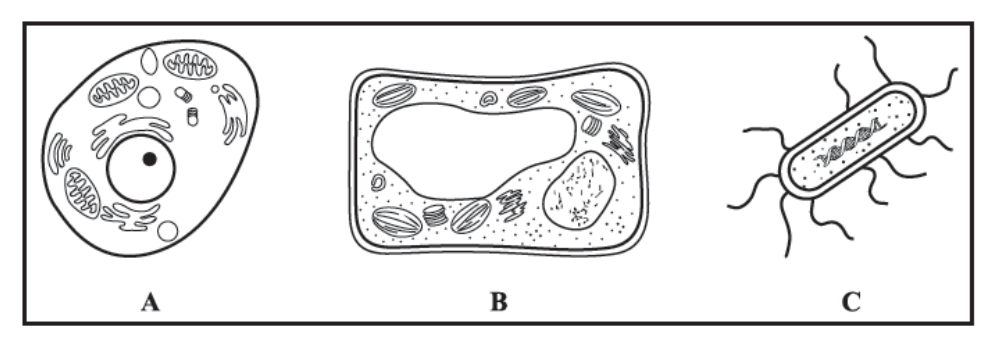
Figure 3 shows three different types of cells, A, B and C.
Name the types of cell labelled A, B and C in Figure 3.
A B C
[3 marks]
Name TWO structures that are common to the three types of cell.
[2 marks]
State TWO differences between the type of cell labelled A and the type of cell labelled C.
[2 marks]
Tissues made up of Type B cells are placed in a container of concentrated salt solution and left for one hour.
Describe THREE changes in the appearance of the cells after one hour in the concentrated salt solution, and give an explanation to account for these changes.
[4 marks]
Tissues made up of Type A cells and Type B cells are placed in a container of distilled water and left for one hour.
Describe how the appearance of Type A cells is expected to differ from that of Type B cells and give an explanation for this difference.
[4 marks]
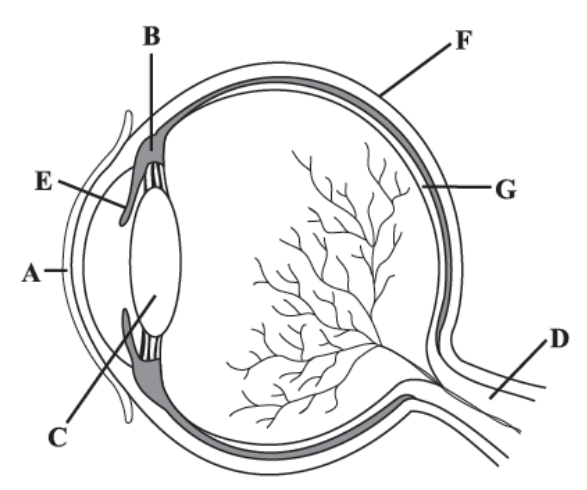
Figure 4 shows a section through the human eye.
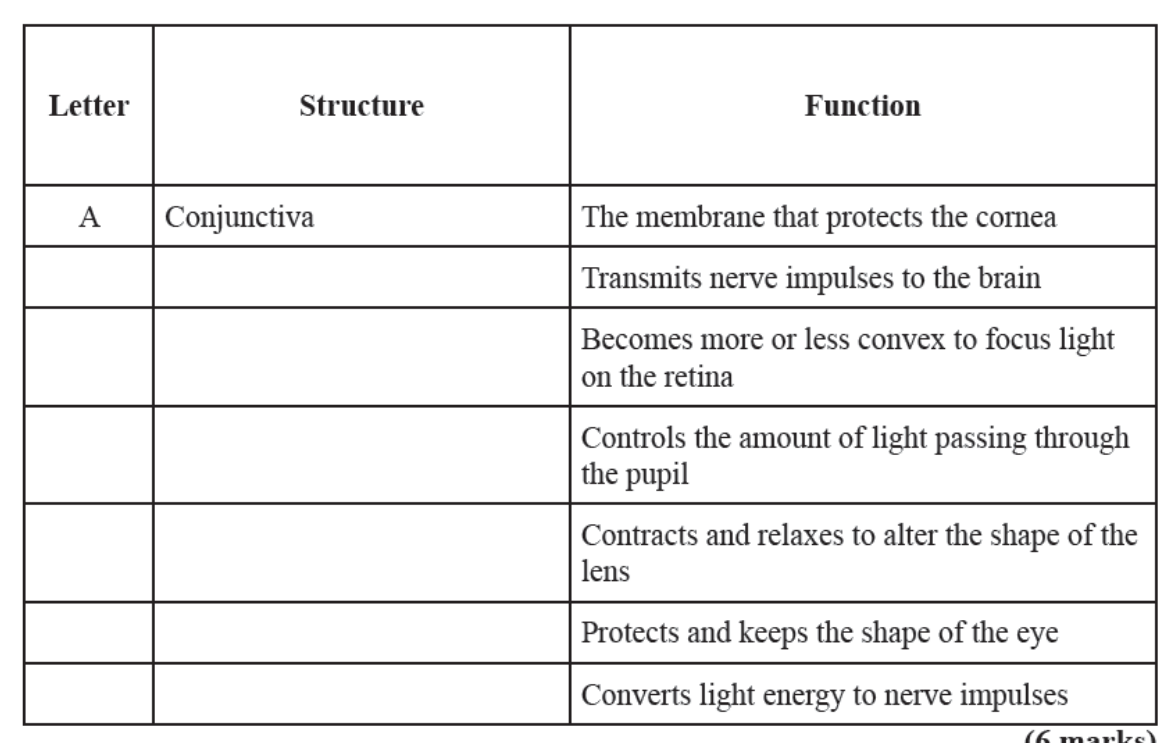
Complete the table by matching EACH labelled part of the eye to its function. Write the letter and the name of the part. The first row has been completed for you.
| Letter | Structure | Function |
|---|---|---|
| A | Conjunctiva | The membrane that protects the cornea |
| Transmits nerve impulses to the brain | ||
| Becomes more or less convex to focus light on the retina | ||
| Controls the amount of light passing through the pupil | ||
| Contracts and relaxes to alter the shape of the lens | ||
| Protects and keeps the shape of the eye | ||
| Converts light energy to nerve impulses |
[6 marks]
Name ONE type of light sensitive cell found in the retina.
[1 mark]
Explain why colours are seen less clearly in dim light than in bright light.
[2 marks]
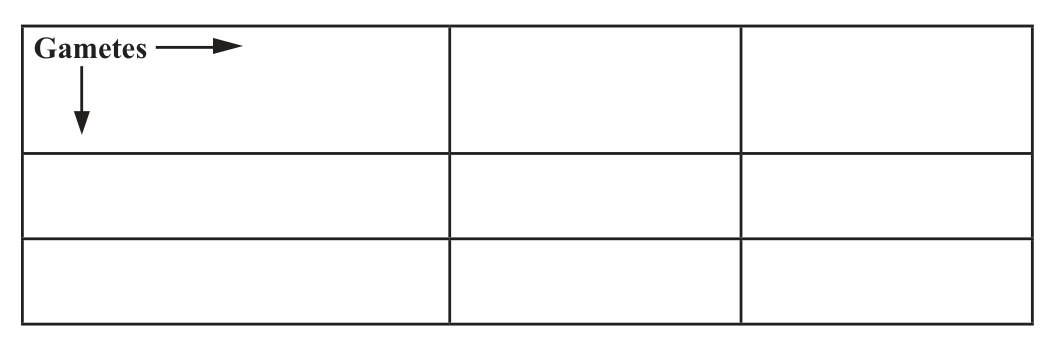
A colour-blind woman mates with a man who has normal colour vision. Determine the probability of this couple having a colour-blind daughter by completing the genetic diagram below.
Parents' phenotypes: Normal colour vision man colour-blind woman
Parents' genotypes: XY XX
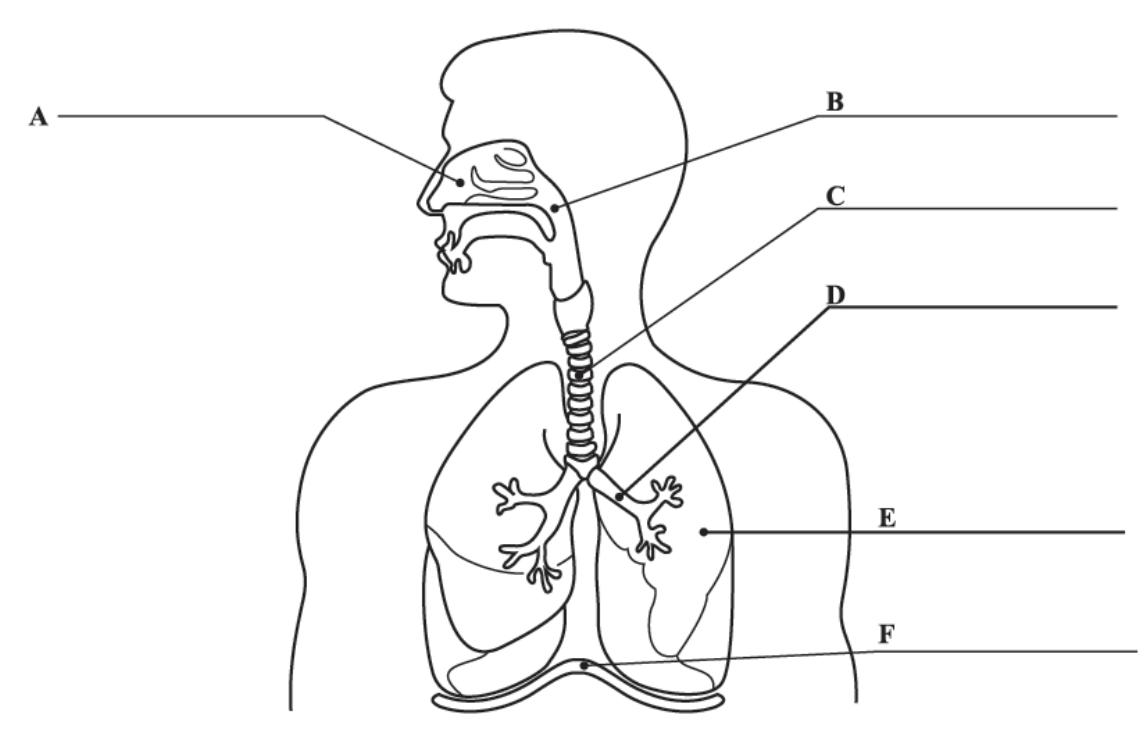
Figure 5 is a diagram of the human respiratory system. Name the parts labelled A, B, C, D, E and F in the space provided.
[6 marks]
State TWO characteristics that the respiratory surface used for gaseous exchange in human beings has in common with the respiratory surface used in flowering plants. Explain how EACH characteristic makes the respiratory surface suitable for gaseous exchange.
[4 marks]
Advertisements for electronic cigarettes promise to supply nicotine to the body without the harmful effects of cigarette smoke. These cigarettes are promoted as a healthier alternative to smoking regular cigarettes. <br/> (i) Outline the effects of THREE named components of cigarette smoke, other than nicotine, on the human body. (ii) Outline TWO ways in which the use of nicotine in electronic cigarettes may be harmful to the human body.
[5 marks]
Outline the effects of THREE named components of cigarette smoke, other than nicotine, on the human body.
[3 marks]
Outline TWO ways in which the use of nicotine in electronic cigarettes may be harmful to the human body.
[2 marks]
Name THREE components of human blood that are important in protecting the body against pathogenic diseases and state the function of EACH.
[6 marks]
Marianne, a one-month-old baby acquires immunity from her mother through breastfeeding. Marianne’s father accidently punctures his finger with a nail but does not need a tetanus antiserum injection because he received a tetanus vaccine the previous year.
Explain how the type of immunity that Marianne acquired from breastfeeding differs from the type of immunity that her father acquired from his vaccine. In your explanation, state the name of EACH type of immunity.
[5 marks]
The authorities prevent children who are not immunized from registering in public schools.
Suggest TWO reasons why some parents may have a valid concern about immunizing their children and TWO reasons why the authorities maintain their position on preventing the entry of unvaccinated children.
[4 marks]
[6 marks]
Plants that reproduce sexually have some advantages compared to those that reproduce only asexually. Outline TWO advantages and THREE disadvantages of sexual reproduction.
Advantages
Disadvantages
[5 marks]
Scientists have successfully cloned animal species.
Suggest TWO reasons why humans may choose to clone animals.
[2 marks]
Outline TWO ethical issues related to the cloning of humans.
[2 marks]
Gametes:
Fertilization cross:
Probability of colour-blind daughter
[6 marks]